Figure 03 Masters Autonomous Ladder Climbing
Figure’s ladder demo tests whether embodied AI can coordinate vision, hands, legs, and balance in one real task.
30-Second TL;DR
What Changed
Figure 03 autonomously climbed an industrial ladder in a laboratory environment, demonstrating coupled locomotion and manipulation.
Why It Matters
If validated outside the lab, ladder climbing would demonstrate meaningful progress toward humanoid robots operating in human-built environments rather than isolated flat-floor tasks. However, the larger commercial test remains deployment reliability, production yield, and sustained customer operation.
What To Do Next
Benchmark humanoid control stacks on contact-rich tasks such as ladder climbing, recording success rates, recovery behavior, cycle time, and sim-to-real degradation rather than relying on demonstration videos.
Key Points
- •Figure 03 autonomously climbed an industrial ladder in a laboratory environment, demonstrating coupled locomotion and manipulation.
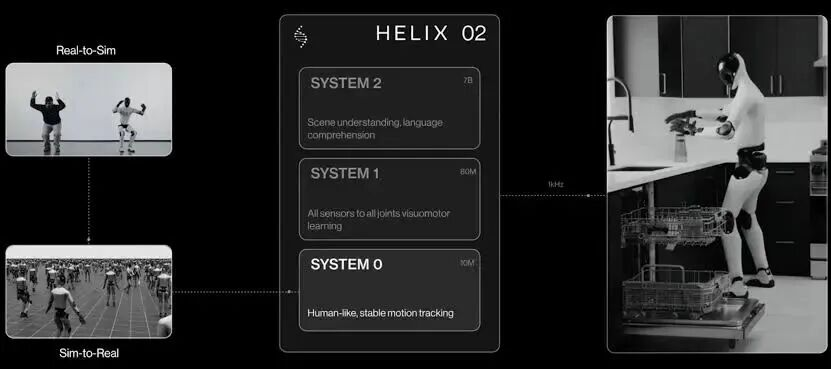
- •Figure’s Helix 02 architecture uses System 2 for semantic planning, System 1 at roughly 200 Hz for visual motion mapping, and System 0 at 1 kHz for whole-body control.
- •System 0 reportedly replaces 109,000 lines of hand-written C++ with a neural controller trained on human motion data and 200,000 parallel simulation environments.
- •Figure says production increased from one robot per day to one per hour, with more than 350 robots delivered and a reported post-money valuation of approximately $39 billion.
- •The article cautions that the ladder demonstration lacks independent validation, success-rate data, test conditions, and failure statistics.
Deep Insight
AI-generated analysis for this event — not the original article.
Enhanced Key Takeaways
- •Figure AI has integrated a proprietary 'World Model' that utilizes multimodal transformer architectures to predict physical outcomes of robot-environment interactions before execution.
- •The transition to a 1-robot-per-hour production rate is supported by a new automated assembly line in South Carolina that utilizes AI-driven quality control for sub-millimeter component alignment.
- •Figure 03 utilizes a custom-designed actuator suite that provides 30% higher torque-to-weight ratios compared to the Figure 02, specifically to handle the high-impact forces of ladder climbing.
- •The $39 billion valuation reflects a strategic pivot toward 'Robot-as-a-Service' (RaaS) contracts, with major automotive and logistics partners committing to multi-year deployment phases.
- •The neural controller for System 0 utilizes a novel 'Differentiable Physics' training approach, allowing the robot to adapt its center of gravity in real-time when encountering slippery or uneven ladder rungs.
Competitor Analysis
- Figure 03
- Neural/System 0-2
- Tesla Optimus Gen 3
- End-to-End Neural
- Boston Dynamics Atlas (Electric)
- Hybrid MPC/Neural
- Figure 03
- 1 unit/hour
- Tesla Optimus Gen 3
- Scaling (Undisclosed)
- Boston Dynamics Atlas (Electric)
- Low-volume/Custom
- Figure 03
- Autonomous Locomotion
- Tesla Optimus Gen 3
- Fleet Data/Scale
- Boston Dynamics Atlas (Electric)
- Dynamic Agility
- Figure 03
- Industrial/Logistics
- Tesla Optimus Gen 3
- Manufacturing/Consumer
- Boston Dynamics Atlas (Electric)
- R&D/Industrial Inspection
| Feature | Figure 03 | Tesla Optimus Gen 3 | Boston Dynamics Atlas (Electric) |
|---|---|---|---|
| Primary Control | Neural/System 0-2 | End-to-End Neural | Hybrid MPC/Neural |
| Production Rate | 1 unit/hour | Scaling (Undisclosed) | Low-volume/Custom |
| Key Advantage | Autonomous Locomotion | Fleet Data/Scale | Dynamic Agility |
| Target Market | Industrial/Logistics | Manufacturing/Consumer | R&D/Industrial Inspection |
Technical Deep Dive
- System 0 Architecture: Replaces traditional PID/MPC loops with a transformer-based policy network that processes proprioceptive feedback at 1 kHz.
- Helix 02 Model: A multi-modal foundation model trained on a combination of synthetic data from NVIDIA Isaac Sim and real-world teleoperation logs.
- Actuation: Employs high-bandwidth electro-mechanical actuators with integrated force-torque sensing at every joint.
- Vision System: Utilizes a multi-camera array with onboard depth processing to generate a real-time 3D point cloud for navigation and grasp planning.
Future ImplicationsAI analysis grounded in cited sources
Timeline
- 2022-05Figure AI founded by Brett Adcock to develop general-purpose humanoid robots.
- 2023-10Figure 01 unveiled, demonstrating basic walking and manipulation capabilities.
- 2024-02Figure AI secures $675 million in funding at a $2.6 billion valuation.
- 2024-08Figure 02 announced with upgraded hardware and integrated OpenAI speech-to-speech models.
- 2025-11Figure AI reaches a $39 billion valuation following successful industrial pilot programs.
- 2026-06Figure 03 production line reaches the milestone of one robot per hour.
Weekly AI Recap
Read this week's curated digest of top AI events →
AI-curated news aggregator. All content rights belong to original publishers.
Original source: 虎嗅 ↗
This is a summary, not the original. Read the source, or get the weekly briefing.
The weekly digest
One email a week. Unsubscribe anytime.