Federal judge strikes down $100,000 H-1B visa fee
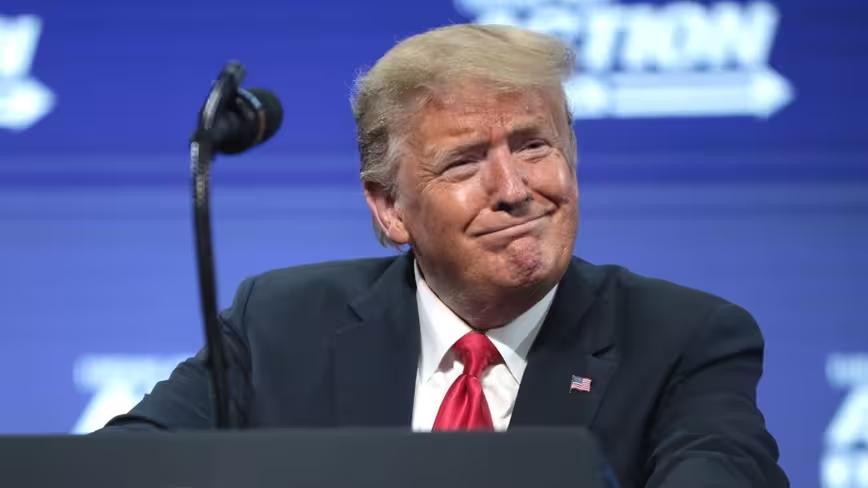
💡Understand the legal shift in US immigration policy that directly impacts the hiring of global AI talent.
⚡ 30-Second TL;DR
What Changed
Judge Leo T. Sorokin vacated the $100,000 H-1B visa fee
Why It Matters
This ruling reduces significant financial barriers for tech companies hiring international AI talent, stabilizing the labor market.
What To Do Next
If your startup was delaying international hires due to visa costs, re-evaluate your global recruitment budget immediately.
Key Points
- •Judge Leo T. Sorokin vacated the $100,000 H-1B visa fee
- •The fee was ruled an unlawful tax exceeding executive authority
- •The ruling cites violations of the Administrative Procedure Act and the Constitution
🧠 Deep Insight
Background and context from public sources — not the original article. 23 sources cited.
🔑 Enhanced Key Takeaways
- •The $100,000 H-1B visa fee was initially imposed through a Presidential Proclamation issued by the Trump administration on September 19, 2025, rather than through a legislative act by Congress.
- •The legal challenge that led to the fee being struck down was brought by a coalition of 20 Democratic state attorneys general, in addition to other organizations and individuals who filed separate lawsuits.
- •Judge Leo T. Sorokin's ruling explicitly categorized the $100,000 charge as an "unlawful tax" rather than a legitimate penalty, emphasizing that the President lacks the constitutional authority to levy taxes without congressional approval.
- •The fee primarily targeted new H-1B petitions for foreign nationals seeking initial entry into the U.S. and was clarified by USCIS not to apply to extensions, amendments, or changes of status for individuals already present in the country.
- •Prior to this ruling, a different U.S. District Court for the District of Columbia had upheld the presidential proclamation imposing the $100,000 fee in a separate lawsuit filed by the U.S. Chamber of Commerce, indicating conflicting judicial interpretations.
🔮 Future ImplicationsAI analysis grounded in cited sources
⏳ Timeline
📎 Sources (23)
Factual claims are grounded in the sources below. Forward-looking analysis is AI-generated interpretation.
- boundless.com
- wolfsdorf.com
- employmentlawworldview.com
- cdflaborlaw.com
- calchamber.com
- fragomen.com
- wolfsdorf.com
- americanimmigrationcouncil.org
- wikipedia.org
- presidentsalliance.org
- theguardian.com
- fisherphillips.com
- crypto.news
- ndtv.com
- investing.com
- kesq.com
- eiglaw.com
- forbes.com
- newrepublic.com
- rnlawgroup.com
- cdflaborlaw.com
- employmentlawworldview.com
- cupahr.org
Weekly AI Recap
Read this week's curated digest of top AI events →
👉Related Updates

AI-curated news aggregator. All content rights belong to original publishers.
Original source: The Next Web (TNW) ↗
This is a summary, not the original. Read the source, or get the weekly briefing.
The weekly digest
One email a week. Unsubscribe anytime.