Faraday Future raises $25M for robotics pivot
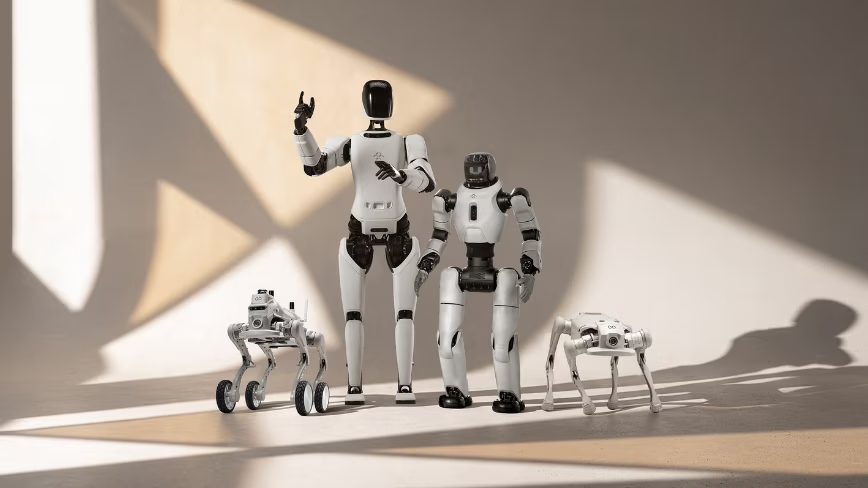
Faraday Future is pivoting to robotics; track how automotive firms are shifting capital into embodied AI.
30-Second TL;DR
What Changed
Raised $25 million via convertible promissory notes.
Why It Matters
The pivot suggests a strategic shift toward embodied AI and robotics, potentially impacting the competitive landscape for EV-to-robotics transitions. Investors and developers should monitor how Faraday Future integrates its automotive software stack into robotics platforms.
What To Do Next
Monitor Faraday Future's upcoming technical whitepapers or patent filings to see if they are utilizing open-source robotics frameworks like ROS 2 or proprietary AI models.
Key Points
- •Raised $25 million via convertible promissory notes.
- •Total financing over the last two months reached $70 million.
- •Capital is earmarked for Phase 1 of the company's robotics business plan through 2026.
Deep Insight
Background and context from public sources — not the original article. 16 sources cited.
Enhanced Key Takeaways
- •Faraday Future is rebranding as a "Physical AI company" with an "AI First" philosophy, focusing on Embodied AI (EAI) humanoid and bionic robots, alongside EAI automotive robots.
- •The company launched three robot series—Futurist, Master, and Aegis—on February 4th, 2026, and began deliveries later that month, shipping 68 units by April 30, 2026, with a target of 1,500 units by year-end.
- •Faraday Future's robotics strategy involves a "Three-in-One ecosystem" of "Device, Data, and Brain & Open-Source and Open Developer Platform" to create a self-reinforcing cycle for AI training and product improvement.
- •The company has partnered with RobotShop for global distribution of its EAI robotics products and is prioritizing the education sector for initial scaled deployment, aiming to build a large-scale EAI robotics education system in the U.S.
- •The recent $70 million in financing, including $45 million in April and $25 million in May, is intended to support Phase 1 of its robotics strategy through 2026, with the company aiming to shift away from high-cost short-term funding.
Technical Deep Dive
- Faraday Future's core technical focus is on Embodied AI (EAI), which encompasses both humanoid and bionic robots, as well as EAI automotive robots.
- The company's strategy is built around a "Three-in-One ecosystem" comprising "Device, Data, and Brain & Open-Source and Open Developer Platform."
- This ecosystem operates on a "Device-Data-Brain" model, designed to create an evolutionary flywheel where increased robot deployments generate more data for AI training, leading to improved product intelligence and accelerated sales.
- Faraday Future has introduced three distinct robot series: Futurist, Master, and Aegis.
- Its AI system, FF AI 2.0 (also integrated into vehicles), reportedly leverages OpenAI, can comprehend complex voice commands in over 50 languages, and retains conversational context.
Future ImplicationsAI analysis grounded in cited sources
Timeline
- 2014Faraday Future founded as an electric vehicle company.
- 2016Faced early financial concerns and suspended plans for a $1 billion factory in Nevada.
- 2018Experienced severe financial and management problems, including layoffs and a dispute with a major investor.
- 2023Began customer deliveries of its FF 91 luxury EV, though in limited numbers.
- 2025Shifted focus to a lower-priced second brand, Faraday X, and continued to report significant net losses.
- 2026-04 to 2026-05Secured a total of $70 million in financing for its Embodied AI (EAI) robotics strategy, launched three robot series, and began deliveries with a target of 1,500 units for the year.
Sources (16)
Factual claims are grounded in the sources below. Forward-looking analysis is AI-generated interpretation.
Weekly AI Recap
Read this week's curated digest of top AI events →
Related Updates


AI-curated news aggregator. All content rights belong to original publishers.
Original source: The Next Web (TNW) ↗
This is a summary, not the original. Read the source, or get the weekly briefing.
The weekly digest
One email a week. Unsubscribe anytime.