FANUC partners with Google to integrate AI agents in robotics
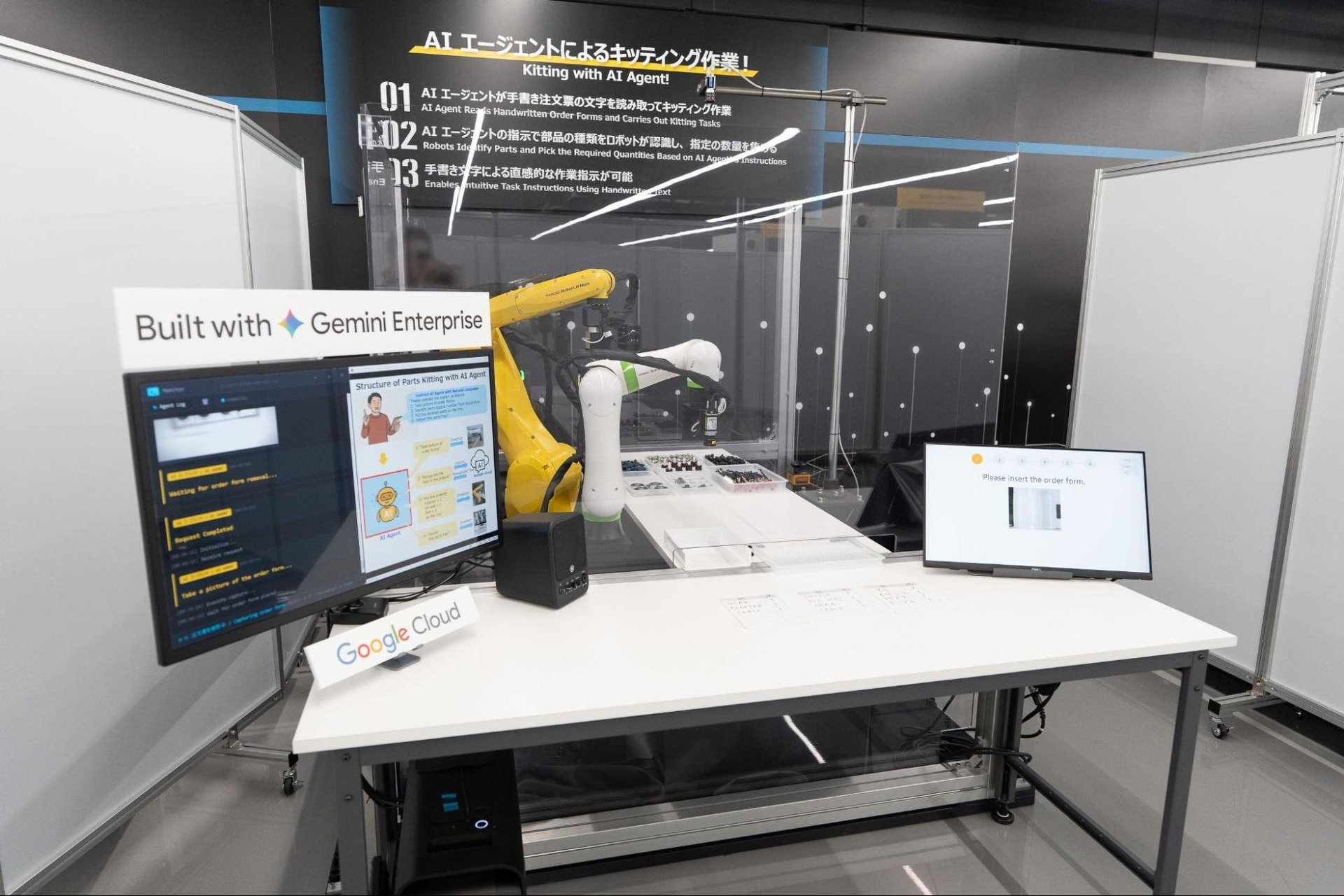
💡Major industrial robotics player integrates Google's AI agents—a key milestone for embodied AI in manufacturing.
⚡ 30-Second TL;DR
What Changed
FANUC and Google are collaborating on physical AI for industrial robots
Why It Matters
This partnership signals a major shift in industrial robotics, moving from rigid programming to adaptive, AI-driven control. It could significantly reduce setup times and increase flexibility in manufacturing lines.
What To Do Next
Monitor FANUC's developer portal for upcoming SDKs or APIs that allow integration of custom AI agents into their robotic controllers.
Key Points
- •FANUC and Google are collaborating on physical AI for industrial robots
- •The system utilizes AI agents to control robotic operations
- •Focuses on advancing industrial automation through AI integration
🧠 Deep Insight
Web-grounded analysis with 16 cited sources.
🔑 Enhanced Key Takeaways
- •The partnership specifically integrates Google Cloud's Gemini Enterprise for generative AI and Google's Intrinsic robotics platform into FANUC's industrial robot systems.
- •FANUC robots will gain advanced capabilities such as processing natural language instructions, identifying and classifying objects in unstructured environments, and autonomously coordinating multiple robots.
- •FANUC has already shipped over 1,000 robots equipped with physical AI capabilities since demonstrating the technology at the International Robot Exhibition in December 2025, indicating accelerating demand.
- •This collaboration provides a crucial 'foundation model layer' that FANUC's existing physical AI stack previously lacked, complementing its ongoing partnership with NVIDIA for simulation and training infrastructure.
- •The integration includes full compatibility with Intrinsic's Flowstate development environment, allowing developers to program FANUC robots through a visual, web-based interface, moving away from proprietary FANUC code.
🛠️ Technical Deep Dive
- AI Foundation Models: The system leverages Google Cloud's Gemini Enterprise, an enterprise-grade generative AI solution, for understanding human instructions and complex reasoning.
- Robotics Platform: Google's Intrinsic robotics platform, including its Flowstate development environment, is integrated to facilitate visual, web-based programming and abstract robot control.
- AI Agent Capabilities: The AI agents are designed to enable robots to process natural language commands, recognize and classify objects in dynamic settings, and autonomously orchestrate tasks among multiple robots.
- Physical AI Concept: This initiative advances 'Physical AI,' which merges cognitive intelligence (like large language models) with physical robotic actions, allowing robots to perceive, make decisions, and execute tasks in real-world environments.
- Simulation and Training: FANUC also utilizes NVIDIA AI infrastructure, including Jetson edge modules for edge AI, NVIDIA Isaac Sim for open robotic simulation, and NVIDIA Omniverse libraries for creating photorealistic digital twins and virtual training.
- Open Platform Support: FANUC robots support ROS 2 (Robot Operating System 2) through open-source drivers and Python as a standard programming language, facilitating the development of AI-driven applications.
- Research Collaboration: FANUC is participating in Google DeepMind's 'Gemini Robotics Trusted Tester Program' to further AI research on foundational robotics models.
- Gemini Robotics Models: Google DeepMind's Gemini Robotics models (e.g., Gemini Robotics 1.5 and Gemini Robotics-ER 1.6) are Vision-Language-Action (VLA) models that translate visual information and instructions into motor commands, enabling robots to reason about physical spaces, plan multi-step tasks, and adapt to new situations.
🔮 Future ImplicationsAI analysis grounded in cited sources
⏳ Timeline
📎 Sources (16)
Factual claims are grounded in the sources below. Forward-looking analysis is AI-generated interpretation.
- Google Search Source
- Google Search Source
- Google Search Source
- Google Search Source
- Google Search Source
- Google Search Source
- Google Search Source
- Google Search Source
- Google Search Source
- Google Search Source
- Google Search Source
- Google Search Source
- Google Search Source
- Google Search Source
- Google Search Source
- Google Search Source
Weekly AI Recap
Read this week's curated digest of top AI events →
👉Related Updates

AI-curated news aggregator. All content rights belong to original publishers.
Original source: ITmedia AI+ (日本) ↗