Extending MCP support for Amazon Bedrock AgentCore Gateway
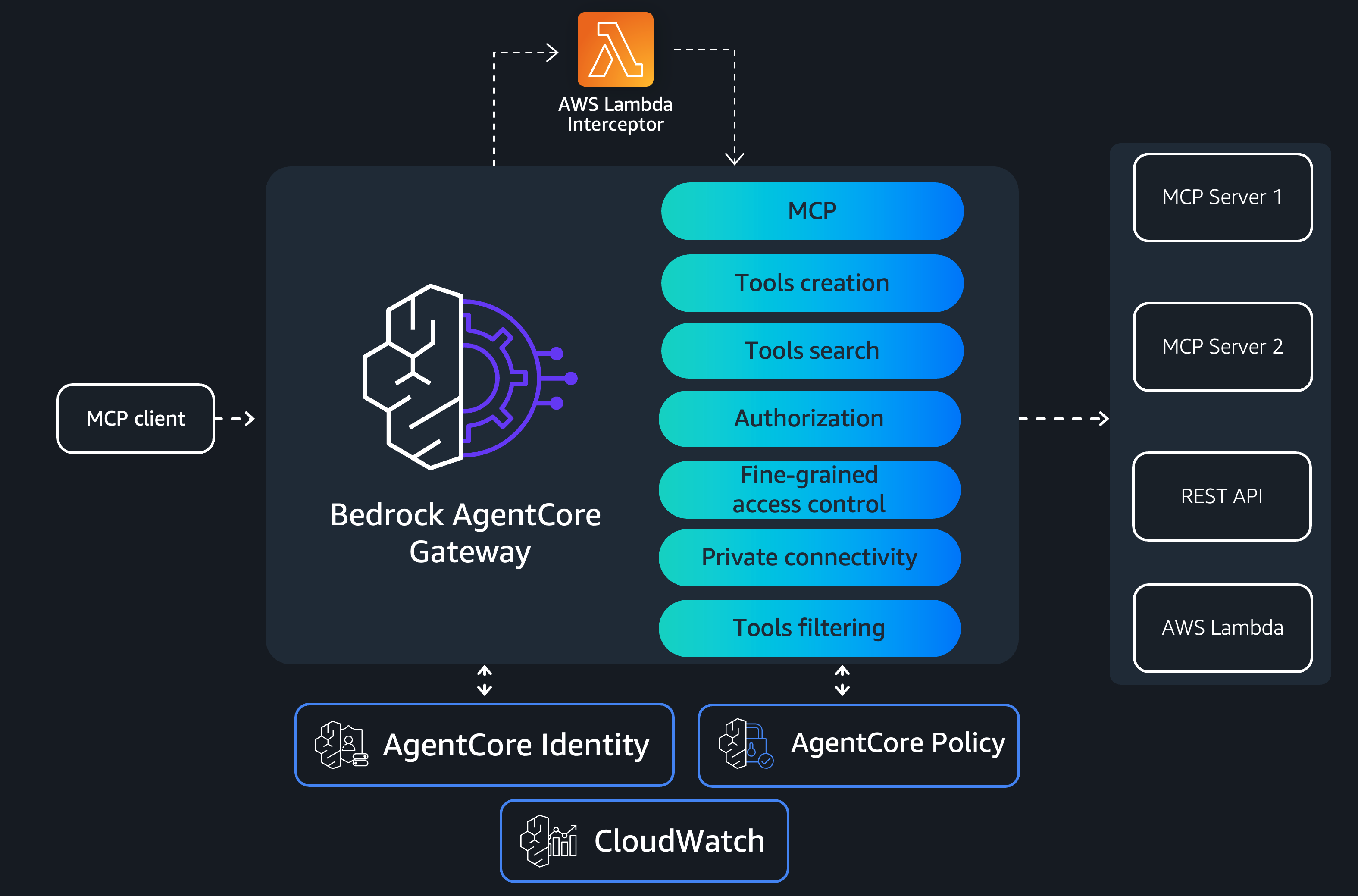
💡Enterprise-grade security and governance for MCP deployments on AWS infrastructure.
⚡ 30-Second TL;DR
What Changed
Centralized credential management for MCP servers at scale
Why It Matters
This update simplifies the operational overhead of managing agentic AI architectures in enterprise settings. It allows teams to scale MCP deployments securely without compromising on governance or visibility.
What To Do Next
Review your current MCP server architecture and evaluate if Amazon Bedrock AgentCore Gateway can replace your custom middleware for centralized security and logging.
Key Points
- •Centralized credential management for MCP servers at scale
- •Enhanced observability into tool usage across enterprise teams
- •Security features to prevent data exfiltration in production environments
- •Fine-grained access control for MCP-based agentic workflows
🧠 Deep Insight
Background and context from public sources — not the original article. 24 sources cited.
🔑 Enhanced Key Takeaways
- •The Model Context Protocol (MCP) is an open standard, inspired by the Language Server Protocol, that enables LLM applications to securely connect with external data sources and tools, streamlining integrations by reducing the need for N*M custom connections to N+M standardized ones.
- •Amazon Bedrock AgentCore Gateway now supports server-side tool execution through its integration with the Bedrock Responses API, allowing models to discover, select, and execute tools directly during inference without requiring client-side orchestration, thereby reducing application complexity and latency.
- •AgentCore Identity, a component of AgentCore, provides centralized agent identity management, including a secure token vault for OAuth 2.0 tokens and API keys, and supports various OAuth 2.0 flows (2LO and 3LO) for secure, identity-aware authorization when agents access external services.
- •AgentCore Observability offers deep visibility into agent performance by emitting telemetry data in OpenTelemetry (OTEL)-compatible format, enabling detailed visualizations of agent workflow steps, including token usage, latency, session duration, and error rates, through Amazon CloudWatch dashboards and integrations with third-party tools like Langfuse and Dynatrace.
- •AgentCore Gateway can unify multiple existing MCP servers, whether custom-built, publicly available, or open-source, under a single control plane, facilitating consistent tool discovery, access, and management across different organizational units or product features.
🛠️ Technical Deep Dive
- Model Context Protocol (MCP): An open standard built on JSON-RPC 2.0 foundations, designed to standardize how LLM applications interact with external tools, environments, and memory. It defines how AI agents discover capabilities, subscribe to data streams, and maintain contextual state across interactions. MCP utilizes OAuth for authentication and incorporates a permission model where the host controls client access to specific servers and tools, ensuring data isolation between sessions.
- AgentCore Gateway: This service acts as a centralized hub, converting various input types such as OpenAPI specifications, Smithy models, and AWS Lambda functions into MCP-compatible tools. It provides comprehensive ingress and egress authentication, supporting the OAuth 2.0 Authorization Code flow via AgentCore Identity. The Gateway integrates with the Bedrock Responses API to enable server-side tool execution and connects to external MCP servers using the
SynchronizeGatewayTargetsAPI for protocol handshakes and capability indexing. - AgentCore Identity: A dedicated service for managing AI agent identities. It features a secure token vault for encrypting and storing OAuth 2.0 Access and Refresh tokens, API keys, and OAuth client secrets using AWS Key Management Service (KMS). AgentCore Identity supports both OAuth 2.0 client credentials grant (2LO) and authorization code grant (3LO), facilitating identity-aware authorization by securely passing user context to agent code.
- AgentCore Observability: This component is designed for tracing, debugging, and monitoring agent performance in production. It emits telemetry data in an OpenTelemetry (OTEL)-compatible format, allowing for integration with existing monitoring stacks. Detailed visualizations of agent workflow steps, including metrics like token usage, response latency, session duration, and error rates, are provided through Amazon CloudWatch dashboards. It also supports integration with third-party observability platforms like Langfuse and Dynatrace.
🔮 Future ImplicationsAI analysis grounded in cited sources
⏳ Timeline
📎 Sources (24)
Factual claims are grounded in the sources below. Forward-looking analysis is AI-generated interpretation.
Weekly AI Recap
Read this week's curated digest of top AI events →
👉Related Updates
AI-curated news aggregator. All content rights belong to original publishers.
Original source: AWS Machine Learning Blog ↗
This is a summary, not the original. Read the source, or get the weekly briefing.
The weekly digest
One email a week. Unsubscribe anytime.