Evolution of Corporate AI Research Paradigms
Understand why top tech firms are abandoning basic research labs and how it changes your AI development strategy.
30-Second TL;DR
What Changed
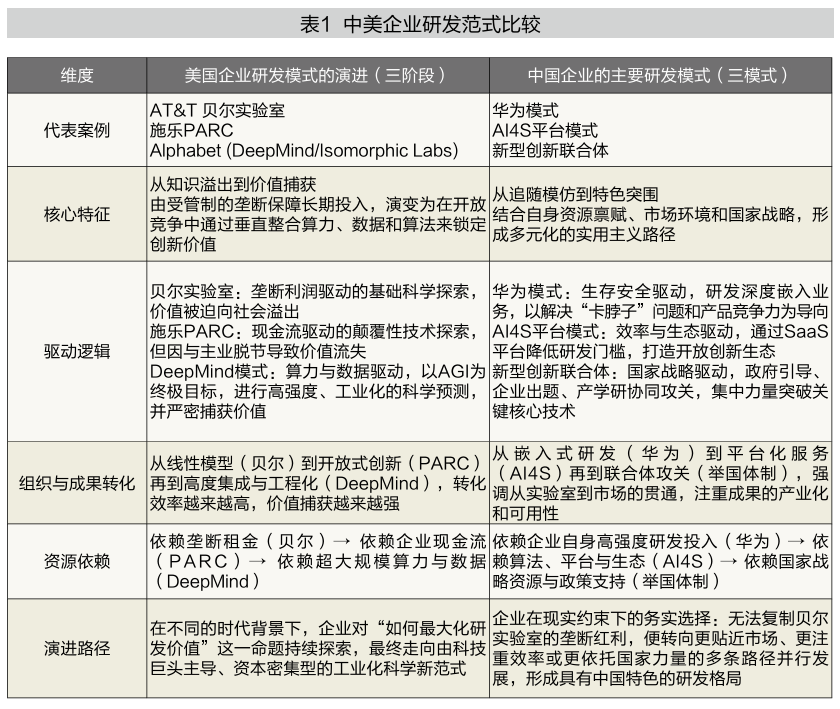
Bell Labs model relied on monopoly-funded long-term basic research.
Why It Matters
This shift signals a move away from 'ivory tower' basic research toward immediate product-market fit, forcing AI practitioners to prioritize engineering efficiency over pure scientific exploration.
What To Do Next
Evaluate your R&D roadmap to ensure it aligns with immediate product value capture rather than long-term, non-commercial basic research.
Key Points
- •Bell Labs model relied on monopoly-funded long-term basic research.
- •Xerox PARC pioneered open innovation but struggled with commercialization.
- •Modern AI labs like Google DeepMind are shifting toward product-oriented engineering.
- •Chinese tech giants are pivoting away from centralized research labs due to economic and geopolitical pressures.
Deep Insight
AI-generated analysis for this event — not the original article.
Enhanced Key Takeaways
- •The 'Bell Labs model' was fundamentally underpinned by the 1956 AT&T consent decree, which mandated patent licensing, inadvertently fueling the semiconductor revolution by preventing AT&T from monopolizing its own inventions.
- •Modern corporate AI research is increasingly characterized by 'compute-compute' moats, where the primary barrier to entry is not just talent, but the ability to secure and manage massive GPU clusters (e.g., H100/B200 deployments).
- •Chinese tech giants, including Alibaba and Tencent, have transitioned toward 'Open Source First' strategies (e.g., Qwen, Hunyuan) as a defensive mechanism to maintain ecosystem relevance despite restricted access to advanced Western semiconductor hardware.
- •The shift from fundamental research to product-oriented engineering is being accelerated by the 'AI Talent War,' where researchers are increasingly incentivized by equity in startups rather than the long-term, publication-heavy culture of traditional corporate labs.
- •Recent academic studies indicate a 'publication gap' where corporate labs are increasingly keeping proprietary model architectures and training datasets secret, effectively ending the era of open-science AI collaboration that defined the 2010s.
Technical Deep Dive
- Shift from Transformer-only architectures to Mixture-of-Experts (MoE) models to optimize inference costs and reduce latency in production environments.
- Implementation of Reinforcement Learning from Human Feedback (RLHF) and Direct Preference Optimization (DPO) as standard post-training pipelines to align models with commercial safety and utility requirements.
- Adoption of model distillation techniques to compress large-scale foundation models into smaller, edge-deployable versions for mobile and local device integration.
- Integration of Retrieval-Augmented Generation (RAG) frameworks to mitigate hallucination and provide real-time data grounding for enterprise AI applications.
Future ImplicationsAI analysis grounded in cited sources
Timeline
- 1947-12Bell Labs researchers Bardeen and Brattain demonstrate the first point-contact transistor.
- 1970-01Xerox PARC is founded, initiating the era of personal computing and GUI research.
- 2014-01Google acquires DeepMind, marking the beginning of the modern corporate AI lab acquisition wave.
- 2022-11Launch of ChatGPT triggers a massive industry pivot toward generative AI productization.
- 2024-05Major Chinese tech firms begin restructuring research divisions to prioritize immediate commercial AI revenue.
Weekly AI Recap
Read this week's curated digest of top AI events →
AI-curated news aggregator. All content rights belong to original publishers.
Original source: 虎嗅 ↗
This is a summary, not the original. Read the source, or get the weekly briefing.
The weekly digest
One email a week. Unsubscribe anytime.