EVgo Builds Tesla V4 Superchargers Under License
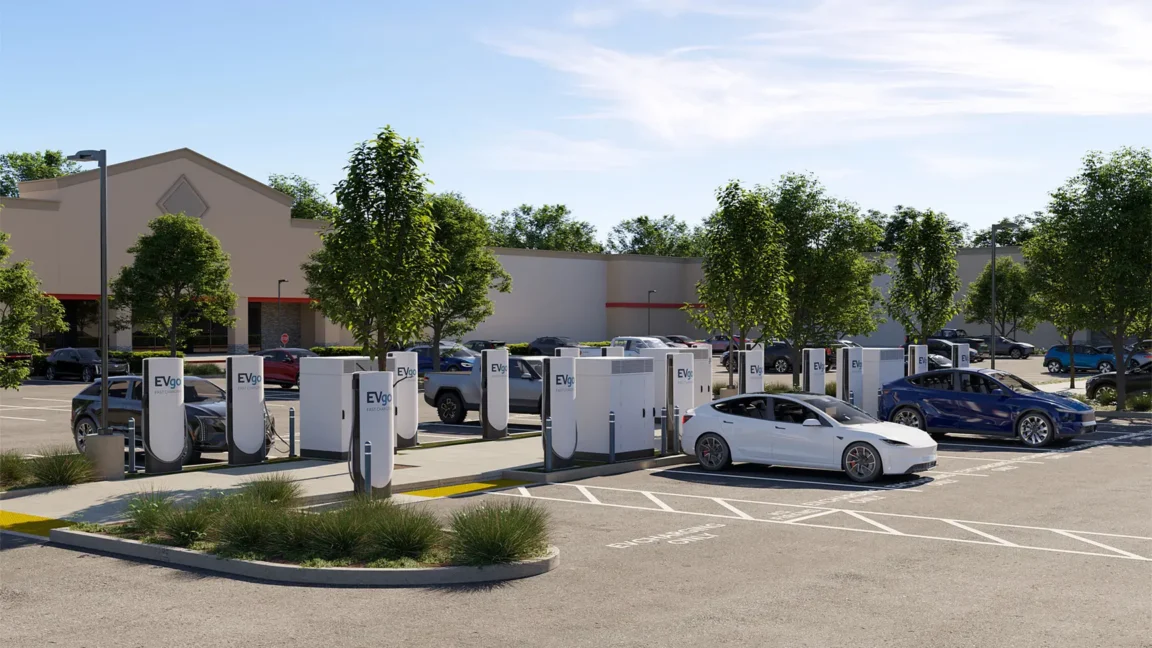
Licensed V4 chargers expand Tesla’s network while combining NACS and CCS1 support.
30-Second TL;DR
What Changed
EVgo is producing Tesla V4 Superchargers under license.
Why It Matters
The arrangement could expand access to Tesla-compatible charging infrastructure and improve interoperability for EV drivers. It also demonstrates how licensing can extend a platform’s hardware and network footprint through external operators.
What To Do Next
If you build EV, mapping, or fleet software, test Tesla navigation and EVgo station data integrations for dual-connector compatibility.
Key Points
- •EVgo is producing Tesla V4 Superchargers under license.
- •The new chargers will be listed in the Tesla navigation app.
- •Each charger supports both NACS and CCS1 plugs.
Deep Insight
AI-generated analysis for this event — not the original article.
Enhanced Key Takeaways
- •The licensing agreement marks a strategic shift in Tesla's business model, transitioning from a closed-loop proprietary network to a hardware-as-a-service provider for third-party charging operators.
- •EVgo's implementation utilizes Tesla's V4 cabinet architecture, which supports higher voltage outputs (up to 1000V) to accommodate 800V vehicle architectures more efficiently than previous generations.
- •This partnership is facilitated by the integration of Tesla's 'Autocharge+' equivalent protocols, allowing for seamless Plug and Charge functionality across the EVgo network for Tesla-native users.
- •The deal includes a revenue-sharing component where EVgo pays a licensing fee to Tesla for every kilowatt-hour dispensed through the licensed V4 hardware.
- •Regulatory compliance for these units is managed under EVgo's existing NEVI (National Electric Vehicle Infrastructure) program certifications, allowing these specific V4 sites to qualify for federal funding.
Competitor Analysis
- EVgo (Tesla V4)
- Up to 350kW+
- Electrify America
- Up to 350kW
- ChargePoint (Express Plus)
- Up to 500kW
- EVgo (Tesla V4)
- NACS & CCS1
- Electrify America
- CCS1 & NACS (Transitioning)
- ChargePoint (Express Plus)
- CCS1, CHAdeMO, NACS
- EVgo (Tesla V4)
- Tesla App
- Electrify America
- Proprietary App
- ChargePoint (Express Plus)
- Proprietary App
- EVgo (Tesla V4)
- Yes (Native)
- Electrify America
- Yes (ISO 15118)
- ChargePoint (Express Plus)
- Yes (ISO 15118)
| Feature | EVgo (Tesla V4) | Electrify America | ChargePoint (Express Plus) |
|---|---|---|---|
| Max Power | Up to 350kW+ | Up to 350kW | Up to 500kW |
| Connector Types | NACS & CCS1 | CCS1 & NACS (Transitioning) | CCS1, CHAdeMO, NACS |
| Native Integration | Tesla App | Proprietary App | Proprietary App |
| Plug & Charge | Yes (Native) | Yes (ISO 15118) | Yes (ISO 15118) |
Technical Deep Dive
- V4 Cabinet Architecture: Utilizes a modular power electronics design that decouples the power cabinet from the dispenser unit, allowing for longer cable reach and easier maintenance.
- Voltage Range: Supports 400V and 800V battery architectures natively, optimizing charging curves for modern EVs.
- Communication Protocol: Employs ISO 15118-20 for advanced vehicle-to-grid (V2G) and Plug and Charge capabilities.
- Thermal Management: Features liquid-cooled cables to maintain high current throughput without exceeding thermal limits during sustained charging sessions.
- Connectivity: Integrated LTE/5G and Ethernet backhaul for real-time diagnostics and remote firmware updates via Tesla's backend infrastructure.
Future ImplicationsAI analysis grounded in cited sources
Timeline
- 2022-11Tesla announces the North American Charging Standard (NACS) and opens the design to the public.
- 2023-05Ford and GM announce adoption of NACS, triggering a wave of industry-wide standardization.
- 2024-02Tesla begins initial pilot deployments of V4 Supercharger hardware in North America.
- 2025-10Tesla officially launches its hardware licensing program for third-party charging network operators.
- 2026-06EVgo announces the first site deployment utilizing licensed Tesla V4 hardware.
Weekly AI Recap
Read this week's curated digest of top AI events →
AI-curated news aggregator. All content rights belong to original publishers.
Original source: Ars Technica ↗
This is a summary, not the original. Read the source, or get the weekly briefing.
The weekly digest
One email a week. Unsubscribe anytime.