Evaluating GitHub Copilot Agentic Harness Performance
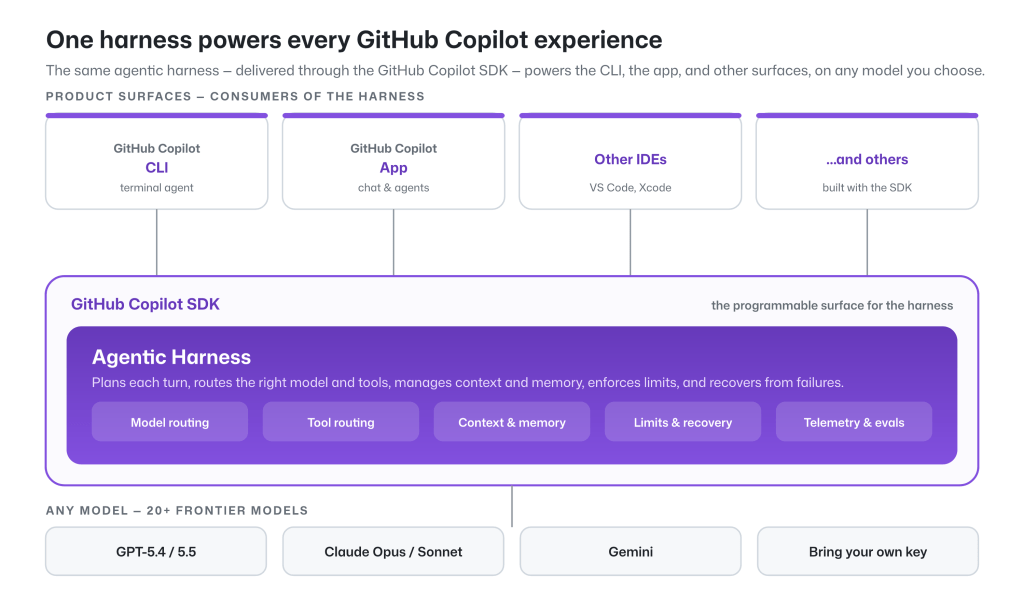
Learn how to optimize agentic workflows by selecting the right model for performance and token efficiency.
30-Second TL;DR
What Changed
Evaluated agentic harness performance across 20+ LLMs
Why It Matters
This research provides developers with insights into how model choice affects agentic workflow performance, helping teams optimize for both cost and accuracy.
What To Do Next
Review the GitHub blog post to understand how your choice of LLM impacts agentic task latency and token consumption.
Key Points
- •Evaluated agentic harness performance across 20+ LLMs
- •Focused on balancing task accuracy with token efficiency
- •Demonstrated flexibility in model selection for agentic workflows
Deep Insight
AI-generated analysis for this event — not the original article.
Enhanced Key Takeaways
- •The agentic harness utilizes a standardized evaluation framework that decouples the agent's reasoning logic from the underlying LLM provider, allowing for rapid A/B testing of model performance.
- •GitHub's research indicates that smaller, specialized models often outperform larger general-purpose models in specific coding tasks when paired with optimized agentic tool-use prompts.
- •The study identified a 'token-efficiency frontier' where increasing context window size beyond a certain threshold yields diminishing returns for agentic task completion rates.
- •The harness incorporates a multi-stage verification process that includes automated unit testing and static analysis to reduce hallucination rates during code generation.
- •GitHub is actively integrating these findings into the Copilot platform to enable dynamic model routing, where the system automatically selects the most cost-effective model based on task complexity.
Competitor Analysis
- GitHub Copilot Agentic Harness
- Multi-model (20+ LLMs)
- Amazon Q Developer Agent
- Primarily Bedrock/Claude
- Cursor (Composer)
- Multi-model (Claude/GPT/Custom)
- GitHub Copilot Agentic Harness
- Token efficiency & accuracy
- Amazon Q Developer Agent
- Enterprise security & compliance
- Cursor (Composer)
- Developer experience & speed
- GitHub Copilot Agentic Harness
- Decoupled agentic harness
- Amazon Q Developer Agent
- Integrated service-based
- Cursor (Composer)
- IDE-native orchestration
| Feature | GitHub Copilot Agentic Harness | Amazon Q Developer Agent | Cursor (Composer) |
|---|---|---|---|
| Model Flexibility | Multi-model (20+ LLMs) | Primarily Bedrock/Claude | Multi-model (Claude/GPT/Custom) |
| Evaluation Focus | Token efficiency & accuracy | Enterprise security & compliance | Developer experience & speed |
| Architecture | Decoupled agentic harness | Integrated service-based | IDE-native orchestration |
Technical Deep Dive
- The harness employs a ReAct (Reasoning and Acting) framework that allows models to iteratively query external tools such as file system navigators and language servers.
- It utilizes a custom telemetry layer to measure 'Time to First Token' (TTFT) and 'Task Success Rate' (TSR) across heterogeneous model architectures.
- The system implements a prompt-caching mechanism that reduces redundant token consumption during multi-turn agentic interactions.
- Evaluation benchmarks include a proprietary dataset of complex repository-level refactoring tasks that go beyond simple function-level code completion.
Future ImplicationsAI analysis grounded in cited sources
Timeline
- 2021-10GitHub Copilot technical preview launch
- 2023-03Introduction of Copilot X, signaling the shift toward chat and agentic capabilities
- 2024-05GitHub Copilot Extensions announced to enable third-party tool integration
- 2025-02GitHub expands Copilot to support multi-model selection for enterprise users
- 2026-06Publication of the Agentic Harness performance evaluation study
Weekly AI Recap
Read this week's curated digest of top AI events →
AI-curated news aggregator. All content rights belong to original publishers.
Original source: GitHub Blog ↗
This is a summary, not the original. Read the source, or get the weekly briefing.
The weekly digest
One email a week. Unsubscribe anytime.