Europe’s AI startups face confidence, not talent, deficit
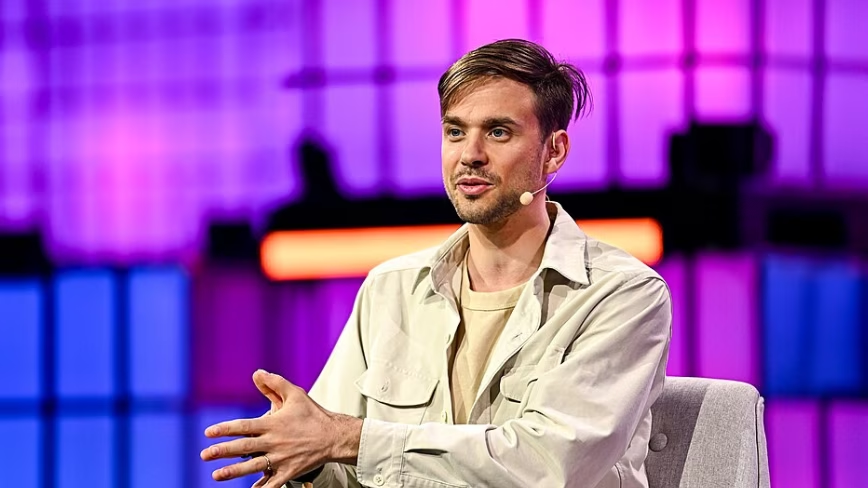
Understand the cultural barriers affecting European AI startups and why local talent may be enough to build global AI.
30-Second TL;DR
What Changed
European AI founders are discouraged by the narrative that success requires moving to San Francisco.
Why It Matters
This perspective challenges the brain drain narrative and encourages founders to leverage local European resources and talent pools to build global-scale AI products.
What To Do Next
Evaluate your current development roadmap to see if local European infrastructure and talent can support your scaling needs before considering relocation.
Key Points
- •European AI founders are discouraged by the narrative that success requires moving to San Francisco.
- •The region possesses sufficient technical talent to compete globally in AI development.
- •Cultural shifts in ambition and confidence are necessary to foster a robust European AI ecosystem.
Deep Insight
AI-generated analysis for this event — not the original article.
Enhanced Key Takeaways
- •European AI investment remains heavily skewed toward early-stage funding, with a documented 'series B gap' that forces startups to seek US capital for scaling, reinforcing the migration narrative.
- •The European Union's AI Act, implemented in the mid-2020s, has introduced specific compliance overheads that some founders argue create a 'regulatory confidence' barrier distinct from technical capability.
- •Data from the European Innovation Council indicates that while technical talent density in hubs like Paris, Berlin, and London rivals Silicon Valley, the commercialization rate of research-led AI startups remains lower due to risk-averse venture capital structures.
- •Lovable, led by Anton Osika, utilizes a 'cursor-native' or 'AI-first' development methodology that emphasizes rapid iteration, challenging traditional software development lifecycles prevalent in legacy European tech firms.
- •Recent industry reports highlight that European AI startups are increasingly adopting 'distributed-first' team models, which allow them to retain local talent while accessing global markets without the necessity of physical relocation.
Future ImplicationsAI analysis grounded in cited sources
Timeline
- 2024-05Anton Osika gains prominence in the AI developer community for his work on GPT-Pilot, an autonomous coding tool.
- 2025-02Lovable officially launches its platform, focusing on AI-assisted full-stack web development.
- 2026-03Lovable secures significant seed/series funding, signaling investor confidence in the 'AI-native' development model.
Weekly AI Recap
Read this week's curated digest of top AI events →
Related Updates


AI-curated news aggregator. All content rights belong to original publishers.
Original source: The Next Web (TNW) ↗
This is a summary, not the original. Read the source, or get the weekly briefing.
The weekly digest
One email a week. Unsubscribe anytime.