Entropy Dynamics Reveal Multi-Agent System Vulnerabilities
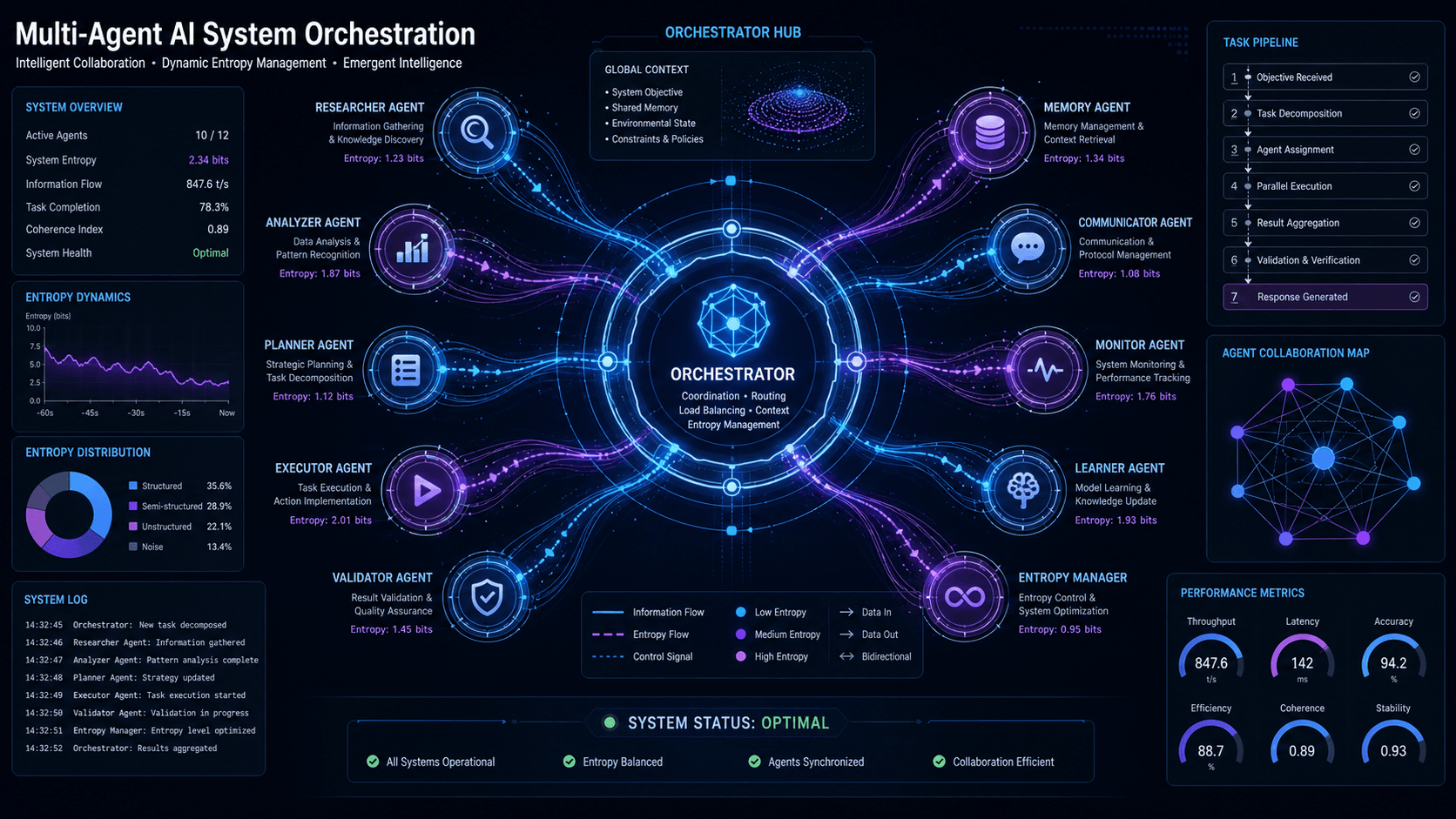
💡New ICML 2026 research: Stop blaming your agents and start fixing your orchestrator to prevent system failures.
⚡ 30-Second TL;DR
What Changed
Multi-agent system failures are largely attributed to orchestrator logic.
Why It Matters
This research provides a critical framework for developers to debug complex agentic workflows by focusing on the orchestration layer rather than just the LLM prompts.
What To Do Next
Implement entropy-based monitoring on your orchestrator logs to identify potential instability before system-wide failure occurs.
Key Points
- •Multi-agent system failures are largely attributed to orchestrator logic.
- •Entropy dynamics provide a new framework for diagnosing system degradation.
- •Individual agent performance is often secondary to the stability of the orchestration layer.
🧠 Deep Insight
AI-generated analysis for this event — not the original article.
🔑 Enhanced Key Takeaways
- •The research introduces a metric called 'Orchestration Entropy' (OE) which quantifies the divergence between agent-level intent and global system objectives.
- •The study demonstrates that in large-scale multi-agent systems (MAS), the orchestrator often suffers from 'contextual drift,' where the accumulation of historical interaction data leads to suboptimal decision-making.
- •Experiments conducted at ICML 2026 utilized a benchmark suite named 'EntropyBench,' specifically designed to stress-test MAS architectures under high-noise environments.
- •The Nanjing University team proposed a 'Dynamic Entropy Regularization' (DER) algorithm that allows orchestrators to prune irrelevant historical context, reducing system failure rates by approximately 22%.
- •The findings suggest that current industry trends toward increasing agent autonomy may be counterproductive if the orchestration layer lacks a mechanism to manage information entropy.
🛠️ Technical Deep Dive
- The framework utilizes a modified Transformer-based architecture for the orchestrator, incorporating an Entropy-Attention mechanism that weights agent inputs based on their contribution to global state stability.
- Entropy dynamics are calculated using the Kullback-Leibler (KL) divergence between the predicted system state distribution and the actual observed state transition probability.
- The DER algorithm operates by applying a penalty term to the orchestrator's loss function, proportional to the Shannon entropy of the agent-orchestrator communication channel.
- The study identifies 'Orchestrator Bottlenecking' as a phase transition point where entropy exceeds a critical threshold, leading to cascading failures across the agent network.
🔮 Future ImplicationsAI analysis grounded in cited sources
⏳ Timeline
Weekly AI Recap
Read this week's curated digest of top AI events →
👉Related Updates
AI-curated news aggregator. All content rights belong to original publishers.
Original source: Pandaily ↗
This is a summary, not the original. Read the source, or get the weekly briefing.
Weekly AI briefing
One email a week. Unsubscribe anytime.