Engineering Medical Agents from Zero to Production
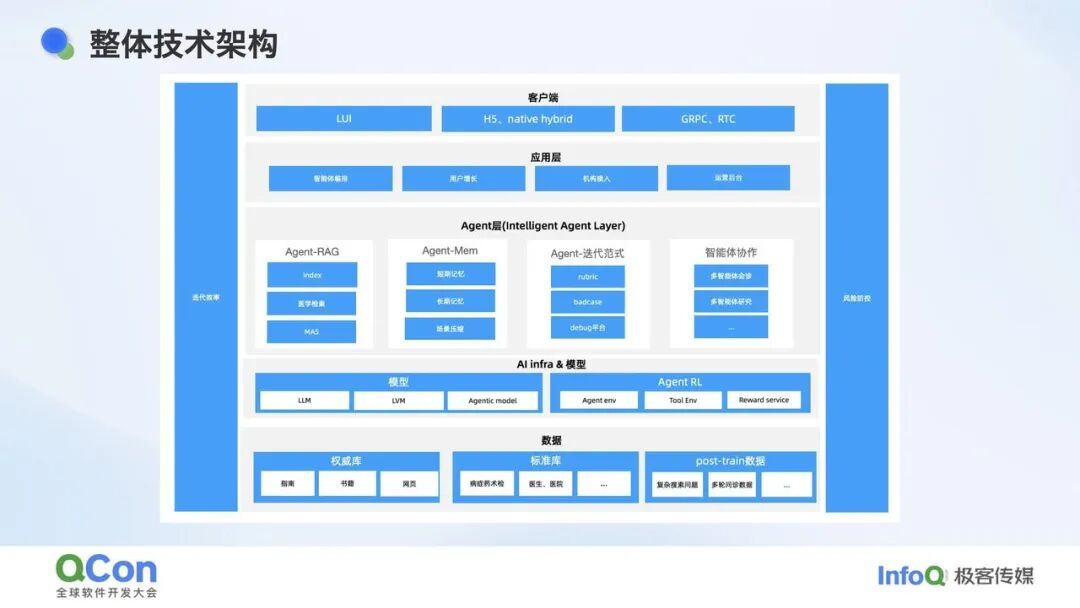
💡Learn how Ant Group manages high-stakes medical AI with automated evaluation and Badcase-driven iteration.
⚡ 30-Second TL;DR
What Changed
Shifted from TDD to Badcase-driven iteration to handle non-deterministic LLM outputs.
Why It Matters
Provides a blueprint for building reliable, high-stakes Agents where accuracy and safety are non-negotiable. It demonstrates how to scale evaluation infrastructure for complex, multi-agent systems.
What To Do Next
Build a dedicated Badcase management pipeline that automatically feeds failures back into your evaluation dataset.
Key Points
- •Shifted from TDD to Badcase-driven iteration to handle non-deterministic LLM outputs.
- •Built a robust evaluation infrastructure that reduced automated testing time from 12 days to hours.
- •Implemented a dual-loop feedback mechanism: integrating Badcase analysis back into the Benchmark.
- •Prioritized risk management with automated guardrails for sensitive medical and psychological scenarios.
🧠 Deep Insight
AI-generated analysis for this event — not the original article.
🔑 Enhanced Key Takeaways
- •Ant Group utilizes a proprietary 'Medical Knowledge Graph' integration that acts as a deterministic grounding layer to constrain LLM hallucinations in clinical reasoning.
- •The engineering framework incorporates a 'Human-in-the-loop' (HITL) verification layer where senior medical professionals audit high-risk agent decisions to generate synthetic training data.
- •Ant Group's medical agents employ a multi-agent orchestration architecture where specialized sub-agents handle triage, symptom analysis, and drug interaction checks separately.
- •The system utilizes a 'Dynamic Prompt Optimization' (DPO) pipeline that automatically adjusts system prompts based on real-time performance metrics from the evaluation infrastructure.
- •Ant Group has standardized a 'Safety-First' deployment protocol that mandates a shadow-mode testing phase before any medical agent is exposed to live user traffic.
📊 Competitor Analysis▸ Show
| Feature | Ant Group Medical Agent | Baidu Lingyi (Medical) | Tencent Health AI |
|---|---|---|---|
| Core Paradigm | Badcase-driven/Data-centric | Knowledge-Graph/RAG | Clinical Pathway/EHR Integration |
| Evaluation | Automated/Dual-loop | Benchmark-based | Expert-review/Clinical Trial |
| Risk Control | Automated Guardrails | Rule-based Filtering | Multi-layer Compliance |
| Market Focus | Consumer/Insurance | Hospital/Clinical | Public Health/Enterprise |
🛠️ Technical Deep Dive
- Architecture: Multi-agent system utilizing a central orchestrator to delegate tasks to specialized medical sub-agents.
- Grounding: Integration of a structured medical knowledge graph to provide factual constraints for LLM generation.
- Evaluation Pipeline: Automated regression testing suite that utilizes synthetic datasets to simulate diverse patient scenarios.
- Guardrails: Real-time monitoring layer that intercepts and blocks non-compliant or high-risk medical advice before output generation.
- Feedback Loop: Automated ingestion of user-reported errors and expert-reviewed 'Badcases' into the fine-tuning dataset.
🔮 Future ImplicationsAI analysis grounded in cited sources
⏳ Timeline
Weekly AI Recap
Read this week's curated digest of top AI events →
👉Related Updates


AI-curated news aggregator. All content rights belong to original publishers.
Original source: 虎嗅 ↗
This is a summary, not the original. Read the source, or get the weekly briefing.
The weekly digest
One email a week. Unsubscribe anytime.