Engineering enterprise-grade data agents for complex analysis
Learn how to solve the 'Text-to-SQL' accuracy gap in enterprise production environments.
30-Second TL;DR
What Changed
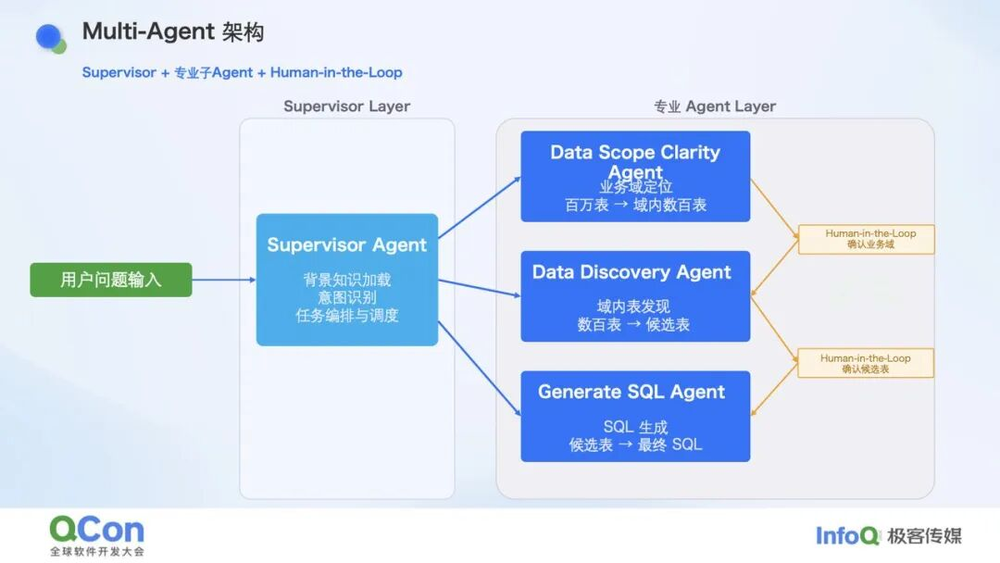
Transitioned from single-link RAG to a Multi-Agent architecture for better task orchestration.
Why It Matters
Moving beyond simple RAG is essential for enterprise adoption; multi-agent systems with human oversight are the current standard for reliable data analysis.
What To Do Next
If building a data agent, implement a multi-agent workflow with explicit Human-in-the-loop confirmation steps for table selection and query logic.
Key Points
- •Transitioned from single-link RAG to a Multi-Agent architecture for better task orchestration.
- •Implemented a three-layer metadata disclosure mechanism to prevent context corruption.
- •Introduced Human-in-the-loop (HITL) verification to ensure data accuracy and resolve ambiguities.
- •Utilized semantic modeling and skill-based mechanisms to improve SQL generation reliability.
Deep Insight
AI-generated analysis for this event — not the original article.
Enhanced Key Takeaways
- •The shift toward multi-agent architectures is driven by the 'Reasoning Gap' in LLMs, where complex OLAP queries require iterative decomposition rather than single-shot generation.
- •Three-layer metadata disclosure typically involves semantic layer mapping, schema pruning based on query intent, and dynamic constraint injection to reduce token overhead and hallucinations.
- •Modern enterprise data agents are increasingly adopting 'Self-Correction Loops' where the agent executes a dry-run SQL query, analyzes the error message, and performs automated debugging before returning results to the user.
- •The integration of vector-based semantic search with deterministic SQL generation is becoming the industry standard to handle unstructured business terminology alongside structured database schemas.
- •Performance benchmarks for these systems are shifting from simple 'Accuracy' metrics to 'Time-to-Insight' and 'Query Complexity Handling' (QCH) scores, reflecting the move toward autonomous data analysis.
Competitor Analysis
- Enterprise Data Agents (General)
- Multi-Agent/Orchestration
- Microsoft Copilot for Power BI
- Integrated Ecosystem
- Databricks AI/BI Genie
- Unified Data/AI Platform
- Snowflake Cortex Analyst
- Managed SQL-Agent Service
- Enterprise Data Agents (General)
- High (Customizable)
- Microsoft Copilot for Power BI
- Moderate
- Databricks AI/BI Genie
- High
- Snowflake Cortex Analyst
- Moderate
- Enterprise Data Agents (General)
- Flexible/External
- Microsoft Copilot for Power BI
- Power BI Semantic Model
- Databricks AI/BI Genie
- Unity Catalog
- Snowflake Cortex Analyst
- Snowflake Horizon
- Enterprise Data Agents (General)
- Variable/Usage-based
- Microsoft Copilot for Power BI
- Per User/Capacity
- Databricks AI/BI Genie
- Compute-based
- Snowflake Cortex Analyst
- Consumption-based
| Feature | Enterprise Data Agents (General) | Microsoft Copilot for Power BI | Databricks AI/BI Genie | Snowflake Cortex Analyst |
|---|---|---|---|---|
| Architecture | Multi-Agent/Orchestration | Integrated Ecosystem | Unified Data/AI Platform | Managed SQL-Agent Service |
| HITL Support | High (Customizable) | Moderate | High | Moderate |
| Semantic Layer | Flexible/External | Power BI Semantic Model | Unity Catalog | Snowflake Horizon |
| Pricing | Variable/Usage-based | Per User/Capacity | Compute-based | Consumption-based |
Technical Deep Dive
- Agent Orchestration: Utilizes Directed Acyclic Graph (DAG) task planning to manage dependencies between data retrieval, transformation, and visualization agents.
- Semantic Modeling: Employs Graph-based representations of database schemas to capture relationships that are often lost in flat relational structures.
- Context Management: Implements sliding-window memory buffers combined with long-term vector storage to maintain state across multi-turn analytical conversations.
- SQL Generation: Uses Few-Shot Prompting with dynamic example selection based on query similarity to improve syntax adherence for complex OLAP dialects.
Future ImplicationsAI analysis grounded in cited sources
Timeline
- 2023-05Initial industry shift from simple Text-to-SQL RAG to agentic workflows.
- 2024-02Introduction of standardized semantic modeling layers for LLM-integrated data platforms.
- 2025-01Widespread adoption of Human-in-the-loop (HITL) verification protocols in enterprise AI deployments.
- 2025-11Emergence of multi-agent orchestration frameworks specifically optimized for OLAP environments.
Weekly AI Recap
Read this week's curated digest of top AI events →
AI-curated news aggregator. All content rights belong to original publishers.
Original source: 虎嗅 ↗
This is a summary, not the original. Read the source, or get the weekly briefing.
The weekly digest
One email a week. Unsubscribe anytime.