Embodied AI Moves From PPT to Production
Humanoid robotics is leaving demos behind—production data, supply chains, and unit economics now decide winners.
30-Second TL;DR
What Changed
Tesla says Optimus is its most difficult product to mass-produce because the robot requires a new supply chain and thousands of new components.
Why It Matters
The competitive advantage in embodied AI is shifting from impressive prototypes to repeatable production, reliable operation, proprietary data, and cost-effective deployment. Cloud and platform providers may capture value by supplying the common infrastructure rather than building every robot themselves.
What To Do Next
Prototype one constrained factory task on CloudRobo or an equivalent robotics platform, and measure cycle time, success rate, recovery rate, and data-collection cost before expanding scope.
Key Points
- •Tesla says Optimus is its most difficult product to mass-produce because the robot requires a new supply chain and thousands of new components.
- •Xiaomi reported that its humanoid robot's dual-sided nut-loading success rate improved from 90.2% to 98% after four months in an automotive factory.
- •Huawei Cloud opened public testing for CloudRobo and partnered with Yijiahe to combine industrial robot data with cloud-based cognitive decision-making.
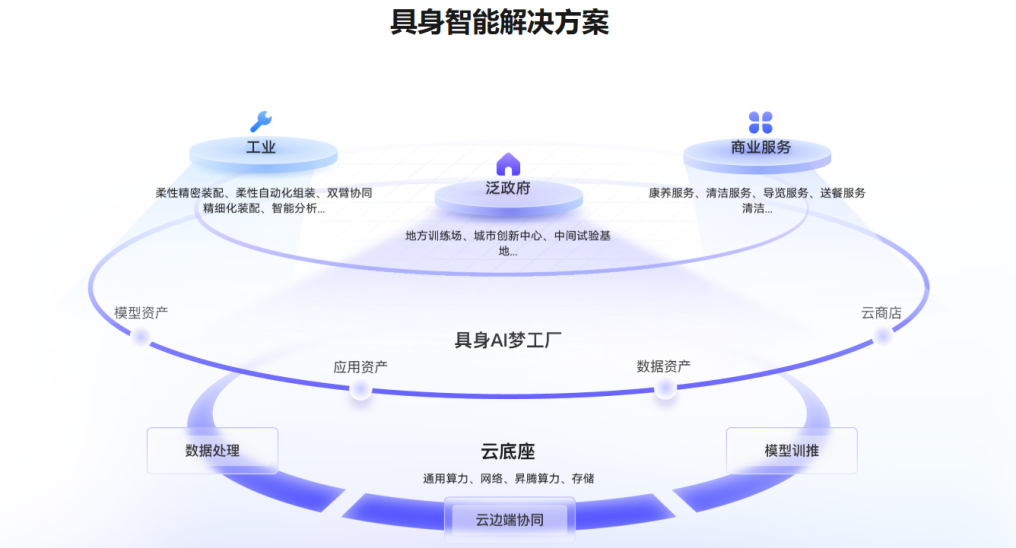
- •Tencent released a four-layer embodied AI stack covering cloud infrastructure, models, platforms, and applications.
- •China's embodied AI financing reportedly reached 93.5 billion yuan in the first half of 2026, with capital concentrating on large players.
Deep Insight
AI-generated analysis for this event — not the original article.
Enhanced Key Takeaways
- •The Chinese Ministry of Industry and Information Technology (MIIT) released updated standards in mid-2026 specifically targeting safety and interoperability protocols for humanoid robots in manufacturing environments.
- •Data scarcity in specialized industrial tasks is being addressed through 'synthetic data factories' where companies like Tencent and Huawei are generating high-fidelity simulation environments to train robot policies before physical deployment.
- •The shift toward 'embodied AI' has triggered a surge in demand for specialized actuators and harmonic drives, leading to a 30% year-over-year increase in domestic production capacity for high-precision robot components in China.
- •Recent industry reports indicate that the 'foundation model' approach for robots is moving toward multi-modal architectures that integrate tactile and force-feedback sensors directly into the transformer-based decision-making loop.
- •Major Chinese automotive OEMs are increasingly mandating 'robot-ready' factory designs, requiring new facilities to include standardized charging docks and communication interfaces for humanoid integration.
Competitor Analysis
- Tesla (Optimus)
- Full-stack vertical integration
- Xiaomi (CyberOne/CyberGear)
- Consumer-industrial hybrid
- Huawei/Tencent (Platform)
- Cloud-native AI infrastructure
- Tesla (Optimus)
- Internal factory use first
- Xiaomi (CyberOne/CyberGear)
- Automotive assembly lines
- Huawei/Tencent (Platform)
- Partner-based ecosystem
- Tesla (Optimus)
- End-to-end neural networks
- Xiaomi (CyberOne/CyberGear)
- Modular control systems
- Huawei/Tencent (Platform)
- Distributed cloud-edge AI
- Tesla (Optimus)
- Projected <$20k (target)
- Xiaomi (CyberOne/CyberGear)
- Competitive/Cost-plus
- Huawei/Tencent (Platform)
- SaaS/Platform licensing
| Feature | Tesla (Optimus) | Xiaomi (CyberOne/CyberGear) | Huawei/Tencent (Platform) |
|---|---|---|---|
| Primary Focus | Full-stack vertical integration | Consumer-industrial hybrid | Cloud-native AI infrastructure |
| Deployment Strategy | Internal factory use first | Automotive assembly lines | Partner-based ecosystem |
| Model Architecture | End-to-end neural networks | Modular control systems | Distributed cloud-edge AI |
| Pricing Model | Projected <$20k (target) | Competitive/Cost-plus | SaaS/Platform licensing |
Technical Deep Dive
- Architecture: Transitioning from traditional rigid control algorithms to end-to-end transformer models that process visual, tactile, and proprioceptive data simultaneously.
- Simulation: Utilization of NVIDIA Isaac Sim and proprietary cloud-based digital twins to perform millions of hours of reinforcement learning in virtual environments before real-world deployment.
- Hardware: Adoption of quasi-direct drive actuators to improve torque density and back-drivability, essential for safe human-robot collaboration.
- Communication: Implementation of 5G-Advanced (5.5G) protocols to ensure low-latency control loops between cloud-based cognitive engines and edge-based robot controllers.
Future ImplicationsAI analysis grounded in cited sources
Timeline
- 2022-09Tesla unveils the Optimus prototype at AI Day.
- 2022-08Xiaomi officially launches its first-generation humanoid robot, CyberOne.
- 2024-01Tesla demonstrates Optimus Gen 2 with improved dexterity and sensor integration.
- 2025-05Huawei Cloud launches its industrial-focused embodied AI research initiative.
- 2026-03Tencent releases its comprehensive four-layer embodied AI stack for industrial applications.
Weekly AI Recap
Read this week's curated digest of top AI events →
Related Updates

AI-curated news aggregator. All content rights belong to original publishers.
Original source: 虎嗅 ↗
This is a summary, not the original. Read the source, or get the weekly briefing.
The weekly digest
One email a week. Unsubscribe anytime.