Dungeons & Desktops: The resilience of open-source roguelikes
Learn how open-source community dynamics can ensure your software projects survive for decades.
30-Second TL;DR
What Changed
Roguelike 遊戲透過開源社群實現了長期的代碼存續與演變。
Why It Matters
The article illustrates how open-source collaboration models can prevent software rot, providing a blueprint for long-term project sustainability in the AI and developer ecosystem.
What To Do Next
Analyze your open-source repository's bus factor and consider creating a clear contribution roadmap to encourage community-led forks.
Key Points
- •Roguelike 遊戲透過開源社群實現了長期的代碼存續與演變。
- •軟體專案的生命力來自於頻繁的分支(forking)與社群參與。
- •開源模式允許舊專案在被放棄後能被重新啟動與現代化。
Deep Insight
Background and context from public sources — not the original article. 29 sources cited.
Enhanced Key Takeaways
- •The term "roguelike" itself originated from Usenet communities around 1993, used to group similar games characterized by being free, featuring dungeon crawls, and utilizing character-based displays.
- •Early roguelikes such as Angband and Moria were initially developed with custom licenses that, while promoting free distribution, did not fully align with modern open-source definitions, necessitating later re-licensing efforts like Angband's transition to GPLv2 in 2009.
- •The open-source nature of games like NetHack has been pivotal for their sustained, long-term development, fostering community contributions and enabling the recruitment of variant developers into the core development team during periods of reduced activity.
- •Modern roguelike development frequently utilizes open-source toolkits and libraries, including libtcod, Rot.js, RLTK, and T-Engine4, which provide essential functionalities such as procedural map generation, pathfinding, and field of view, thereby streamlining the creation process for new developers.
- •The genre has diversified into "roguelites," which maintain core roguelike elements like procedural generation and permadeath but integrate mechanics from other game genres, often achieving commercial success, in contrast to many traditional roguelikes that remain free and open-source.
Technical Deep Dive
- Core Gameplay Elements: Roguelikes are traditionally defined by procedurally generated levels, turn-based gameplay, grid-based movement, and permanent death of the player character.
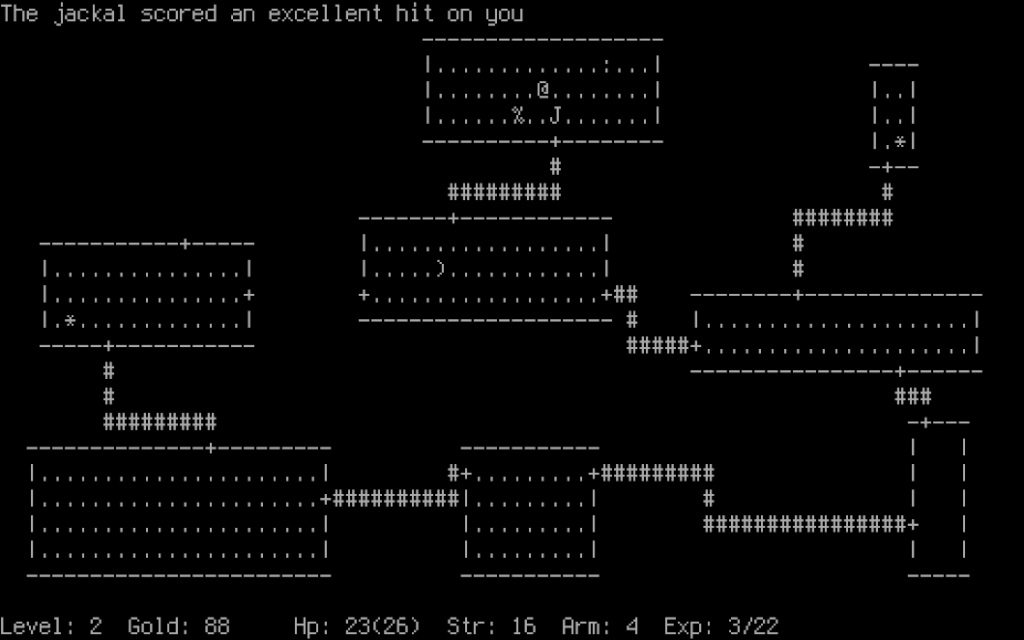
- Display and Interface: Historically, roguelikes utilized ASCII or Extended ASCII glyphs, "DECgraphics," or "IBMgraphics" for their visual interface, allowing them to run on a wide range of computer displays. Modern iterations can also employ graphical tilesets or browser-based rendering with geometric primitives.
- Procedural Generation: Content such as levels, maps, enemies, and items are generated algorithmically at runtime. Techniques like Binary Space Partitioning (BSP) are commonly used for dungeon creation.
- Pathfinding: Many roguelikes implement pathfinding for AI, often utilizing algorithms such as Dijkstra's algorithm, as seen in Dungeon Crawl Stone Soup.
- Development Toolkits and Libraries:
- libtcod (C++/Python): A popular library offering functionalities like console management, pathfinding, and field of view calculations.
- Rot.js (JavaScript): A beginner-friendly library for creating classic roguelikes.
- RLTK (C++14): An SFML-based toolkit providing fast terminal rendering, pathfinding, line-plotting, and support for an Entity-Component-System (ECS) architecture.
- T-Engine4 (Lua): A game engine used for titles like Tales of Maj'Eyal, featuring support for particle effects and online multiplayer.
- RogueSharp (C#): An open-source library that provides a framework for map generation, pathfinding, and field of view functions.
- Roguelike Game Kit (Java): Offers reusable modules for layered map structures, ASCII display, game actions, field of view, and dungeon/wilderness generators.
- Game Architecture: Some contemporary roguelike frameworks, like RLTK, adopt an Entity-Component-System (ECS) design for more flexible and modular game development.
- Community-Driven Content Integration: Games like Dungeon Crawl Stone Soup incorporate hand-crafted "vaults" (pre-designed dungeon sections) into their procedural generation, often contributed by the community to enrich gameplay.
Future ImplicationsAI analysis grounded in cited sources
Timeline
- 1980Rogue is released, establishing foundational genre elements like procedural generation and permadeath.
- 1987NetHack is first released as an open-source derivative of Hack, initiating its long history of community-driven development.
- 1990Angband is created, based on Umoria, becoming another significant open-source roguelike, initially under a custom license.
- 1993The term "roguelike" is coined by Usenet communities to categorize games sharing characteristics with Rogue and its derivatives.
- 2006Dungeon Crawl Stone Soup (DCSS) begins development as a community-driven successor to Linley's Dungeon Crawl, showcasing continued open-source evolution.
- 2009Angband successfully completes its re-licensing to GPLv2, formalizing its open-source status and enabling broader distribution.
Sources (29)
Factual claims are grounded in the sources below. Forward-looking analysis is AI-generated interpretation.
Weekly AI Recap
Read this week's curated digest of top AI events →
AI-curated news aggregator. All content rights belong to original publishers.
Original source: GitHub Blog ↗
This is a summary, not the original. Read the source, or get the weekly briefing.
The weekly digest
One email a week. Unsubscribe anytime.