Duan Jianjun appointed as Volvo China CEO
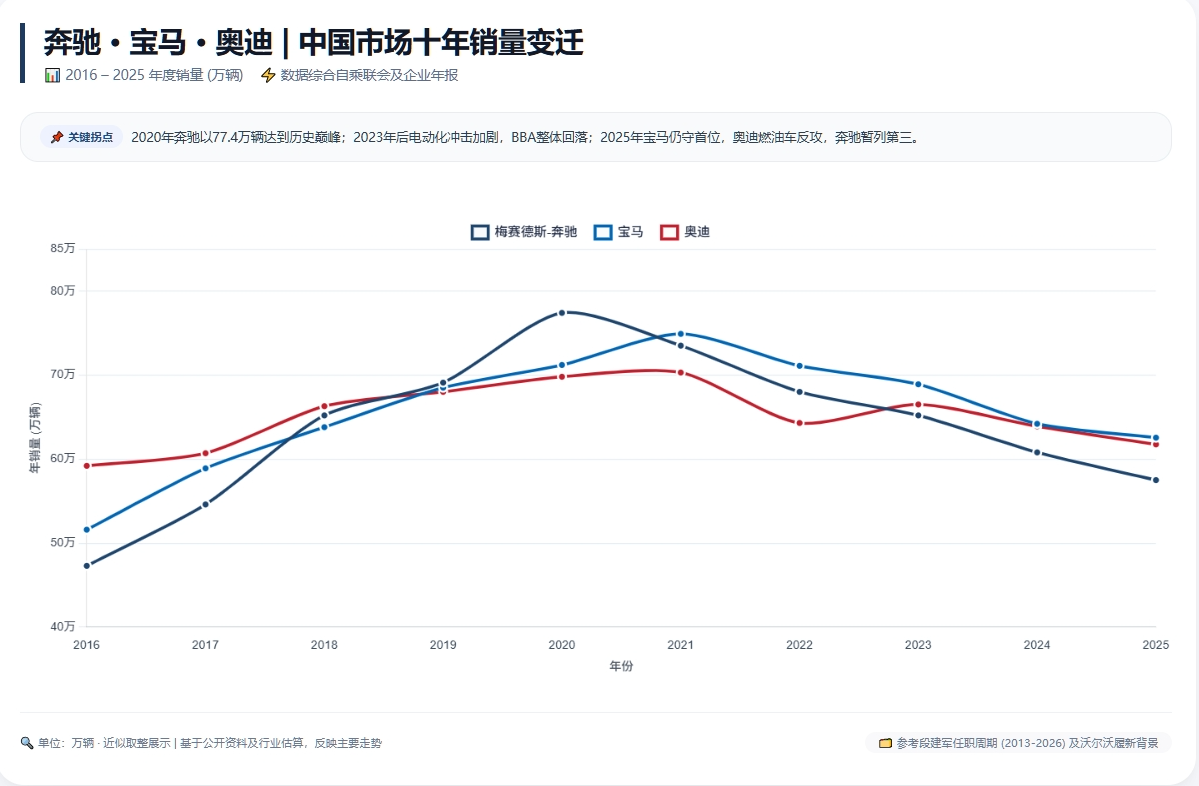
💡Legacy auto leadership shakeup: Can a veteran executive pivot Volvo to compete with Huawei-backed smart cars?
⚡ 30-Second TL;DR
What Changed
Duan Jianjun transitions from Mercedes-Benz to lead Volvo China with expanded authority over R&D and production.
Why It Matters
The appointment reflects a broader trend of legacy automakers replacing leadership to accelerate digital and EV transformation in the Chinese market.
What To Do Next
Monitor Volvo's upcoming product roadmap to see if the new leadership successfully integrates advanced ADAS and smart cockpit features.
Key Points
- •Duan Jianjun transitions from Mercedes-Benz to lead Volvo China with expanded authority over R&D and production.
- •Volvo faces significant market pressure with a 17% year-over-year sales decline in Q1 2026.
- •The appointment aims to replicate Duan's past success in localization while addressing Volvo's brand positioning challenges.
🧠 Deep Insight
Web-grounded analysis with 13 cited sources.
🔑 Enhanced Key Takeaways
- •Duan Jianjun's appointment as President and CEO of Volvo Cars Greater China was effective immediately on May 11, 2026, placing him in charge of the entire value chain from R&D to sales, and he will report to the China Board of Directors while joining the Group's global core management and global sales management teams.
- •Prior to joining Volvo, Duan Jianjun served as President and CEO of Mercedes-Benz Sales China from May 2023, a role that made him the first Chinese executive to lead a top-tier global luxury automaker's sales operations in China.
- •Volvo's 17% year-over-year sales decline in Greater China during Q1 2026, totaling approximately 28,300 units, was attributed to intense market competition, seasonal effects, and the extended Chinese New Year holiday period.
- •Despite the overall sales downturn, Volvo's Battery Electric Vehicle (BEV) sales in Greater China saw a 12% increase in Q1 2026, and overall electrified models (BEV and Plug-in Hybrid) surged by 116% to 7,604 units, constituting 27% of Volvo's total sales in the region.
- •Volvo's traditional internal combustion engine (ICE) models, such as the XC60 and S90, are experiencing substantial terminal discounts in China, reaching approximately RMB 130,000, which signals a significant erosion of their foundational market position.
📊 Competitor Analysis▸ Show
| Competitor | NEV Market Share (April 2026) | Key Offerings/Strategy |
|---|---|---|
| BYD | 21.4% (China NEV retail sales) | Dominant across budget to premium EVs, diversified lineup (BEV, PHEV, EREV), competitive pricing ($9,000-$58,000 range) |
| Geely | 11.3% (China NEV retail sales) | Strong momentum in budget and mid-tier EV segments (Galaxy, Zeekr brands), combining accessible pricing with advanced software features |
| Changan | 7.6% (China NEV retail sales) | Growing presence in NEV market, achieved 6.4% YoY growth in monthly NEV sales |
| Tesla | Fell out of top 10 (China NEV retail sales) | Facing strong competition from domestic brands, sales volume dropped to 25,956 units in April 2026 |
| Volvo (Contextual) | Electrified models accounted for 27% of its total sales in Greater China in Q1 2026, with BEV sales up 12% | Facing tough competition on pricing and new product launches, with significant discounts on ICE models; aims to strengthen product competitiveness and redefine brand value proposition |
🔮 Future ImplicationsAI analysis grounded in cited sources
⏳ Timeline
📎 Sources (13)
Factual claims are grounded in the sources below. Forward-looking analysis is AI-generated interpretation.
Weekly AI Recap
Read this week's curated digest of top AI events →
👉Related Updates

AI-curated news aggregator. All content rights belong to original publishers.
Original source: 虎嗅 ↗