Doubao Begins Charging for AI-Driven Conversions
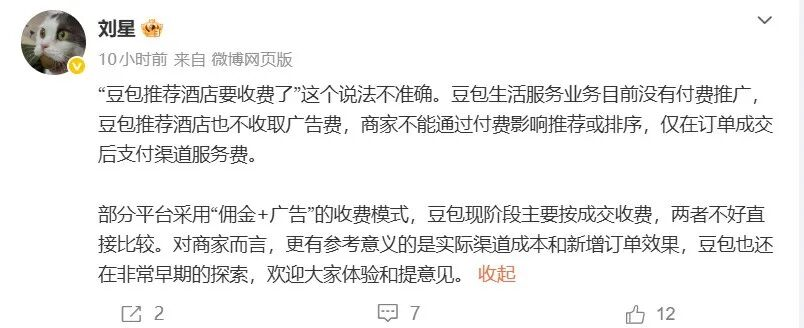
Doubao is turning AI recommendations into a separately priced, measurable commerce channel.
30-Second TL;DR
What Changed
Doubao-referred hotel orders are charged an 11.4% software service fee plus a 0.6% payment fee.
Why It Matters
For AI commerce builders, this marks a shift from conversational recommendation to measurable performance-based monetization. Higher fees may be acceptable if Doubao proves that its orders are incremental, but attribution and ranking transparency will become critical for merchant trust.
What To Do Next
Prototype an AI-commerce attribution dashboard that compares Doubao-sourced conversion, incremental margin, and channel fees against existing Douyin traffic.
Key Points
- •Doubao-referred hotel orders are charged an 11.4% software service fee plus a 0.6% payment fee.
- •Some lifestyle-service orders carry a 17.4% software service fee, reaching about 18% after payment charges.
- •The separate Doubao channel enables attribution analysis of AI-generated orders and their incremental value.
- •Doubao has integrated hotel, travel, shopping, ordering, payment, and after-sales workflows into its conversational interface.
- •The policy raises transparency questions about ranking neutrality, merchant access, and whether AI orders are truly incremental.
Deep Insight
AI-generated analysis for this event — not the original article.
Enhanced Key Takeaways
- •Doubao's monetization strategy aligns with ByteDance's broader push to integrate AI agents directly into the consumer transaction funnel, moving beyond simple ad-based revenue models.
- •The fee structure is being implemented as part of a 'closed-loop' ecosystem strategy, where Doubao acts as both the discovery engine and the transaction facilitator to capture data attribution.
- •Industry analysts suggest this move is a response to the high inference costs associated with running large-scale multimodal models like Doubao, necessitating a shift toward transaction-based revenue.
- •Merchants are reportedly concerned that the AI-driven attribution model may overlap with existing traffic sources, potentially leading to 'double-dipping' on commission fees for the same customer.
- •Doubao has been aggressively expanding its 'Agent' ecosystem, allowing businesses to deploy custom AI agents that can now directly trigger these service fees upon successful conversion.
Competitor Analysis
- Doubao (ByteDance)
- Transaction/Service Fees
- Kimi (Moonshot AI)
- Subscription/API Usage
- Ernie Bot (Baidu)
- Ad/Cloud Integration
- Doubao (ByteDance)
- High (Full Transaction Loop)
- Kimi (Moonshot AI)
- Low (Focus on Productivity)
- Ernie Bot (Baidu)
- Medium (Search/Cloud)
- Doubao (ByteDance)
- High (Transactional)
- Kimi (Moonshot AI)
- Medium (Informational)
- Ernie Bot (Baidu)
- High (Enterprise)
| Feature | Doubao (ByteDance) | Kimi (Moonshot AI) | Ernie Bot (Baidu) |
|---|---|---|---|
| Primary Revenue Model | Transaction/Service Fees | Subscription/API Usage | Ad/Cloud Integration |
| Ecosystem Depth | High (Full Transaction Loop) | Low (Focus on Productivity) | Medium (Search/Cloud) |
| AI Agent Capability | High (Transactional) | Medium (Informational) | High (Enterprise) |
Technical Deep Dive
- Doubao utilizes a proprietary multimodal model architecture optimized for low-latency conversational commerce.
- The attribution system relies on a real-time event-tracking pipeline that links conversational intent tokens to specific merchant SKU IDs.
- The platform employs a dynamic routing mechanism that differentiates between organic traffic and AI-referred traffic to calculate the incremental service fee.
- Integration with ByteDance's internal payment infrastructure (Douyin Pay) allows for automated fee deduction at the point of settlement.
Future ImplicationsAI analysis grounded in cited sources
Timeline
- 2023-08ByteDance launches Doubao as a standalone AI chatbot app in China.
- 2024-05Doubao significantly reduces API pricing to compete with other Chinese LLM providers.
- 2025-02Doubao integrates deeper e-commerce and lifestyle service booking capabilities.
- 2026-04Doubao introduces 'Agent' creation tools for merchants to facilitate direct customer interaction.
Weekly AI Recap
Read this week's curated digest of top AI events →
AI-curated news aggregator. All content rights belong to original publishers.
Original source: 虎嗅 ↗
This is a summary, not the original. Read the source, or get the weekly briefing.
The weekly digest
One email a week. Unsubscribe anytime.