Dopamine Loop Regulates Social Avoidance
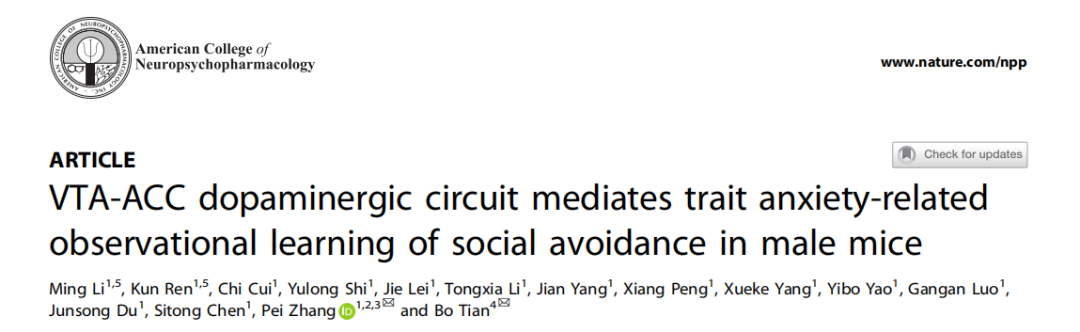
💡Social avoidance mechanism discovery boosts AI for behavioral psychology simulations.
⚡ 30-Second TL;DR
What Changed
VTA-ACC dopamine circuit controls observational social avoidance learning
Why It Matters
Deepens insight into anxiety-driven social behaviors, informing AI models for social robotics and mental health simulations.
What To Do Next
Model VTA-ACC dopamine dynamics in your RL agents for realistic anxiety-based social decision-making.
Key Points
- •VTA-ACC dopamine circuit controls observational social avoidance learning
- •High-anxiety mice show reduced avoidance after peer defeat observation
- •Low-anxiety mice display increased avoidance in contrast
- •Published in Nature subjournal
🧠 Deep Insight
Background and context from public sources — not the original article. 3 sources cited.
🔑 Enhanced Key Takeaways
- •The VTA-NAc (nucleus accumbens) dopamine circuit, not VTA-ACC, is the primary pathway implicated in social defeat stress responses, with optogenetic inhibition of VTA→NAc projections reversing stress-induced social withdrawal in mice[2]
- •Sex differences in dopamine system responsiveness to social contexts are significant: females show greater TH/c-fos positive cells (dopamine neuron activation markers) across the entire VTA compared to males, with the ventral VTA particularly sensitive to aversive social contexts[2]
- •Chronic social defeat stress triggers homeostatic plasticity in VTA dopamine neurons through altered potassium ion channel activity, with susceptible mice showing enhanced firing rates and increased activity of NAc-projecting dopaminergic neurons that promote social avoidance[1]
🛠️ Technical Deep Dive
- •VTA dopamine neuron hyperactivity in susceptible mice involves increased Ih (hyperpolarization-activated cyclic nucleotide-gated channel current); local infusion of HCN channel inhibitors (ZD7288, cilobradine/DK-AH 269) into VTA normalizes social avoidance[1]
- •Noradrenergic signaling modulates VTA dopaminergic activity during social stress via α1-adrenergic receptors (α1ARs) and α2ARs on VTA dopamine neurons, with acute social defeat increasing norepinephrine and corticotropin-releasing factor (CRF) release acting on CRF-R2[1]
- •Social isolation in adolescent mice induces sustained expression of GluA2-lacking AMPA receptors in VTA putative dopaminergic neurons, requiring PVN oxytocin (Oxt) projections to VTA for homeostatic plasticity regulation of social behaviors[1]
- •Dopamine influences inhibitory (GABAergic) transmission in prefrontal cortex; blocking dopamine receptors or GABA-A receptors attenuates social context effects, suggesting dopamine coordinates excitatory/inhibitory neurotransmission balance[1]
🔮 Future ImplicationsAI analysis grounded in cited sources
⏳ Timeline
📎 Sources (3)
Factual claims are grounded in the sources below. Forward-looking analysis is AI-generated interpretation.
Weekly AI Recap
Read this week's curated digest of top AI events →
👉Related Updates



AI-curated news aggregator. All content rights belong to original publishers.
Original source: 钛媒体 ↗
This is a summary, not the original. Read the source, or get the weekly briefing.
The weekly digest
One email a week. Unsubscribe anytime.