Domestic DDR5 Chips Enter Supply Chain at Scale
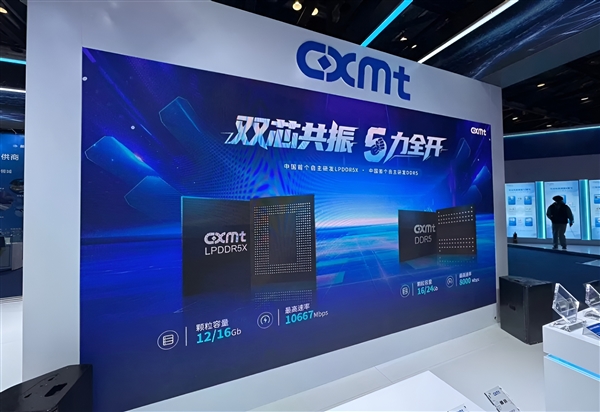
💡Critical infrastructure update: Domestic DRAM breakthroughs impact AI hardware costs and supply chain resilience.
⚡ 30-Second TL;DR
What Changed
CXMT achieves substantive breakthrough in DDR5 manufacturing
Why It Matters
Increased availability of domestic DDR5 chips may lower hardware costs for AI infrastructure and reduce reliance on international supply chains.
What To Do Next
Evaluate the cost-performance ratio of CXMT-based DDR5 modules for your local AI inference server builds.
Key Points
- •CXMT achieves substantive breakthrough in DDR5 manufacturing
- •Domestic memory modules are transitioning from validation to mass market
- •AI-driven industry cycle accelerates domestic DRAM adoption
🧠 Deep Insight
Web-grounded analysis with 25 cited sources.
🔑 Enhanced Key Takeaways
- •CXMT's DDR5 chips support speeds up to 8,000 Mbps and are available in 16Gb and 24Gb die densities, utilizing a 16nm process technology (G4 DRAM generation) which reduces cell size by 20% compared to their previous 18nm node.
- •Chinese memory module vendors such as Powev (with brands like Sinker, Gloway, and KingBank) and Comay are actively releasing consumer and enterprise DDR5 products based on CXMT dies, with some consumer models available since late 2024 and server memories entering mass production and delivery in May 2026.
- •The global memory market is experiencing an "AI-driven supercycle," with AI data centers projected to consume a significant portion (up to 70% of high-end DRAM or 20% of total DRAM wafer capacity equivalent) of the supply in 2026, leading to sharp price increases and a strategic reallocation of manufacturing capacity by major players towards HBM and high-capacity DDR5.
- •CXMT is actively developing 15nm DRAM, aiming for mass production in late 2026, and is also working on HBM3 technology, having supplied samples to Chinese AI hardware developers like Huawei, demonstrating a strategic move into high-performance AI memory.
📊 Competitor Analysis▸ Show
| Feature/Metric | CXMT | Samsung | SK Hynix | Micron |
|---|---|---|---|---|
| Process Node (DDR5) | 16nm (G4), targeting 15nm | 1b (14-12 nm) to 1c (12-11 nm) | 1b (10 nm 5th gen) to 1c (10 nm 6th gen) | 1γ (1-gamma) |
| DDR5 Speeds | Up to 8,000 Mbps | (Implied high-end, e.g., 1c node) | (Implied high-end, e.g., 1c node) | Up to 9200 MT/s (1γ DDR5) |
| DDR5 Die Density | 16Gb, 24Gb | Most advanced 32Gb | Most advanced 32Gb | (Implied high-end, e.g., 1γ node) |
| Market Share (DRAM) | ~5% (2023), ~10% (Q4 2025 target) | >1/3 of global capacity | (Part of >90% oligopoly) | (Part of >90% oligopoly) |
| HBM Development | HBM3 in development, samples supplied | HBM3E leadership | HBM3E leadership | (Part of HBM market) |
| EUV Lithography Use | Relies on deep UV multi-patterning (quadruple/sextuple) due to sanctions | Heavily relies on EUV for advanced nodes | Heavily relies on EUV for advanced nodes | (Implied advanced lithography) |
🛠️ Technical Deep Dive
- CXMT's DDR5 chips support speeds of up to 8,000 Mbps (or MT/s) and are available in 16Gb and 24Gb die densities.
- The company utilizes a 16nm process technology (G4 DRAM generation) for its DDR5 products, which has reduced DRAM cell size by 20% compared to its previous 18nm (G3) node.
- A detailed analysis of CXMT's 16Gb DDR5 chip shows a die size of 66.99 mm² and a bit density of 0.239 Gb/mm².
- While CXMT's 16nm node corresponds to the D1z generation (15.8 ~ 16.2 nm) of global leaders, Samsung, SK Hynix, and Micron are currently producing DDR5 with more advanced nodes (12-14nm).
- CXMT has achieved an 80% yield rate for its DDR5 chips by late 2024, with a target of 90% by the end of 2025.
- Due to US sanctions restricting access to EUV lithography, CXMT is innovating within the boundaries of deep UV equipment, employing quadruple and even sextuple patterning to achieve sub-20nm features.
- The DDR5 product portfolio from CXMT includes various module types such as UDIMM, SODIMM, RDIMM, CSODIMM, CUDIMM, and TFF MRDIMM, catering to servers, workstations, personal computers, and laptops.
- CXMT is also developing 15nm DRAM, with R&D planned for completion by 2025 and mass production targeted for late 2026, aiming to achieve this without EUV.
🔮 Future ImplicationsAI analysis grounded in cited sources
⏳ Timeline
📎 Sources (25)
Factual claims are grounded in the sources below. Forward-looking analysis is AI-generated interpretation.
- Google Search Source
- Google Search Source
- Google Search Source
- Google Search Source
- Google Search Source
- Google Search Source
- Google Search Source
- Google Search Source
- Google Search Source
- Google Search Source
- Google Search Source
- Google Search Source
- Google Search Source
- Google Search Source
- Google Search Source
- Google Search Source
- Google Search Source
- Google Search Source
- Google Search Source
- Google Search Source
- Google Search Source
- Google Search Source
- Google Search Source
- Google Search Source
- Google Search Source
Weekly AI Recap
Read this week's curated digest of top AI events →
👉Related Updates



AI-curated news aggregator. All content rights belong to original publishers.
Original source: cnBeta (Full RSS) ↗