Dog Vibe-Codes Games via Claude Prompts
💡Dog-powered LLM game dev: prompt mastery for noisy inputs & automation loops
⚡ 30-Second TL;DR
What Changed
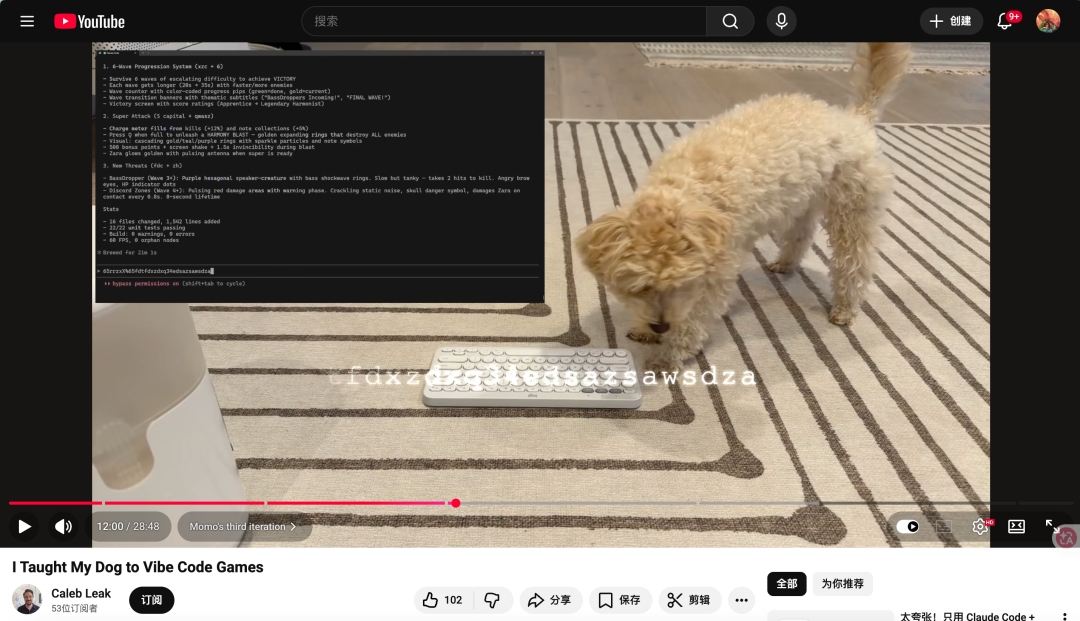
Prompt engineers Claude to interpret random dog keystrokes as creative game designs.
Why It Matters
Showcases LLM robustness to noisy inputs via role-playing prompts, enabling novel human-AI-pet interactions. Could inspire accessible coding tools for non-traditional users or creative ideation pipelines.
What To Do Next
Test role-playing prompts in Claude 3.5 Sonnet to decode random strings into code.
Key Points
- •Prompt engineers Claude to interpret random dog keystrokes as creative game designs.
- •Raspberry Pi 5 captures Bluetooth keys, Rust DogKeyboard filters and injects to Claude.
- •Aqara C1 feeder auto-dispenses treats via Zigbee after input thresholds.
- •Godot 4.6 C# games auto-tested for controls, audio, enemies before completion.
- •Full loop: dog input → AI decode → game build → validation → reward.
🧠 Deep Insight
Background and context from public sources — not the original article. 6 sources cited.
🔑 Enhanced Key Takeaways
- •Caleb Leak released open-source repositories including TeaLeaves for AI-assisted game dev tools and prompts, DogKeyboard Rust app for input routing, and Quasar Saz as the first dog-vibe-coded Godot game[1][2][3][4].
- •The system enables Claude to self-test games via Python screenshot scripts and input sequence commands like 'left for 3 seconds, fire', turning AI into its own QA tester for rendering, playability, and scene validation[1].
- •Momo is a 2-year-old 9-pound cavapoo (cavalier king charles spaniel and toy poodle mix), with project iterations shown in a 28-minute YouTube video from Feb 24, 2026, demonstrating progressive game builds[1][4].
- •Leak's key insight is that AI dev bottlenecks lie in feedback loops, improved by Claude's self-screenshot, play-testing, and linting capabilities rather than prompt refinement[1][4].
🛠️ Technical Deep Dive
- •Uses Godot 4.6 with 100% C# game logic generated by Claude Code[1][4].
- •DogKeyboard: Rust application on host that proxies filtered Bluetooth keyboard input from Raspberry Pi, manages Zigbee treat dispensing via Aqara C1 after keystroke thresholds, and controls session chimes[2][4].
- •TeaLeaves: GitHub repo with tools, prompts, and source code for AI-assisted Godot game development via Claude[2][4].
- •Validation tools: Python script for game screenshots to check rendering (e.g., title screen vs. black window); input automation for sequences like 'left 3s, pause 2s, right 1 frame, fire' followed by screenshot analysis[1].
- •Example game Quasar Saz: Full Godot C# source on GitHub, 'designed by a dog, interpreted by Claude Code'[3].
🔮 Future ImplicationsAI analysis grounded in cited sources
⏳ Timeline
📎 Sources (6)
Factual claims are grounded in the sources below. Forward-looking analysis is AI-generated interpretation.
Weekly AI Recap
Read this week's curated digest of top AI events →
👉Related Updates
AI-curated news aggregator. All content rights belong to original publishers.
Original source: 虎嗅 ↗
This is a summary, not the original. Read the source, or get the weekly briefing.
Weekly AI briefing
One email a week. Unsubscribe anytime.