DLSS 5: Just an AI Filter, Not Geometry AI
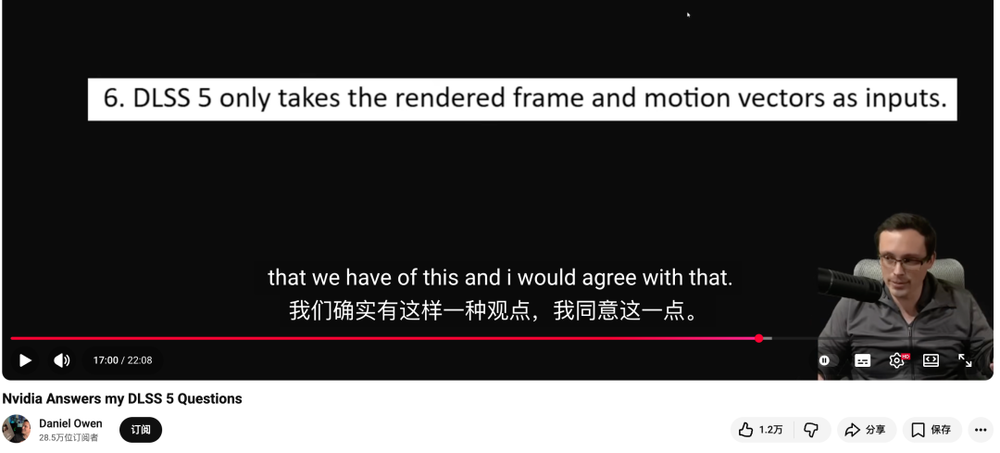
💡Nvidia admits DLSS 5 ignores 3D data—critical for game devs using AI upscaling
⚡ 30-Second TL;DR
What Changed
Inputs: single 2D rendered frame + motion vectors; no 3D geometry, depth, or PBR access.
Why It Matters
Undermines trust in Nvidia's AI rendering hype, forcing devs to test fidelity trade-offs. Limits true PBR enhancement, pushing alternatives for geometry-aware upscaling.
What To Do Next
Test DLSS 5 demo in Unreal Engine on a PBR-heavy scene to check asset alterations.
Key Points
- •Inputs: single 2D rendered frame + motion vectors; no 3D geometry, depth, or PBR access.
- •AI infers materials like hair/skin from 2D image, often altering developer assets (e.g., hair length asymmetry).
- •No developer controls beyond basic intensity/color sliders; surprises even partners like Capcom.
- •Outputs 'beautify' scenes by guessing, destroying original lighting and details.
- •Huang's GTC claims of geometry anchoring contradicted by official responses.
🧠 Deep Insight
AI-generated analysis for this event — not the original article.
🔑 Enhanced Key Takeaways
- •Industry analysts note that DLSS 5 utilizes a temporal-spatial reconstruction model that relies heavily on a proprietary 'hallucination' buffer, which prioritizes perceptual stability over pixel-perfect fidelity to the original render pipeline.
- •Internal documentation leaks suggest that Nvidia's 'Neural Geometry' marketing terminology refers to post-process mesh-edge smoothing rather than actual geometric reconstruction, leading to the reported discrepancies between developer intent and final output.
- •The controversy has triggered a pushback from game engine developers who are now demanding 'bypass' APIs to prevent AI-driven material inference from overriding physically-based rendering (PBR) shaders in competitive eSports titles.
📊 Competitor Analysis▸ Show
| Feature | Nvidia DLSS 5 | AMD FSR 4.0 | Intel XeSS 2.0 |
|---|---|---|---|
| Core Tech | AI-driven 2D reconstruction | Spatial/Temporal Upscaling | AI-enhanced reconstruction |
| Hardware Req | Proprietary Tensor Cores | Hardware Agnostic | XMX/DP4a Cores |
| Geometry Access | None (Post-process) | None | Limited (Motion Vectors) |
| Developer Control | Minimal (Intensity/Color) | High (Open Source) | Moderate (SDK access) |
🛠️ Technical Deep Dive
- •Architecture: Utilizes a multi-stage convolutional neural network (CNN) that operates exclusively in screen space on the final frame buffer.
- •Input Pipeline: Consumes color buffers, motion vectors, and jitter offsets; explicitly lacks hooks into the G-buffer or depth-stencil buffers for geometric reconstruction.
- •Inference Mechanism: Employs a pre-trained generative model that maps 2D pixel patterns to 'expected' material textures, effectively performing a style-transfer operation rather than a reconstruction operation.
- •Latency Impact: Introduces a fixed-cost overhead for the inference pass, which is independent of scene geometric complexity.
🔮 Future ImplicationsAI analysis grounded in cited sources
⏳ Timeline
Weekly AI Recap
Read this week's curated digest of top AI events →
👉Related Updates
AI-curated news aggregator. All content rights belong to original publishers.
Original source: 虎嗅 ↗
This is a summary, not the original. Read the source, or get the weekly briefing.
Weekly AI briefing
One email a week. Unsubscribe anytime.