🐯虎嗅•Stalecollected in 17m
DL Chip Guide: GPU, TPU to FPGA
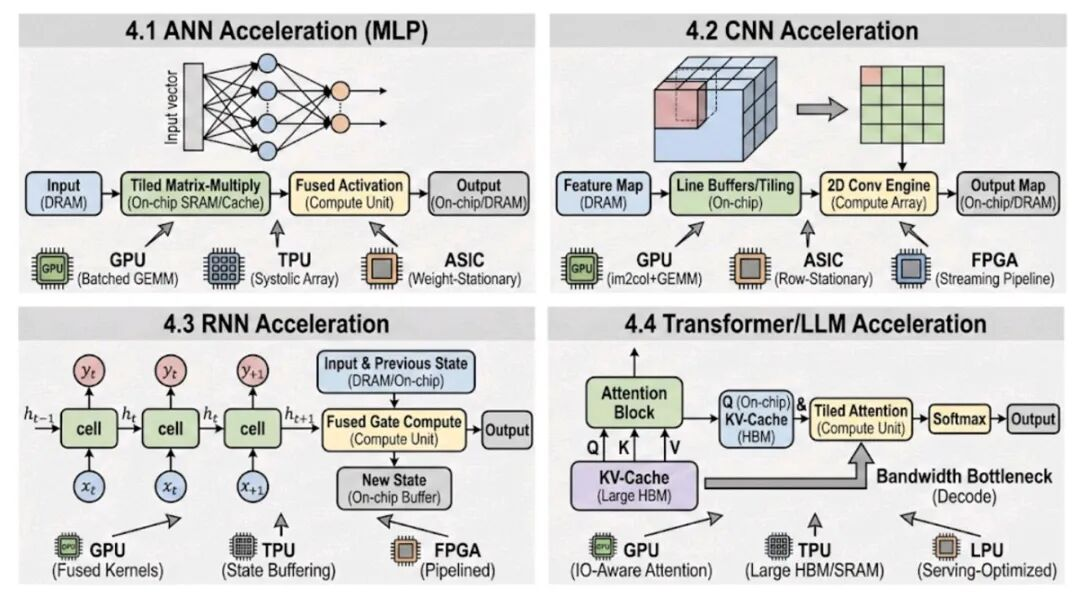
💡Master DL hardware bottlenecks—memory BW kills inference; GPU/TPU/FPGA deep dive.
⚡ 30-Second TL;DR
What Changed
Inference slowdowns stem from memory bandwidth, not compute; KV cache limits Transformers.
Why It Matters
Guides practitioners to pick accelerators matching model architecture, optimizing inference latency/cost for production AI systems.
What To Do Next
Benchmark systolic array emulation in PyTorch for your next Transformer inference optimization.
Who should care:Developers & AI Engineers
Key Points
- •Inference slowdowns stem from memory bandwidth, not compute; KV cache limits Transformers.
- •GPU ANN accel: tiling, fusion, mixed-precision (INT8 boosts 4x throughput).
- •TPU/NPU: systolic arrays for zero-overhead matrix multiply; compiler-critical.
- •FPGA: fixed-latency spatial pipelines; ASIC: wired GEMM for max efficiency.
🧠 Deep Insight
AI-generated analysis for this event.
🔑 Enhanced Key Takeaways
- •The emergence of Processing-in-Memory (PIM) and Near-Memory Computing (NMC) architectures is specifically targeting the 'memory wall' by integrating logic directly into DRAM or HBM stacks to minimize data movement energy costs.
- •Interconnect technology, such as NVLink and CXL (Compute Express Link), has become as critical as the compute silicon itself, enabling disaggregated memory pools that allow multiple GPUs to share a unified KV cache for massive Transformer models.
- •The industry is shifting toward 'domain-specific' software-defined hardware, where compilers like MLIR (Multi-Level Intermediate Representation) are increasingly responsible for mapping high-level graph operations to hardware-specific primitives, effectively abstracting the underlying silicon complexity.
🛠️ Technical Deep Dive
- •Systolic Arrays: Utilize a grid of Processing Elements (PEs) where data flows through the array in a rhythmic, pipelined fashion, minimizing register file access by reusing data across adjacent PEs.
- •KV Cache Optimization: Techniques like PagedAttention (vLLM) and Multi-Query Attention (MQA) are being implemented at the hardware-compiler interface to reduce memory fragmentation and bandwidth pressure during autoregressive decoding.
- •Mixed-Precision Arithmetic: Modern accelerators leverage FP8 (E4M3/E5M2 formats) to double throughput compared to BF16 while maintaining sufficient numerical stability for inference, often supported by hardware-level stochastic rounding.
- •FPGA Spatial Pipelines: Unlike GPUs that rely on SIMT (Single Instruction, Multiple Threads), FPGAs implement custom data-flow architectures where the hardware circuit is reconfigured to match the specific layer topology of a CNN or Transformer, achieving deterministic latency.
🔮 Future ImplicationsAI analysis grounded in cited sources
Hardware-level support for sparsity will become a standard feature in all high-end inference chips by 2027.
As model sizes grow, the energy efficiency gains from skipping zero-value computations in sparse matrices are becoming too significant for general-purpose architectures to ignore.
CXL 3.0 adoption will lead to the decline of monolithic GPU memory architectures.
The ability to pool memory across nodes via low-latency interconnects allows for scaling model capacity beyond the physical limits of a single chip's HBM capacity.
📰
Weekly AI Recap
Read this week's curated digest of top AI events →
👉Related Updates



AI-curated news aggregator. All content rights belong to original publishers.
Original source: 虎嗅 ↗