DJI Alumni Become Shenzhen’s Robotics Startup Engine

💡See why DJI alumni are attracting instant funding—and which motion-control skills transfer to embodied AI.
⚡ 30-Second TL;DR
What Changed
At least 19 to 20 DJI-affiliated startups with disclosed financing can be identified, while private early-stage deals likely make the real number higher.
Why It Matters
The article describes a repeatable embodied-AI startup pattern: experienced robotics engineers combine motion-control know-how, rapid hardware manufacturing, AI, and global distribution. This could accelerate commercialization across physical products, but aggressive pre-product valuations may also increase capital-allocation and execution risk.
What To Do Next
For your next robotics prototype, benchmark the sensor-fusion loop, motor-control latency, and battery-management stack before investing in a larger generative-AI layer.
Key Points
- •At least 19 to 20 DJI-affiliated startups with disclosed financing can be identified, while private early-stage deals likely make the real number higher.
- •Reported cumulative financing exceeded RMB 3 billion, including substantial funding for companies such as XtalPi? No—examples include Shenzhen-based robotics and hardware ventures.
- •The startups target diverse hardware categories, including 3D printers, mobile power stations, lawn robots, wheelchairs, CNC machines, and humanoid or aerial systems.
- •The transferable technical foundation is closed-loop motion control: sensors measure movement, algorithms calculate corrections, and motors apply force within milliseconds.
- •DJI’s refusal to go public and limited internal incubation channels may be pushing employees toward external entrepreneurship, while investors aggressively recruit them.
🧠 Deep Insight
Background and context from public sources — not the original article. 12 sources cited.
🔑 Enhanced Key Takeaways
- •The 'DJI Playbook' emphasizes high technical barriers and R&D-heavy models, shifting Shenzhen's hardware startup culture away from low-cost assembly toward niche, high-performance robotics.
- •The RoboMaster competition serves as a critical talent pipeline, training engineers in competitive robotics and creating a direct recruitment stream for both DJI and subsequent spin-off ventures.
- •Shenzhen's Nanshan District, often called 'Robot Valley,' provides a 24-hour rapid prototyping supply chain infrastructure that was significantly matured by DJI's operational requirements.
- •Global institutional capital from firms like HSBC, UBS, and Nomura is increasingly targeting Shenzhen's robotics sector, using DJI's market dominance as a primary proof-of-concept for investment risk assessment.
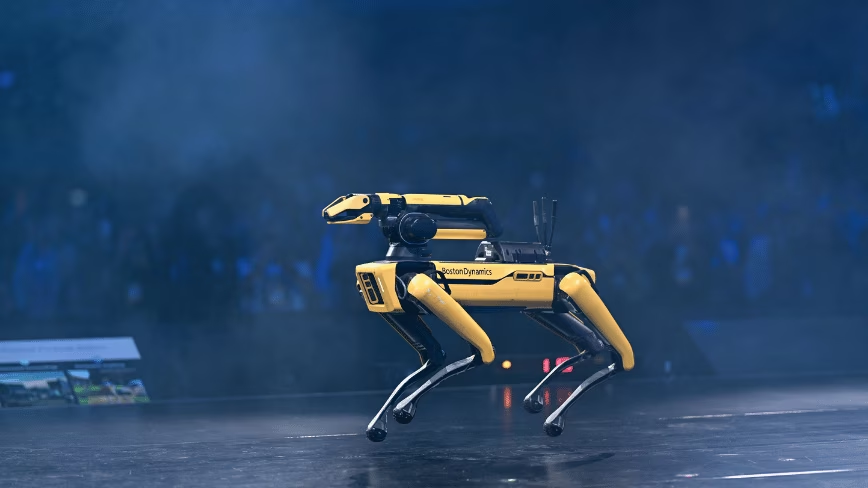
- •The ecosystem has successfully diversified into quadruped and humanoid robotics, with companies like Shenzhen Lumisition Robotics Co., Ltd. applying DJI-pioneered flight control and sensor fusion technologies to ground-based locomotion.
🛠️ Technical Deep Dive
- Core motion control architecture relies on high-frequency sensor fusion (IMU, optical flow, and LiDAR) integrated with closed-loop PID or FOC (Field Oriented Control) algorithms.
- Implementation of rapid prototyping cycles utilizes localized CNC machining and 3D printing clusters within the Nanshan district to achieve sub-24-hour iteration speeds.
- Quadrupedal locomotion systems leverage DJI-derived actuator designs, focusing on high torque-to-weight ratios and millisecond-latency feedback loops for dynamic balance.
- Software stacks often utilize modular middleware similar to ROS (Robot Operating System) but optimized for embedded ARM-based architectures to ensure real-time performance in consumer-grade hardware.
🔮 Future ImplicationsAI analysis grounded in cited sources
⏳ Timeline
📎 Sources (12)
Factual claims are grounded in the sources below. Forward-looking analysis is AI-generated interpretation.
Weekly AI Recap
Read this week's curated digest of top AI events →
👉Related Updates



AI-curated news aggregator. All content rights belong to original publishers.
Original source: 虎嗅 ↗
This is a summary, not the original. Read the source, or get the weekly briefing.
Weekly AI briefing
One email a week. Unsubscribe anytime.