Divide & Conquer: Weak Models Beat GPT-4o on Long Contexts
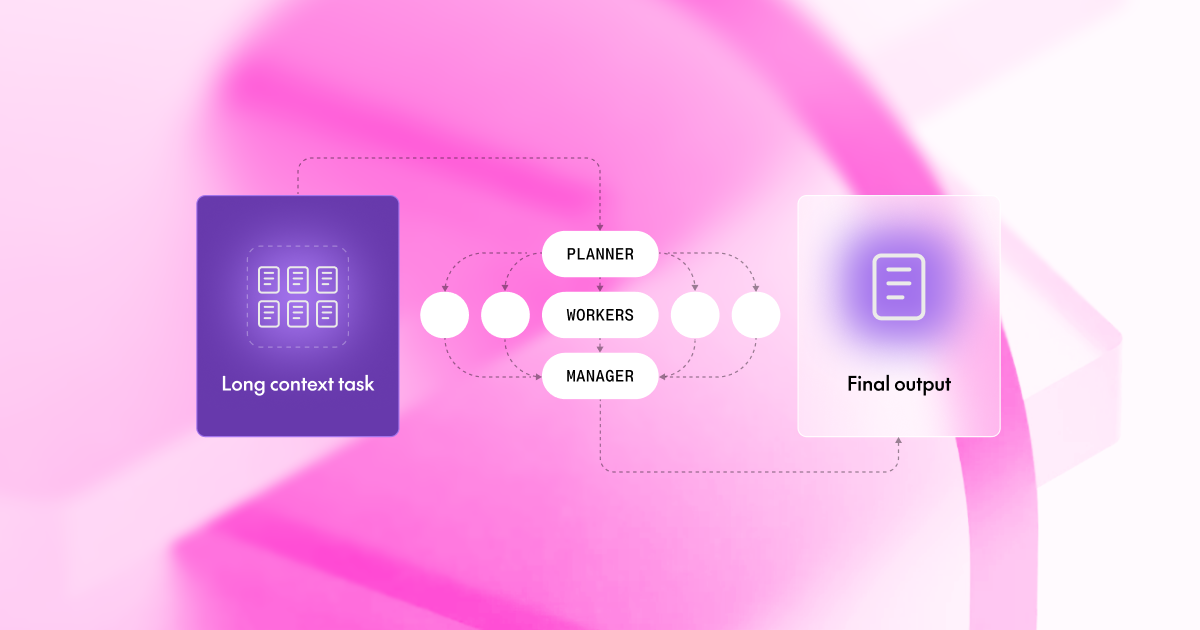
💡Small models outperform GPT-4o on long contexts via simple framework!
⚡ 30-Second TL;DR
What Changed
LLM performance degrades on growing context windows
Why It Matters
Enables cost-effective long-context processing with smaller, cheaper models instead of premium ones like GPT-4o. Reduces dependency on massive models, broadening access for AI practitioners handling documents.
What To Do Next
Implement Divide & Conquer with Llama-3-70B on your long-context document tasks.
Key Points
- •LLM performance degrades on growing context windows
- •Divide & Conquer uses planner to split tasks into parallel chunks
- •Workers process chunks; manager aggregates results
- •Llama-3-70B and Qwen-72B outperform GPT-4o on long-context tasks
🧠 Deep Insight
AI-generated analysis for this event — not the original article.
🔑 Enhanced Key Takeaways
- •The 'Divide & Conquer' framework specifically addresses the 'Lost in the Middle' phenomenon, where LLMs struggle to retrieve information located in the center of long context windows, by enforcing modular processing.
- •By utilizing smaller, specialized models for chunk processing, the framework significantly reduces inference latency and token costs compared to single-shot processing with massive frontier models.
- •The approach leverages a hierarchical agentic workflow where the 'Manager' model is fine-tuned to handle complex reasoning tasks required for synthesizing disparate information across chunks, mitigating the loss of global context.
📊 Competitor Analysis▸ Show
| Feature | Divide & Conquer (Together AI) | RAG (Standard) | Long-Context Native Models (e.g., Gemini 1.5 Pro) |
|---|---|---|---|
| Architecture | Hierarchical Agentic | Retrieval-Augmented | Monolithic Context Window |
| Latency | Low (Parallelized) | Medium (Retrieval overhead) | High (KV Cache growth) |
| Cost | Optimized (Smaller models) | Variable | High (Input token volume) |
| Accuracy | High (Task-specific) | Variable (Retrieval dependent) | High (Recall dependent) |
🛠️ Technical Deep Dive
- •Planner Module: Utilizes a lightweight model to decompose the user prompt into sub-queries or sub-tasks based on document structure.
- •Worker Parallelism: Distributes document chunks across multiple worker instances, allowing for simultaneous processing of independent segments.
- •Manager Aggregator: Employs a reasoning-capable model to perform a 'Map-Reduce' style aggregation, resolving cross-chunk dependencies and contradictions.
- •Context Window Management: Effectively bypasses the KV-cache bottleneck of monolithic models by keeping individual chunk sizes within the optimal performance range of the worker models.
🔮 Future ImplicationsAI analysis grounded in cited sources
⏳ Timeline
Weekly AI Recap
Read this week's curated digest of top AI events →
👉Related Updates
AI-curated news aggregator. All content rights belong to original publishers.
Original source: Together AI Blog ↗
This is a summary, not the original. Read the source, or get the weekly briefing.
The weekly digest
One email a week. Unsubscribe anytime.