DiDi Rebrands and Launches AI-Integrated App 8.0
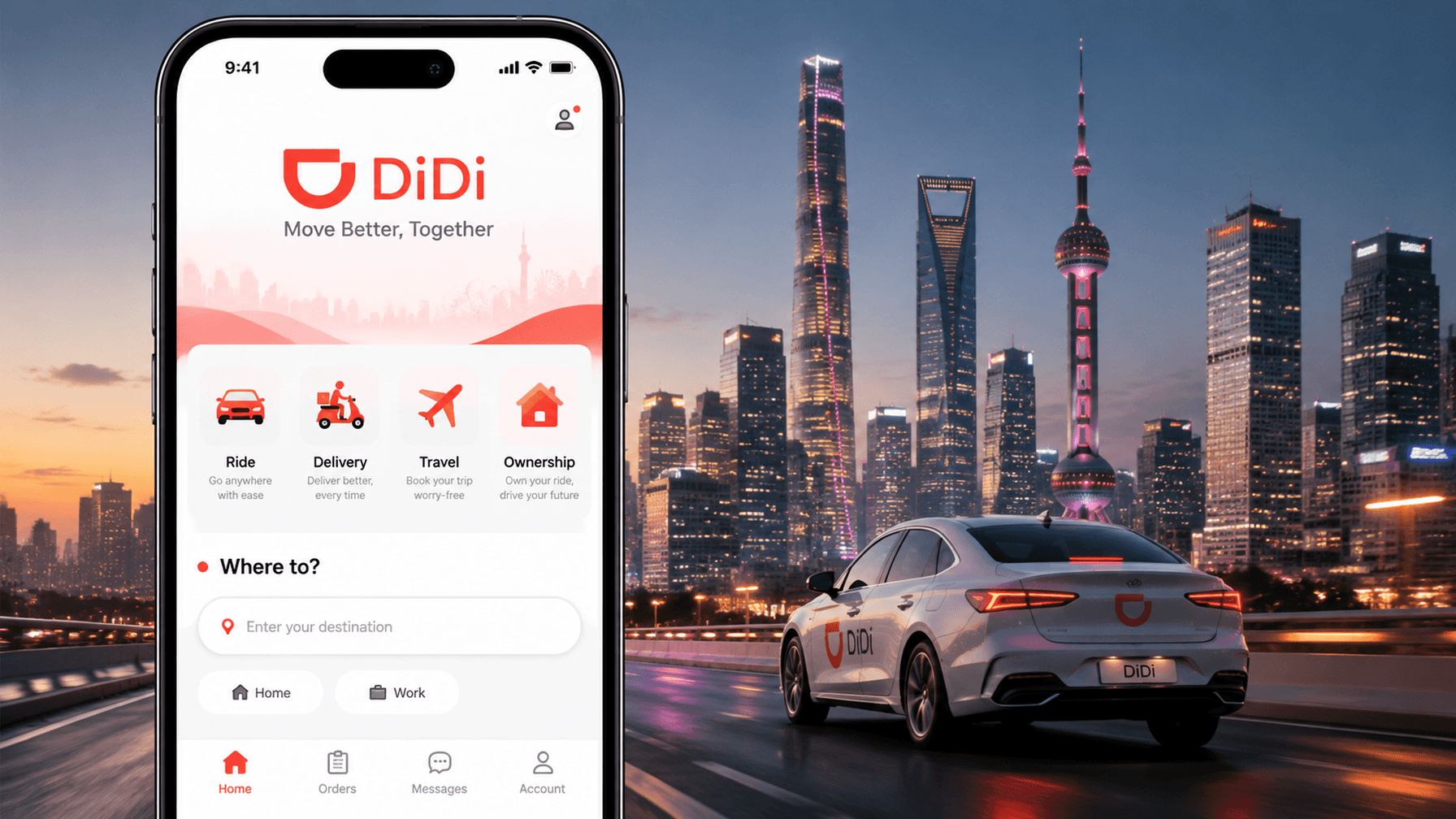
💡See how a major ride-hailing giant is pivoting its strategy by embedding AI into a massive super-app ecosystem.
⚡ 30-Second TL;DR
What Changed
Removed 'Chuxing' from the brand name to reflect platform expansion
Why It Matters
The integration with WeChat's AI ecosystem signals a shift toward more intelligent, conversational user interfaces in ride-hailing. This move forces competitors to accelerate their own AI-driven platform service integrations.
What To Do Next
Analyze the WeChat AI integration patterns to understand how to leverage existing super-app ecosystems for your own service distribution.
Key Points
- •Removed 'Chuxing' from the brand name to reflect platform expansion
- •Launched App 8.0 featuring a new four-pillar organizational structure
- •Integrated platform services with the WeChat AI ecosystem
🧠 Deep Insight
Background and context from public sources — not the original article. 15 sources cited.
🔑 Enhanced Key Takeaways
- •The rebranding from 'DiDi Chuxing' to 'DiDi' and the App 8.0 launch signify a strategic shift from a pure ride-hailing service to a comprehensive 'super app' or 'all-in-one lifestyle service platform' encompassing mobility, food delivery, logistics, and financial services.
- •App 8.0 introduces a redesigned interface with new top navigation tabs for 'Delivery,' 'Travel,' and 'Driver,' alongside the existing 'Ride' tab, and new bottom navigation for 'Messages' and 'Trips,' streamlining access to its expanded service offerings.
- •The deep integration with the WeChat AI ecosystem, powered by Tencent's Hunyuan large model and DiDi's own big data, enables natural language commands within WeChat for ride requests, eliminating the need to open the DiDi app.
- •DiDi's AI assistant, 'Xiao Di,' leverages generative AI to interpret and fulfill over 90 specific user preferences expressed in natural language, such as requesting vehicles with large trunks or drivers known for smooth driving, enhancing personalized service and customer satisfaction.
- •DiDi's international operations, particularly in Latin America (Brazil and Mexico), are emerging as a significant growth engine, with substantial market share in mobility and expanding into food delivery and financial services, often through localized brands like 99.
🛠️ Technical Deep Dive
- The WeChat AI integration is a result of deep collaboration between Tencent's Hunyuan large model and DiDi's proprietary big data and capacity scheduling technology.
- DiDi's AI assistant, 'Xiao Di,' utilizes generative AI to process and translate over 90 distinct service attributes from natural language user requests into concrete matching criteria for driver allocation.
- DiDi operates AI Labs in Beijing (established 2017) and Mountain View, California (established 2018), focusing on AI-based security, intelligent driving technologies, natural language processing, computer vision, deep learning, and operations research.
- The 'DiDi Smart Transportation Brain,' launched in 2018, is an AI-powered solution that uses real-time data from DiDi vehicles, government sources, and partners to optimize urban traffic management, including dynamically adjusting traffic light timings.
- DiDi's autonomous driving unit is actively deploying Level 4 robotaxis, with a fleet exceeding 500 vehicles in cities like Shanghai and Guangzhou by 2025.
- The DiDi Gemini platform, launched in 2025, is a proprietary hardware system for autonomous vehicles, integrating 50 sensors and redundant computing capabilities to support complex urban autonomy.
- The autonomous driving AI operates on a multi-layered system comprising perception (using cameras, radar, lidar for 3D mapping and object identification), prediction (anticipating other road users' behavior), and control (translating decisions into vehicle actions).
🔮 Future ImplicationsAI analysis grounded in cited sources
⏳ Timeline
📎 Sources (15)
Factual claims are grounded in the sources below. Forward-looking analysis is AI-generated interpretation.
Weekly AI Recap
Read this week's curated digest of top AI events →
👉Related Updates
AI-curated news aggregator. All content rights belong to original publishers.
Original source: Pandaily ↗
This is a summary, not the original. Read the source, or get the weekly briefing.
The weekly digest
One email a week. Unsubscribe anytime.