DeepSeek V4 Flash Resets the AI API Price Floor
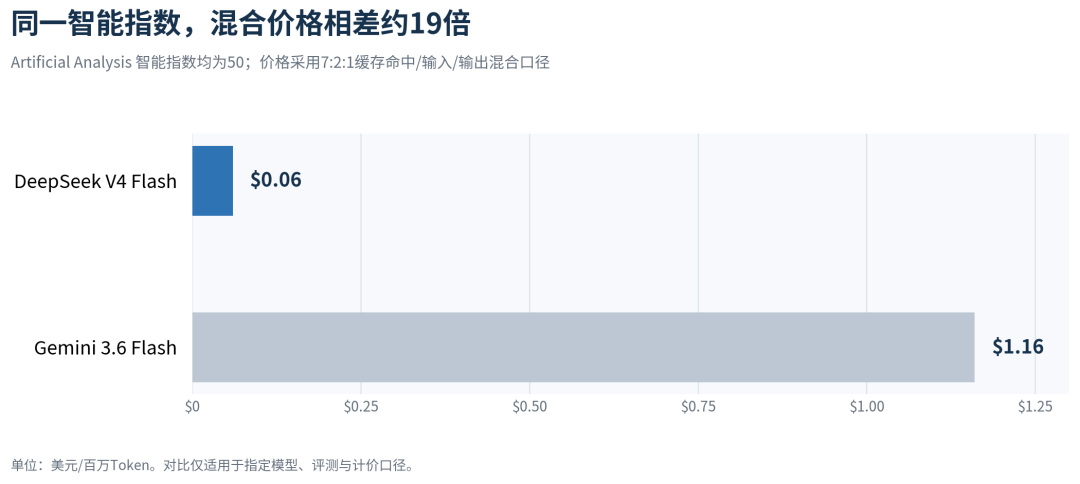
DeepSeek’s equal-score, 19x-cheaper API could reshape every AI product’s unit economics.
30-Second TL;DR
What Changed
DeepSeek V4 Flash API pricing is RMB 0.02 per million cached input tokens, RMB 1 per million uncached input tokens, and RMB 2 per million output tokens.
Why It Matters
The launch could materially lower inference budgets for agent and software products, while forcing competing providers to justify premium pricing with better reliability, latency, tool use, or domain performance. Model startups may need differentiated applications, proprietary data, or high switching costs rather than competing on raw benchmark scores alone.
What To Do Next
Run a cost-and-quality bake-off by routing a representative agent workload through DeepSeek V4 Flash’s OpenAI-compatible API and your current model, measuring total task cost, retries, latency, and success rate.
Key Points
- •DeepSeek V4 Flash API pricing is RMB 0.02 per million cached input tokens, RMB 1 per million uncached input tokens, and RMB 2 per million output tokens.
- •Artificial Analysis gave DeepSeek V4 Flash and Gemini 3.6 Flash the same intelligence score of 50, while estimating a roughly 19-fold price gap under a mixed-usage model.
- •The article defines the “DeepSeek kill line” as the point where a model loses scalable demand if it is more expensive without delivering proportionally greater capability.
- •Frontier-model training costs are rising rapidly, while model convergence, open weights, and standardized APIs weaken pricing power and increase customer portability.
Deep Insight
AI-generated analysis for this event — not the original article.
Enhanced Key Takeaways
- •DeepSeek V4 Flash utilizes a proprietary 'DeepSeek-MoE' architecture that optimizes compute utilization by activating only a fraction of total parameters per token, significantly reducing inference latency.
- •The aggressive pricing strategy is supported by DeepSeek's internal 'HCP' (High-Efficiency Compute Platform) which reportedly achieves 40% higher hardware utilization rates compared to standard industry clusters.
- •Market analysts note that DeepSeek's pricing model has forced major cloud providers to introduce 'pre-emptible' or 'spot' API tiers to compete with the V4 Flash cost structure.
- •DeepSeek V4 Flash incorporates a novel 'Context-Aware Caching' mechanism that allows developers to store frequently used system prompts at a fraction of the standard input token cost, further driving down long-context application expenses.
- •The 'DeepSeek kill line' has triggered a shift in venture capital investment, with firms now prioritizing 'inference-optimized' startups over those relying on general-purpose frontier models.
Competitor Analysis
- DeepSeek V4 Flash
- RMB 1.00
- Gemini 3.6 Flash
- ~RMB 19.00
- GPT-4o-mini
- ~RMB 15.00
- DeepSeek V4 Flash
- 50
- Gemini 3.6 Flash
- 50
- GPT-4o-mini
- 48
- DeepSeek V4 Flash
- MoE (Sparse)
- Gemini 3.6 Flash
- Dense/Hybrid
- GPT-4o-mini
- Dense
- DeepSeek V4 Flash
- Cost/Efficiency
- Gemini 3.6 Flash
- Ecosystem/Multimodal
- GPT-4o-mini
- Latency/Reliability
| Feature | DeepSeek V4 Flash | Gemini 3.6 Flash | GPT-4o-mini |
|---|---|---|---|
| Input Price (per 1M) | RMB 1.00 | ~RMB 19.00 | ~RMB 15.00 |
| Intelligence Score | 50 | 50 | 48 |
| Architecture | MoE (Sparse) | Dense/Hybrid | Dense |
| Primary Advantage | Cost/Efficiency | Ecosystem/Multimodal | Latency/Reliability |
Technical Deep Dive
- Architecture: Employs a Mixture-of-Experts (MoE) framework with fine-grained expert granularity to balance parameter count and active compute.
- Quantization: Supports native FP8 inference, which reduces memory bandwidth requirements and allows for higher throughput on H100/B200 hardware.
- KV Cache Optimization: Implements Multi-Head Latent Attention (MLA) to drastically reduce the memory footprint of the Key-Value cache during long-context generation.
- Training Infrastructure: Utilizes a custom-built communication library that optimizes All-to-All collective operations across high-speed interconnects.
Future ImplicationsAI analysis grounded in cited sources
Timeline
- 2024-01DeepSeek releases its first open-weights model, signaling a shift toward high-performance, low-cost accessibility.
- 2024-12DeepSeek V3 launch introduces significant efficiency gains in MoE training and inference.
- 2026-06DeepSeek V4 Flash enters public beta, establishing the new industry price floor for API tokens.
Weekly AI Recap
Read this week's curated digest of top AI events →
AI-curated news aggregator. All content rights belong to original publishers.
Original source: 虎嗅 ↗
This is a summary, not the original. Read the source, or get the weekly briefing.
The weekly digest
One email a week. Unsubscribe anytime.