DeepSeek tops global usage rankings

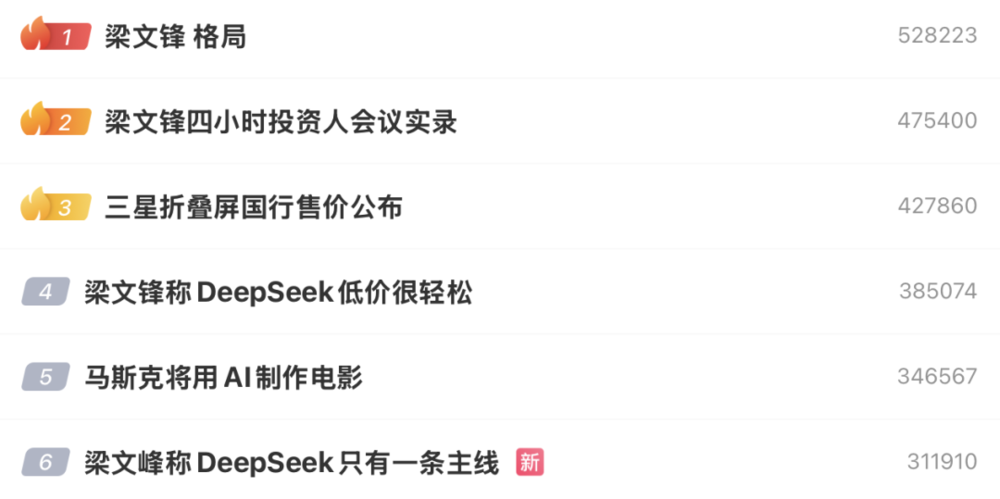
💡DeepSeek tops global usage charts, signaling a major shift in AI model adoption and developer preference.
⚡ 30-Second TL;DR
What Changed
DeepSeek secures the number one spot on global AI model usage charts
Why It Matters
DeepSeek's dominance suggests a market shift toward models that offer superior performance-to-cost ratios, challenging established incumbents. For practitioners, this validates the viability of integrating alternative, high-efficiency models into production workflows.
What To Do Next
Evaluate DeepSeek's API performance against your current model provider to determine if you can reduce inference costs without sacrificing output quality.
Key Points
- •DeepSeek secures the number one spot on global AI model usage charts
- •The platform's rapid growth reflects high developer demand for cost-effective, high-performance LLMs
- •Huawei is developing new chip strategies for future Mate 90 integration
- •Unitree Robotics reaches a valuation of 42 billion RMB in latest funding round
🧠 Deep Insight
Web-grounded analysis with 23 cited sources.
🔑 Enhanced Key Takeaways
- •DeepSeek's V4 Pro model has achieved top rankings for "intelligence-per-dollar" due to a permanent 75% price cut, making it significantly more cost-efficient than OpenAI's GPT-5.5 and Anthropic's Claude Opus 4.7.
- •DeepSeek's models, particularly V3 and R1, leverage a Mixture-of-Experts (MoE) architecture, activating only a subset of its 671 billion total parameters (around 37 billion) per token, which contributes to its efficiency and lower training costs.
- •DeepSeek's training cost for its V3 model was reportedly around $5.5 million, significantly less than the estimated $100 million for OpenAI's GPT-4, demonstrating a highly cost-effective approach to developing high-performance LLMs.
- •DeepSeek's mobile app, based on the DeepSeek-R1 model, surpassed ChatGPT as the most downloaded freeware app on the iOS App Store in the United States by January 26, 2025.
- •DeepSeek's V4 models offer a 1M-token context window and 384K max output tokens, a major expansion from previous versions, with automatic context caching to reduce costs for repeated prompts.
📊 Competitor Analysis▸ Show
| Feature/Model | DeepSeek V4 Flash | DeepSeek V4 Pro | OpenAI GPT-5.5 (estimated) | Anthropic Claude Opus 4.7 (estimated) | Google Gemini (general) | Alibaba Qwen3-235B-A22B (open-source) |
|---|---|---|---|---|---|---|
| API Pricing (per 1M tokens) | Input: $0.14 (cache miss), Output: $0.28 | Input: $1.74 (cache miss), Output: $3.48 (promo) | Input: ~$1.25, Output: ~$10 | Input: ~$3, Output: ~$15 | Primarily free/integrated, low revenue per user | N/A (open-source, self-hostable) |
| Context Window | 1M tokens | 1M tokens | N/A (typically large) | N/A (typically large) | Up to 1M tokens (Gemini 3 Pro) | N/A (varies by model) |
| Max Output Tokens | 384K tokens | 384K tokens | N/A | N/A | N/A | N/A |
| Intelligence Index Cost | N/A | $268 | ~$3,216 (12x DeepSeek V4 Pro) | ~$5,092 (19x DeepSeek V4 Pro) | N/A | N/A |
| HumanEval (Coding) | N/A | N/A | N/A | N/A | N/A | N/A |
| MMLU-Pro | N/A | N/A | Beats DeepSeek V3 (78%) | Outperformed by DeepSeek V3 (88.5%) | N/A | 80.6% |
| LiveCodeBench | N/A | N/A | N/A | N/A | N/A | 69.5% |
| Best For | High-volume production, general tasks, most coding | Flagship reasoning, complex coding, agentic workflows | General-purpose, broad applications | High-end professional market | Productivity, search, generative AI integration | Coding, general knowledge, balanced/efficient |
| Market Share (Feb 2026) | N/A | N/A | 60.5% (ChatGPT) | N/A (Anthropic revenue share 31.4% Q1 2026) | 23.9% | 3.6% (developer usage) |
🛠️ Technical Deep Dive
- Mixture-of-Experts (MoE) Architecture: DeepSeek-V3 and R1 utilize an MoE framework with 671 billion total parameters, but only approximately 37 billion are activated per token during a single forward pass, significantly reducing computational overhead and enhancing efficiency.
- Multi-head Latent Attention (MLA): This innovation, present in DeepSeek-V2 and V3, replaces traditional attention mechanisms by compressing Key (K) and Value (V) matrices into a latent vector, improving inference efficiency by reducing the need to re-compute attention from scratch.
- DeepSeekMoE: A component designed to facilitate economical training through sparse computation, validated in DeepSeek-V2 and V3.
- Manifold-constrained Hyper-connections (mHC): Introduced in DeepSeek V4, these new connections link layers in a way that helps the model maintain context across extremely long codebases or documents, reducing the number of parameters required for long-range dependencies.
- Extended Context Window: DeepSeek V4 models feature a 1M-token context window and a unified 384K max output tokens across all modes, a substantial increase from previous versions like V3.2's 128K context window.
- Training Data and Efficiency: DeepSeek-V3 was pre-trained on a massive dataset of 14.8 trillion tokens, with a composition of 87% code and 13% natural language. The models are noted for achieving high performance with significantly fewer GPU-hours (e.g., 2.8 million GPU-hours for DeepSeek LLM) compared to competitors.
- FP8 Precision Training: DeepSeek V3 leverages FP8 precision for training, allowing it to utilize scaling laws more aggressively despite compute limitations.
- Multi-Token Prediction (MTP) Objective: DeepSeek-V3 employs an MTP training objective, which has been observed to enhance overall performance on evaluation benchmarks.
- DeepSeek Sparse Attention (DSA): DeepSeek-V3.2 introduces DSA for efficient long-context processing.
🔮 Future ImplicationsAI analysis grounded in cited sources
⏳ Timeline
📎 Sources (23)
Factual claims are grounded in the sources below. Forward-looking analysis is AI-generated interpretation.
Weekly AI Recap
Read this week's curated digest of top AI events →
👉Related Updates
AI-curated news aggregator. All content rights belong to original publishers.
Original source: Ifanr (爱范儿) ↗