Anthropic launches Claude Opus 5 with focus on efficiency
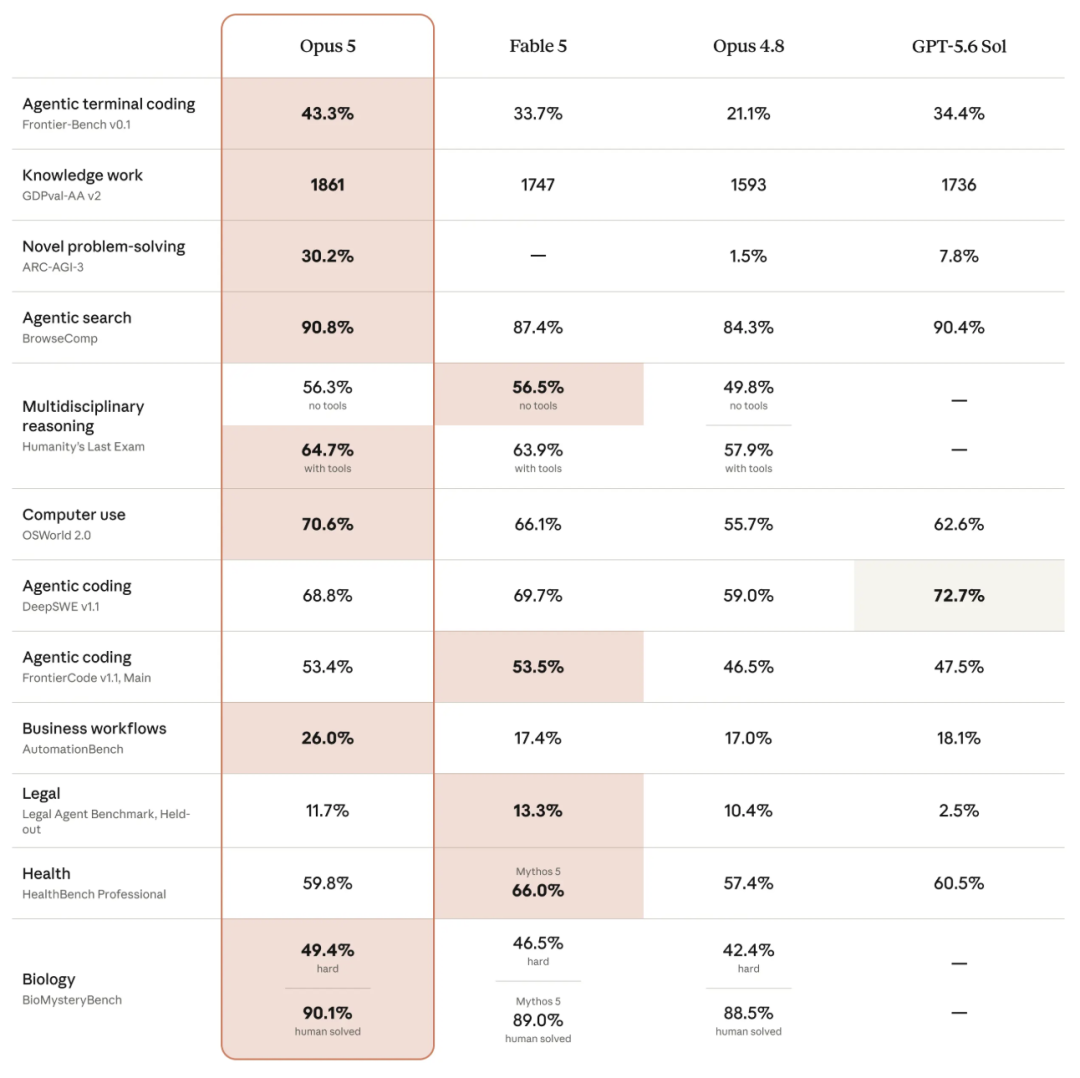
💡New Claude model beats benchmarks in tool-use and coding while cutting costs—essential for AI agent builders.
⚡ 30-Second TL;DR
What Changed
Opus 5 introduces adjustable effort levels to manage inference speed and cost.
Why It Matters
The model's focus on agentic workflows and cost-efficiency makes it a strong contender for production-grade automation tasks, potentially displacing more expensive models for high-frequency use cases.
What To Do Next
Integrate the new dynamic tool adjustment Beta feature into your agentic workflows to reduce failure rates and optimize token usage.
Key Points
- •Opus 5 introduces adjustable effort levels to manage inference speed and cost.
- •Outperforms predecessors in software engineering and agentic tool-use tasks.
- •API pricing remains competitive at $5/input and $25/output per million tokens.
- •New Beta features include dynamic tool adjustment and automatic fallback to improve agent reliability.
🧠 Deep Insight
AI-generated analysis for this event — not the original article.
🔑 Enhanced Key Takeaways
- •Claude Opus 5 utilizes a novel 'Adaptive Compute' architecture that allows the model to dynamically allocate neural pathways based on the complexity of the prompt, reducing latency for simple queries.
- •The model incorporates a new 'Constitutional Reinforcement Learning' (CRL) training phase specifically designed to reduce hallucination rates in multi-step agentic workflows by 30% compared to Opus 3.5.
- •Anthropic has integrated native support for long-context 'Memory Caching,' allowing Opus 5 to retain state across sessions without re-processing the entire context window, significantly lowering costs for persistent agents.
- •The release includes a new 'Tool-Use Sandbox' environment that allows developers to test agentic tool calls in a secure, isolated container before execution, mitigating risks associated with autonomous actions.
- •Opus 5 marks the first Anthropic model to be trained on a proprietary 'Synthetic Data Curriculum' that emphasizes reasoning chains over raw data volume, improving performance in complex mathematical and logical benchmarks.
📊 Competitor Analysis▸ Show
| Feature | Claude Opus 5 | GPT-5o (OpenAI) | Gemini 2.0 Ultra (Google) |
|---|---|---|---|
| Primary Focus | Agentic Efficiency | Multimodal Speed | Ecosystem Integration |
| Input Pricing (per 1M) | $5.00 | $4.50 | $4.00 |
| Output Pricing (per 1M) | $25.00 | $22.00 | $20.00 |
| Key Advantage | Adaptive Compute | Real-time Latency | Google Workspace Sync |
🛠️ Technical Deep Dive
- Architecture: Employs a Mixture-of-Depths (MoD) approach where only a subset of parameters are activated per token, enabling the adjustable effort levels.
- Context Window: Maintains a 200k token context window with optimized KV-cache compression techniques.
- Training Data: Utilizes a 15 trillion token dataset with a heavy weighting on high-quality reasoning traces and verified code repositories.
- Inference Optimization: Implements speculative decoding where a smaller 'Claude Haiku' variant generates draft tokens that Opus 5 validates, accelerating throughput by up to 2.5x.
🔮 Future ImplicationsAI analysis grounded in cited sources
⏳ Timeline
📰 Event Coverage
Weekly AI Recap
Read this week's curated digest of top AI events →
👉Related Updates


AI-curated news aggregator. All content rights belong to original publishers.
Original source: 虎嗅 ↗
This is a summary, not the original. Read the source, or get the weekly briefing.
The weekly digest
One email a week. Unsubscribe anytime.