DeepSeek Raises Billions and Enters Robotics
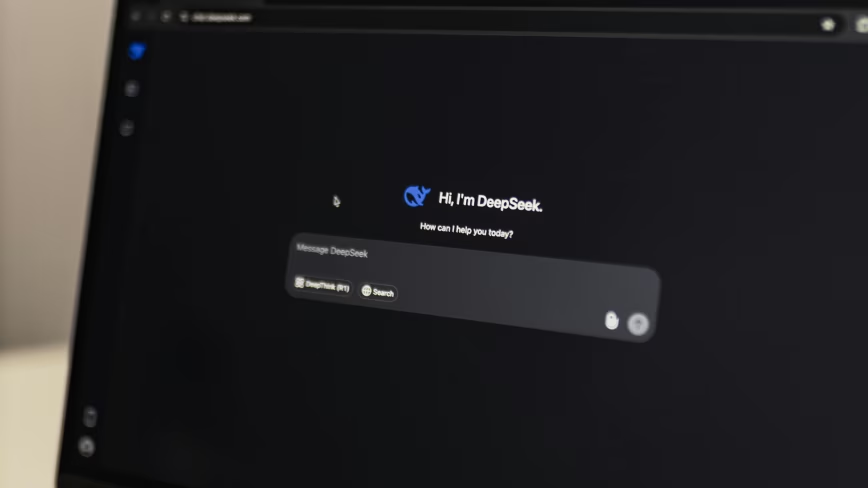
DeepSeek is moving from cheap AI models into billion-dollar funding and robotics.
30-Second TL;DR
What Changed
DeepSeek has reopened a multibillion-dollar fundraising effort.
Why It Matters
A major fundraising round could give DeepSeek more resources to compete in frontier AI and robotics. Its move into robotics may also accelerate the integration of foundation models with physical systems.
What To Do Next
Evaluate whether DeepSeek’s available models and APIs can support your workload before committing to a new model vendor.
Key Points
- •DeepSeek has reopened a multibillion-dollar fundraising effort.
- •The lab has taken a stake in China’s best-known robot maker.
- •Its strategy is expanding from cost-efficient AI models toward robotics and embodied AI.
Deep Insight
AI-generated analysis for this event — not the original article.
Enhanced Key Takeaways
- •DeepSeek's cost-efficiency model relies on a proprietary Mixture-of-Experts (MoE) architecture that significantly reduces FLOPs required for training compared to dense models.
- •The robotics investment is specifically targeted at integrating DeepSeek's reasoning models into humanoid hardware to solve complex manipulation tasks in unstructured environments.
- •The fundraising round is reportedly aimed at securing high-end GPU clusters, specifically targeting H100/H200 equivalents despite ongoing export restrictions.
- •DeepSeek has been actively recruiting top-tier talent from Chinese academic institutions and former employees of major US-based AI labs to bolster its embodied AI division.
- •The company's shift toward robotics is part of a broader Chinese state-backed initiative to achieve self-sufficiency in the 'AI+Robotics' industrial stack.
Competitor Analysis
- DeepSeek (Embodied)
- MoE / Efficient Reasoning
- Tesla (Optimus)
- End-to-End Neural Net
- Figure AI
- Multimodal Transformer
- OpenAI (Partnerships)
- Large Foundation Models
- DeepSeek (Embodied)
- Strategic Stake/Partnership
- Tesla (Optimus)
- Vertical Integration
- Figure AI
- Proprietary Hardware
- OpenAI (Partnerships)
- Hardware Agnostic
- DeepSeek (Embodied)
- High Efficiency/Low Cost
- Tesla (Optimus)
- High R&D/Capital Intensive
- Figure AI
- High R&D/Capital Intensive
- OpenAI (Partnerships)
- High Inference Cost
| Feature | DeepSeek (Embodied) | Tesla (Optimus) | Figure AI | OpenAI (Partnerships) |
|---|---|---|---|---|
| Model Architecture | MoE / Efficient Reasoning | End-to-End Neural Net | Multimodal Transformer | Large Foundation Models |
| Hardware Strategy | Strategic Stake/Partnership | Vertical Integration | Proprietary Hardware | Hardware Agnostic |
| Cost Profile | High Efficiency/Low Cost | High R&D/Capital Intensive | High R&D/Capital Intensive | High Inference Cost |
Technical Deep Dive
- DeepSeek utilizes a Multi-head Latent Attention (MLA) mechanism which drastically reduces KV cache memory usage during inference.
- The embodied AI stack leverages DeepSeek-V3/R1 reasoning capabilities to perform hierarchical task planning for robotic actuators.
- Implementation involves a simulation-to-reality (Sim2Real) pipeline using NVIDIA Isaac Gym for training policies before deployment on physical hardware.
- The architecture supports dynamic computation, allowing the model to allocate more parameters to complex reasoning tasks while keeping simple motor control tasks lightweight.
Future ImplicationsAI analysis grounded in cited sources
Timeline
- 2023-04DeepSeek officially launches as a research-focused AI lab in China.
- 2024-01Release of DeepSeek-V2, showcasing significant cost-per-token reductions.
- 2025-01DeepSeek-R1 is released, demonstrating advanced reasoning capabilities via reinforcement learning.
- 2026-05DeepSeek announces initial research into embodied AI and robotic control systems.
- 2026-08DeepSeek secures stake in major robotics manufacturer and initiates new funding round.
Weekly AI Recap
Read this week's curated digest of top AI events →
Related Updates

AI-curated news aggregator. All content rights belong to original publishers.
Original source: The Next Web (TNW) ↗
This is a summary, not the original. Read the source, or get the weekly briefing.
The weekly digest
One email a week. Unsubscribe anytime.