DeepSeek Pricing Resets the AI Race
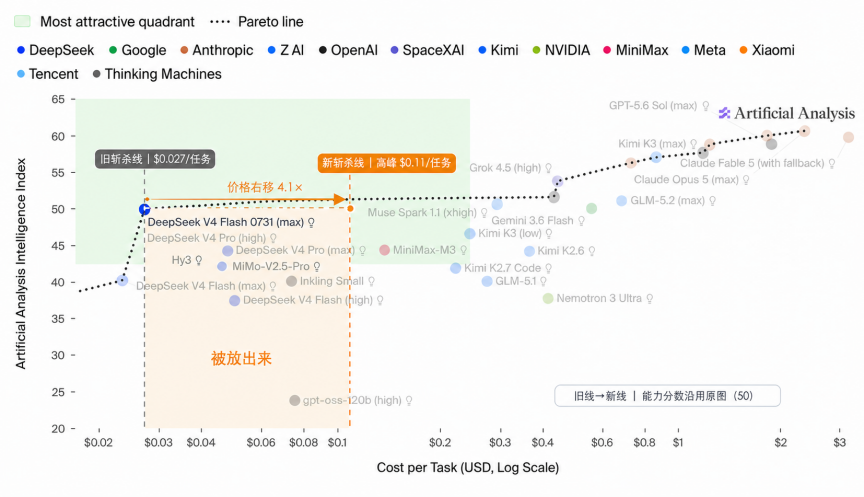
💡DeepSeek’s price move could change which models are economically viable for your next AI product.
⚡ 30-Second TL;DR
What Changed
DeepSeek’s pricing change is the article’s central event.
Why It Matters
Lower model pricing can pressure competitors’ margins and accelerate adoption by developers and startups. Teams choosing a model provider may need to reassess total inference cost, quality, and switching risk.
What To Do Next
Benchmark your current production workload against the latest DeepSeek API pricing using identical prompts, token volumes, latency targets, and quality checks.
Key Points
- •DeepSeek’s pricing change is the article’s central event.
- •The adjustment may reset cost expectations across the large-model market.
- •The analysis asks which providers can survive the new competitive threshold.
🧠 Deep Insight
Background and context from public sources — not the original article. 13 sources cited.
🔑 Enhanced Key Takeaways
- •DeepSeek transitioned from a flat-rate pricing model to a demand-based, dual-tier system featuring peak and off-peak billing cycles.
- •The August 2026 update effectively reversed a permanent 75% price reduction implemented by the company just three months prior in May 2026.
- •API costs for flagship models like V4-Pro and V4-Flash saw increases exceeding 4x, with peak-hour output costs reaching $3.96 per million tokens for V4-Pro.
- •The cost of cache hits, previously a primary competitive differentiator for DeepSeek, experienced a significant surge with some tiers rising by over 1,000%.
- •Regulatory pressure regarding 'involution'—destructive, unsustainable market competition—from Chinese authorities is cited as a potential catalyst for this industry-wide shift toward rationalized pricing.
📊 Competitor Analysis▸ Show
| Feature | DeepSeek (V4-Pro) | OpenAI (GPT-5.6 Sol) | Anthropic (Claude Opus 5) |
|---|---|---|---|
| Peak Output Price | $3.96 / 1M tokens | Significantly Higher | Significantly Higher |
| Off-Peak Output Price | $1.98 / 1M tokens | N/A | N/A |
| Pricing Strategy | Demand-based/Tiered | Premium/Fixed | Premium/Fixed |
🛠️ Technical Deep Dive
- Implementation of time-of-use (TOU) billing logic based on UTC windows (01:00–04:00 and 06:00–10:00).
- Shift from loss-leader infrastructure utilization to capacity-constrained resource allocation.
- Optimization of cache hit pricing to reflect actual hardware memory overhead rather than subsidized acquisition costs.
🔮 Future ImplicationsAI analysis grounded in cited sources
⏳ Timeline
📎 Sources (13)
Factual claims are grounded in the sources below. Forward-looking analysis is AI-generated interpretation.
Weekly AI Recap
Read this week's curated digest of top AI events →
👉Related Updates


AI-curated news aggregator. All content rights belong to original publishers.
Original source: 钛媒体 ↗
This is a summary, not the original. Read the source, or get the weekly briefing.
Weekly AI briefing
One email a week. Unsubscribe anytime.