DeepSeek Harness Bets on Self-Modifying Agents
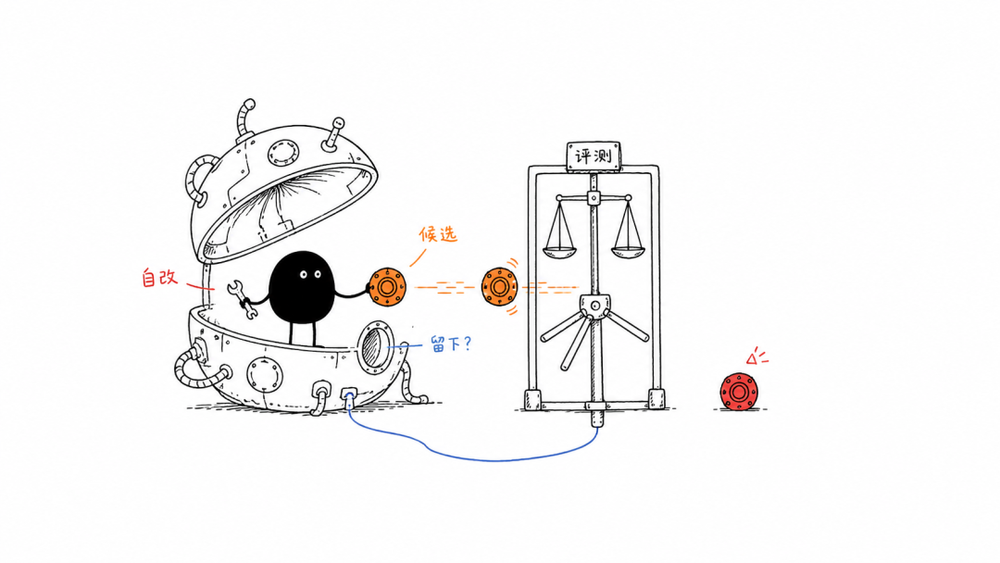
💡DeepSeek Harness turns plugins into runtime objects that agents may eventually inspect and modify themselves.
⚡ 30-Second TL;DR
What Changed
DeepSeek Harness places core runtime capabilities—including models, tools, memory, scheduling, UI, and agent loops—behind replaceable plugin interfaces.
Why It Matters
If the architecture matures, agent developers could build systems that adapt their tools, memory, or control loops in response to task failures. However, self-modification also expands the attack surface and makes rollback, permissioning, observability, and invariant enforcement critical design requirements.
What To Do Next
Clone the DeepSeek Harness repository and test its self-modification example inside an isolated sandbox with explicit plugin permissions and rollback checks.
Key Points
- •DeepSeek Harness places core runtime capabilities—including models, tools, memory, scheduling, UI, and agent loops—behind replaceable plugin interfaces.
- •Its self-modification capability lets an agent inspect its runtime and mount or unmount plugins, with a repository example showing an agent modifying its own runtime.
- •Cordis provides a formal model for reversible effects, dependency management, and composable dynamic loading, but its guarantees depend on assumptions that real-world plugins may violate.
- •The project is still in developer preview, so plugin seams, event persistence, third-party configuration, and operational safety are not yet fully validated.
🧠 Deep Insight
AI-generated analysis for this event.
🔑 Enhanced Key Takeaways
- •DeepSeek Harness leverages the Cordis framework to implement a 'runtime-as-code' paradigm, allowing agents to treat their own execution environment as a mutable data structure.
- •The architecture utilizes a capability-based security model where plugins are isolated via sandboxed environments, though the self-modification feature introduces potential 'jailbreak' vectors if not strictly governed.
- •The project integrates with DeepSeek's proprietary model API endpoints while maintaining an agnostic interface layer to support third-party LLMs via standardized adapter patterns.
- •Development focus has shifted toward 'state-persistence-as-a-service,' enabling agents to pause, serialize, and resume complex multi-step reasoning chains across different hardware nodes.
- •The developer preview includes a specialized 'Observability Plugin' that logs self-modification events, allowing developers to audit how an agent alters its own toolset during runtime.
📊 Competitor Analysis▸ Show
| Feature | DeepSeek Harness | LangGraph (LangChain) | AutoGen (Microsoft) |
|---|---|---|---|
| Self-Modification | Native/First-class | Limited/Manual | Via Orchestrator |
| Plugin Architecture | Modular/Dynamic | Component-based | Task-based |
| Primary Focus | Runtime Mutability | Graph-based Workflows | Multi-Agent Collaboration |
| Pricing | Open Source (MIT/Apache) | Open Source | Open Source |
🛠️ Technical Deep Dive
- Runtime Architecture: Built on a plugin-host pattern where the core loop communicates with plugins via a gRPC-like interface to ensure language-agnostic plugin development.
- Cordis Integration: Uses a formal state-machine definition for dynamic loading, ensuring that plugin mounting/unmounting operations are atomic and reversible.
- Sandboxing: Implements WebAssembly (Wasm) runtimes for third-party plugin execution to prevent unauthorized system-level access during self-modification.
- Event Bus: Utilizes a centralized, asynchronous event bus for inter-plugin communication, supporting pub/sub patterns for agent state synchronization.
🔮 Future ImplicationsAI analysis grounded in cited sources
⏳ Timeline
Weekly AI Recap
Read this week's curated digest of top AI events →
👉Related Updates
AI-curated news aggregator. All content rights belong to original publishers.
Original source: 虎嗅 ↗