From Digital Industry to AI-Driven Operations
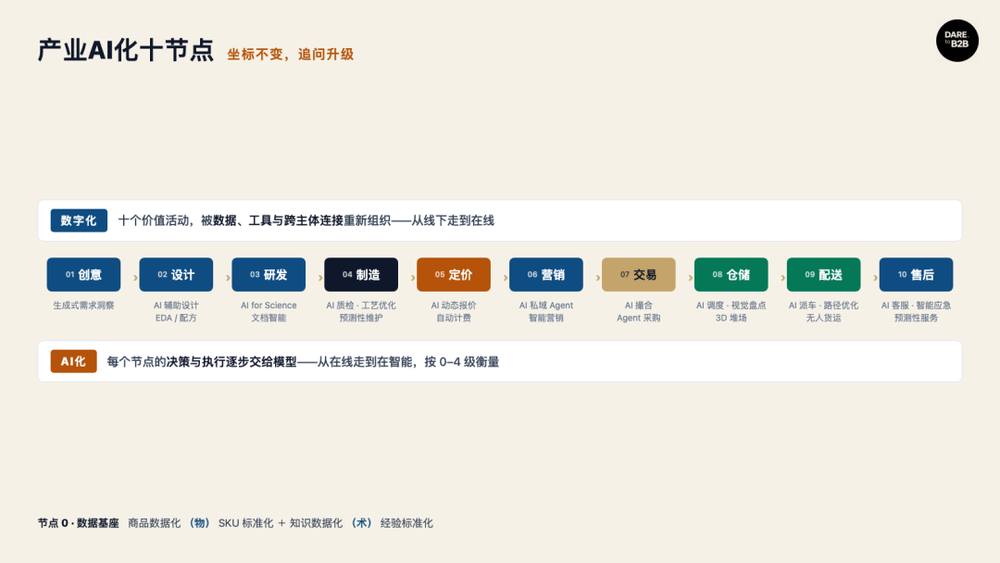
💡A practical framework for turning industrial workflows, product data, and expert know-how into production-grade AI opera
⚡ 30-Second TL;DR
What Changed
Industrial AI transformation keeps the original ten value-chain nodes but asks who makes decisions, how AI intervenes, and whether it augments, replaces, or creates work.
Why It Matters
For enterprise AI builders, the framework shifts attention from simply putting workflows online to making decisions auditable and executable by models. It also suggests that data governance and knowledge capture may be prerequisites for production-grade agents in manufacturing, logistics, pricing, and service operations.
What To Do Next
Choose one operational workflow, build a SKU-and-experience data schema, and score its current AI maturity against the 0–4 rubric before selecting an agent or model.
Key Points
- •Industrial AI transformation keeps the original ten value-chain nodes but asks who makes decisions, how AI intervenes, and whether it augments, replaces, or creates work.
- •SKU standardization gives models structured access to product semantics, cross-market parameters, and regulatory requirements.
- •Experience standardization converts tacit expert knowledge into reusable organizational assets for consistent, scalable execution.
- •Each node can be scored from level 0 to 4: no AI intervention, tool assistance, embedded decision support, autonomous execution, and cross-party collaboration.
- •Rule-based automation, 3D modeling, dictionaries, and parameter libraries should not be mislabeled as AI without models participating in decisions or execution.
🧠 Deep Insight
AI-generated analysis for this event.
🔑 Enhanced Key Takeaways
- •The framework aligns with the 'Industrial Internet 2.0' shift, moving beyond simple IoT connectivity toward generative AI-driven autonomous agents that manage supply chain volatility.
- •Standardization of SKUs is increasingly leveraging Large Multimodal Models (LMMs) to automatically map unstructured CAD/CAM data into standardized enterprise resource planning (ERP) formats.
- •The maturity model (Level 0-4) mirrors the ISA-95 standard for enterprise-control system integration, specifically targeting the transition from Level 3 (Manufacturing Operations Management) to Level 4 (Business Planning and Logistics).
- •Experience standardization is being implemented via 'Knowledge Graphs' that link tacit expert workflows to real-time sensor telemetry, preventing the 'black box' problem in AI decision-making.
- •The framework addresses the 'Data Silo' challenge by proposing a unified semantic layer that allows AI models to interpret cross-party data without requiring full data migration to a central cloud.
🛠️ Technical Deep Dive
- Architecture utilizes a multi-agent system (MAS) where specialized agents handle specific nodes (e.g., R&D agent, Logistics agent) and communicate via a shared semantic bus.
- Implementation relies on Retrieval-Augmented Generation (RAG) pipelines that ingest proprietary industrial manuals and historical performance logs to ground AI decisions.
- Model evaluation metrics include 'Decision Accuracy Rate' (DAR) and 'Human-in-the-loop Intervention Frequency' (HIF) to measure the transition from tool assistance to autonomous execution.
- Data standardization protocols utilize JSON-LD and OPC-UA standards to ensure interoperability between legacy industrial hardware and modern AI inference engines.
🔮 Future ImplicationsAI analysis grounded in cited sources
Weekly AI Recap
Read this week's curated digest of top AI events →
👉Related Updates
AI-curated news aggregator. All content rights belong to original publishers.
Original source: 虎嗅 ↗