DeepSeek Financing Reveals Divergent AI Strategies of Tech Giants
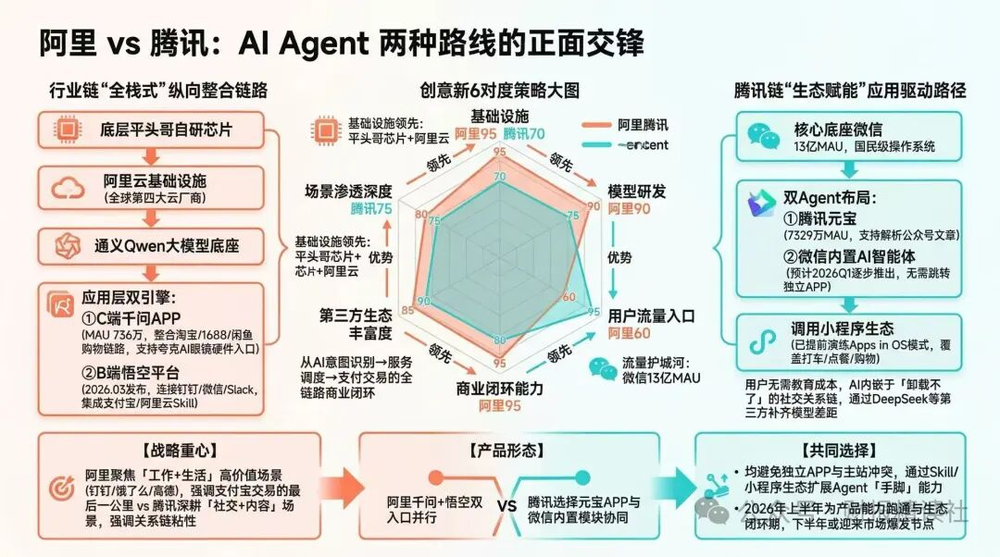
💡Understand how Alibaba, Tencent, and ByteDance are using capital to shape the future of China's AI ecosystem.
⚡ 30-Second TL;DR
What Changed
Alibaba aims to integrate AI models into its ecosystem for control, while Tencent prefers a 'light' financial investment approach.
Why It Matters
The divergent strategies of these giants will shape the competitive landscape for AI infrastructure and application deployment in China.
What To Do Next
Evaluate whether your AI startup's growth strategy aligns with 'ecosystem integration' or 'independent infrastructure' before accepting capital from big tech.
Key Points
- •Alibaba aims to integrate AI models into its ecosystem for control, while Tencent prefers a 'light' financial investment approach.
- •ByteDance is aggressively investing 200 billion in AI, focusing on the C-end 'Doubao' app to capture user time.
- •DeepSeek maintains independence to avoid being 'locked' into any single giant's infrastructure.
🧠 Deep Insight
Web-grounded analysis with 20 cited sources.
🔑 Enhanced Key Takeaways
- •DeepSeek's recent financing round is expected to raise its valuation to as much as US$50 billion, a fivefold increase from initial reports, with participation from state-linked investors and Tencent.
- •DeepSeek's latest models, the DeepSeek-V4 series, are notably optimized to run on Huawei chips for inference, signaling a strategic move towards reducing reliance on US technology and fostering a sovereign AI ecosystem within China.
- •ByteDance's consumer-facing AI app, Doubao, which has surpassed 100 million daily active users, is now testing tiered subscription models, marking a significant industry shift in China from aggressive user acquisition to commercial viability and revenue generation.
- •Alibaba Cloud has committed RMB 380 billion ($53.4 billion) in AI and cloud infrastructure investments over the next three years, aiming to establish itself as a full-stack AI service provider with its Qwen models functioning as an 'operating system of the AI era.'
- •Tencent is not only a financial participant in DeepSeek's funding but is also actively developing its proprietary Hunyuan LLM, integrating it across its extensive product ecosystem like WeChat and QQ, and focusing on building AI agents, infrastructure, and knowledge bases.
📊 Competitor Analysis▸ Show
LLM Comparison: DeepSeek, Alibaba (Qwen), Tencent (Hunyuan), and ByteDance (Doubao)
| Feature/Model | DeepSeek-V2 | DeepSeek-V4-Pro | Alibaba Qwen3-Max | Tencent Hunyuan T1 | ByteDance Doubao (underlying model) |
|---|---|---|---|---|---|
| Architecture | Mixture-of-Experts (MoE) | Mixture-of-Experts (MoE) | Dense (over 1 trillion parameters) | Proprietary (Deep-thinking model) | Proprietary MoE multimodal model |
| Total Parameters | 236 Billion | 1.6 Trillion | >1 Trillion | Not specified, but aims for larger parameters | Not specified, but aims for larger parameters |
| Activated Params | 21 Billion per token | 49 Billion per token | All parameters | Not specified | Not specified |
| Context Length | 128K tokens | 1 Million tokens | Not specified | Not specified | Not specified |
| Key Innovations | Multi-head Latent Attention (MLA), DeepSeekMoE | Optimized for Huawei chips, 1M context window | Multimodal (VL, Omni), Agent development platform | Multimodal (Vision, Voice, 3D), AI Agents | Aggressive low-cost pricing (initially), multimodal |
| Hardware Opt. | Nvidia (historically), now Huawei for inference | Huawei chips for inference | Optimized for Alibaba Cloud infrastructure | Aligns with domestic chips, Nvidia H20 orders | Potentially in-house AI chips |
| Benchmark Perf. | Comparable to GPT-4 (with fewer activated params) | Strong performance on agentic coding (SWE-bench) | On par with top closed-source models (SWE-Bench) | Outperformed GPT-4.5 and DeepSeek R1 on benchmarks | On par with OpenAI's GPT-4o (Doubao-1.5-Pro) |
| Pricing (C-end) | N/A (focus on open-source/API) | N/A (focus on open-source/API) | Free (Tongyi, Yuanbao) | Free (Yuanbao) | Tiered subscription (68-500 yuan/month) |
| Strategy | Independent, open-source, cost-efficient | Ecosystem control, full-stack AI, open-source Qwen | Financial participation, internal product integration | Direct C-end competition, user time capture | |
| Ecosystem Focus | Broad developer adoption | Alibaba Cloud, enterprise software ecosystem | Tencent products (WeChat, QQ, Meeting) | Doubao app, Douyin e-commerce, Doubao smartphone |
🛠️ Technical Deep Dive
- DeepSeek-V2: This is a Mixture-of-Experts (MoE) language model with 236 billion total parameters, activating only 21 billion parameters per token for efficient inference. It incorporates innovative architectures such as Multi-head Latent Attention (MLA) to significantly reduce KV cache requirements and DeepSeekMoE for economical training and inference. It supports a native context length of 128K tokens.
- DeepSeek-V4 Series: Released in April 2026, this series includes DeepSeek-V4-Pro (1.6-trillion parameters, 49 billion activated per token) and DeepSeek-V4-Flash (284-billion parameters). Both models feature a substantial 1-million token context window. A key technical advancement is their optimization to run efficiently on Huawei chips, particularly for inference, marking a significant step towards hardware-software co-optimization within China.
- DeepSeek-V3: This model is a 671 billion parameter MoE architecture, with 37 billion active parameters. It was noted for its performance and cost-effectiveness.
- Training and Optimization: DeepSeek models are pre-trained on high-quality, multi-source corpora (e.g., 8.1T tokens for DeepSeek-V2) and undergo Supervised Fine-Tuning (SFT) and Reinforcement Learning (RL) to enhance their capabilities. The MoE structure dynamically selects relevant expert sub-networks for each input, reducing computational costs while maintaining high performance.
🔮 Future ImplicationsAI analysis grounded in cited sources
⏳ Timeline
📎 Sources (20)
Factual claims are grounded in the sources below. Forward-looking analysis is AI-generated interpretation.
- Google Search Source
- Google Search Source
- Google Search Source
- Google Search Source
- Google Search Source
- Google Search Source
- Google Search Source
- Google Search Source
- Google Search Source
- Google Search Source
- Google Search Source
- Google Search Source
- Google Search Source
- Google Search Source
- Google Search Source
- Google Search Source
- Google Search Source
- Google Search Source
- Google Search Source
- Google Search Source
Weekly AI Recap
Read this week's curated digest of top AI events →
👉Related Updates

AI-curated news aggregator. All content rights belong to original publishers.
Original source: 虎嗅 ↗