DeepSeek Clarifies 'Random Output' Bug as Model Hallucination
💡Learn how to distinguish between model hallucinations and security vulnerabilities in LLM production.
⚡ 30-Second TL;DR
What Changed
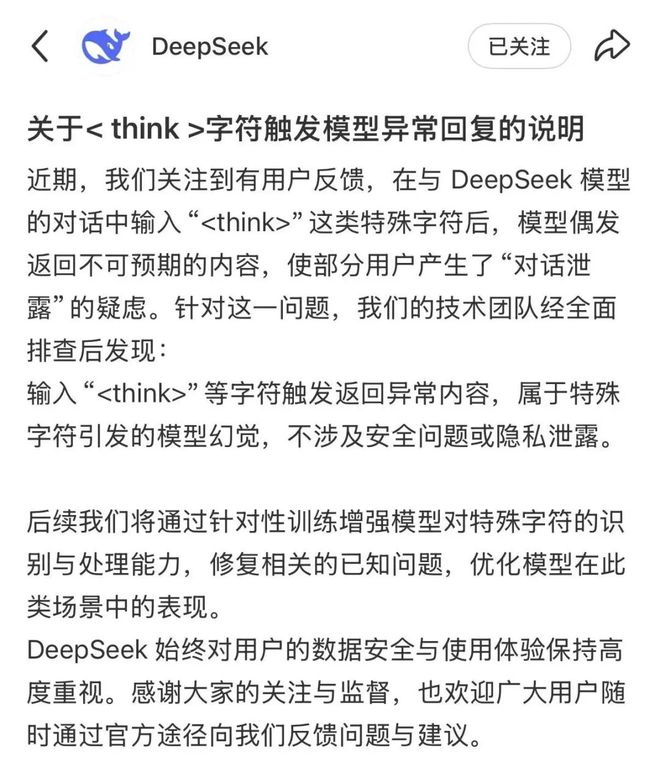
Abnormal responses are caused by specific special character inputs
Why It Matters
This clarification helps maintain user trust by distinguishing between benign model instability and actual security threats. It highlights the importance of robust input sanitization in LLM applications.
What To Do Next
Implement strict input sanitization and character filtering in your LLM pipeline to prevent unexpected model behavior.
Key Points
- •Abnormal responses are caused by specific special character inputs
- •The issue is identified as a model hallucination, not a security vulnerability
- •No user privacy or data leakage occurred during these incidents
🧠 Deep Insight
Web-grounded analysis with 30 cited sources.
🔑 Enhanced Key Takeaways
- •The 'random output' triggered by special character inputs is specifically identified as a form of 'training data extraction,' where the model generates content resembling real dialogue from its internal memory and system prompt, rather than retrieving real-time user conversations.
- •This phenomenon, where special characters lead to anomalous outputs, is a known issue affecting various large language models and has been a subject of academic research, including studies by Google DeepMind in 2023.
- •The appearance of 'today's date' within the anomalous outputs does not indicate a real-time privacy breach but is attributed to the model's system prompt, which incorporates the current date into its responses.
- •DeepSeek's R1 model has demonstrated a significantly higher hallucination rate (14.3%) compared to its predecessor, DeepSeek V3 (3.9%), with a notable portion of these being 'benign' hallucinations where the model adds plausible but unverified information.
📊 Competitor Analysis▸ Show
| Feature/Metric | DeepSeek (V3.2, V4) | OpenAI (GPT-5.x, GPT-4o) | Google (Gemini 3.1 Pro) | Anthropic (Claude Opus 4.x) | Qwen (Qwen3.5) |
|---|---|---|---|---|---|
| Architecture | MoE, MLA, DeepSeekMoE, FP8 training | Transformer | Transformer | Transformer | Transformer |
| Total Parameters | V4-Pro: 1.6T (49B activated) | GPT-5: Undisclosed | Undisclosed | Undisclosed | Qwen3-235B-A22B: 235B |
| Context Window | V4: 1M tokens | Undisclosed | 1M tokens (Gemini 1.5 Pro) | Undisclosed | Undisclosed |
| Training Cost (V3) | ~$6M | GPT-4: ~$100M (2023) | Undisclosed | Undisclosed | Undisclosed |
| Pricing (per 1M input tokens) | V3.2: $0.28 | GPT-5.4: $2.5 | $2 | Opus 4.6: $15 | Qwen 3.5 0.8B: $0.02 |
| SWE-Bench Verified | V3.2: 72%+ | GPT-5.4: ~78-80% | Gemini 3.1 Pro: ~70-75% | Opus 4.5: 80.9% (leads) | Qwen3-235B-A22B: N/A |
| GPQA Diamond | V3.2: 85%+ | GPT-5: N/A | Gemini 3.1 Pro: N/A | Mythos Preview: 94.6% | N/A |
| MMLU Pro | R1-Distill-Llama-70B: 71.2% | N/A | N/A | N/A | Qwen3-235B-A22B: 80.6% |
| Hallucination Rate (Vectara) | R1: 14.3%, V3: 3.9% | GPT-4o: Low | Gemini: Low | Claude: Low | Qwen: Best among open-source |
| Harmful Prompt Block Rate | R1: 0% (100% attack success) | GPT-4o: 86% | Gemini: 64% | Claude: ~86% (implied) | N/A |
🛠️ Technical Deep Dive
- DeepSeek models are built on the transformer architecture, similar to LLaMA, utilizing multi-layered neural networks with billions to trillions of parameters.
- They predominantly use a Mixture-of-Experts (MoE) architecture, such as DeepSeekMoE, which allows for economical training and efficient inference by activating only a subset of total parameters per token (e.g., DeepSeek-V2 has 236 billion total parameters but activates 21 billion per token; DeepSeek-V4-Pro has 1.6 trillion total parameters, activating 49 billion per token).
- A key innovation is Multi-head Latent Attention (MLA), designed to significantly compress the Key-Value (KV) cache during inference, thereby reducing memory requirements and boosting generation throughput (e.g., DeepSeek-V2 reduced KV cache by 93.3% compared to DeepSeek 67B).
- DeepSeek-V3 and R1 models have adopted FP8 precision for pre-training, which enhances compute efficiency (doubling FLOPS compared to FP16) and halves memory usage, enabling the training of larger models within existing hardware constraints.
- The models incorporate Rotary Position Embeddings (RoPE) for positional encoding, RMSNorm for pre-normalization, and SwiGLU activation functions.
- DeepSeek-V2 supports a 128K context length, while the newer V4 series models feature a 1-million token context window.
- Training involves a rigorous data governance process, including filtering for harmful content and employing technical measures to remove personal information, followed by Supervised Fine-Tuning (SFT) and Reinforcement Learning (RL) to align models with human values.
- The 'random output' bug is linked to the model reverting to its training data format when exposed to specific special character inputs, a phenomenon known as training data extraction.
🔮 Future ImplicationsAI analysis grounded in cited sources
⏳ Timeline
📎 Sources (30)
Factual claims are grounded in the sources below. Forward-looking analysis is AI-generated interpretation.
- kucoin.com
- semafor.com
- vectara.com
- nvidia.com
- github.io
- fireworks.ai
- techtimes.com
- lambda.ai
- artificialanalysis.ai
- wikipedia.org
- clickrank.ai
- onyx.app
- cisco.com
- csis.org
- medium.com
- github.com
- planetbanatt.net
- milvus.io
- huggingface.co
- arxiv.org
- medium.com
- deepseek.com
- censinet.com
- mindgard.ai
- arxiv.org
- aisecurityandsafety.org
- pbs.org
- britannica.com
- apnews.com
- washingtonpost.com
Weekly AI Recap
Read this week's curated digest of top AI events →
👉Related Updates

AI-curated news aggregator. All content rights belong to original publishers.
Original source: cnBeta (Full RSS) ↗