Deep Principle Launches MPA for Materials Science Breakthroughs
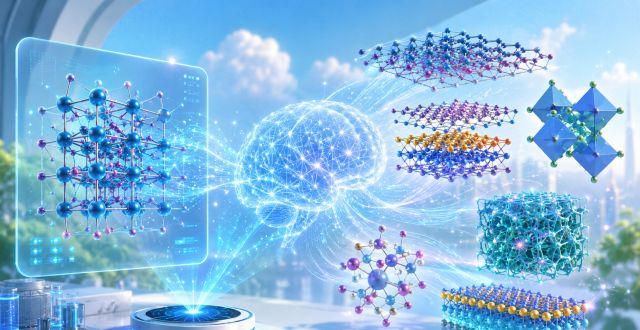
💡A new 'AlphaFold for materials' that applies LLM techniques to achieve SOTA results in industrial R&D.
⚡ 30-Second TL;DR
What Changed
MPA stands for Materials Property Axiom, a specialized foundation model.
Why It Matters
MPA demonstrates the efficacy of applying LLM-style pre-training to scientific domains, potentially accelerating material discovery and industrial R&D.
What To Do Next
Evaluate MPA's API or model weights for your R&D pipeline if you are working on material property prediction or chemical engineering tasks.
Key Points
- •MPA stands for Materials Property Axiom, a specialized foundation model.
- •Achieves state-of-the-art results on 40 real-world industrial materials science tasks.
- •Utilizes large language model training methodologies applied to material data.
🧠 Deep Insight
Background and context from public sources — not the original article. 10 sources cited.
🔑 Enhanced Key Takeaways
- •MPA employs a three-stage training paradigm (pre-training, mid-training, fine-tuning) adapted from large language models, with an innovative physics-guided alignment in the mid-training stage to bridge the gap between computational models and real experimental data.
- •The model's architecture includes a novel "Hybrid Readout" design featuring two parallel pathways: an attention-based pooling pathway for properties dependent on overall molecular character and an atom-wise summation pathway for properties scaling with molecular size, dynamically weighted by a learnable parameter α.
- •Deep Principle, a Beijing-based AI for science startup founded in 2024, has secured significant funding, including a Pre-A round of 100 million yuan in March 2025 and a Series A round of over RMB 100 million in November 2025, with investors like Lenovo, Baidu, Alibaba Entrepreneurs Fund, and Ant Group.
- •Beyond MPA, Deep Principle's product portfolio includes the ReactiveAI platform, Agent Mira (an intelligent agent for autonomous materials discovery), and the development of an automated laboratory called the "AI Materials Factory."
- •Deep Principle has also developed other generative AI models, such as the diffusion model React-OT, which achieves transition-state structure predictions significantly faster than traditional quantum chemistry methods.
🛠️ Technical Deep Dive
- MPA utilizes a three-stage training paradigm: pre-training, mid-training, and fine-tuning, adapted from large language model methodologies.
- The mid-training stage incorporates physics-guided alignment to instill "physical intuition," aiming to reconcile computational idealizations with real-world experimental conditions.
- The model features a "Hybrid Readout" architecture with two distinct parallel pathways:
- An attention-based pooling pathway designed for properties that depend on the overall molecular "character," such as boiling point.
- An atom-wise summation pathway for properties that scale with molecular size, like enthalpy of formation.
- A learnable parameter, α, dynamically weights these two pathways based on the specific property being predicted.
- In extensive benchmarking, MPA demonstrated state-of-the-art performance, outperforming five leading molecular property prediction models (ChemBERTa, ChemProp, Chemeleon, Uni-Mol2, and Suiren) on 38 out of 40 properties in random split tests.
- Deep Principle also employs diffusion models, such as React-OT, which can predict transition-state structures in 0.4 seconds with high accuracy.
- The company integrates large language models for tasks like the generative design of transition metal complexes.
🔮 Future ImplicationsAI analysis grounded in cited sources
⏳ Timeline
📎 Sources (10)
Factual claims are grounded in the sources below. Forward-looking analysis is AI-generated interpretation.
Weekly AI Recap
Read this week's curated digest of top AI events →
👉Related Updates


AI-curated news aggregator. All content rights belong to original publishers.
Original source: Pandaily ↗
This is a summary, not the original. Read the source, or get the weekly briefing.
The weekly digest
One email a week. Unsubscribe anytime.