Dead Brain Tissue Learns to Play Piano
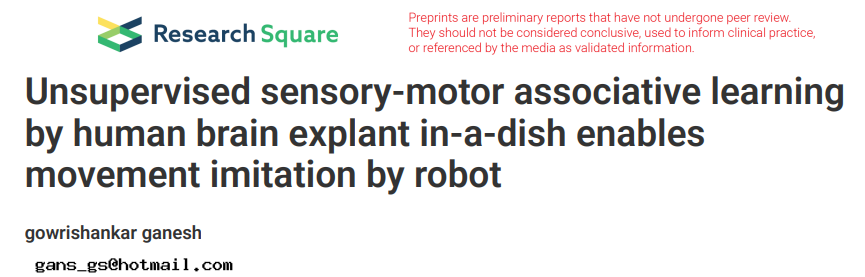
💡A brain slice learned sensorimotor control with 20-watt biological efficiency—without rewards or backpropagation.
⚡ 30-Second TL;DR
What Changed
The experiment used 30 slices of primary motor-cortex tissue from three donors, with 16 slices used in the core imitation experiments.
Why It Matters
The work suggests that biological neural tissue can provide highly energy-efficient adaptive control for simple embodied systems without conventional model training or reward signals. It is still an early preprint with a tiny sample size and a narrow three-note task, so it should not yet be treated as evidence of general intelligence or practical brain-computer interfaces.
What To Do Next
Read the Research Square preprint and prototype a three-class closed-loop benchmark to compare biological adaptation against a lightweight reinforcement-learning controller.
Key Points
- •The experiment used 30 slices of primary motor-cortex tissue from three donors, with 16 slices used in the core imitation experiments.
- •Each brain slice was placed on a 60-electrode microelectrode array, with selected electrodes assigned to motor output and sensory feedback.
- •The closed loop translated neural spikes into finger movements, while piano sounds were converted back into electrical stimulation.
- •Accuracy improved from 31.2% before training to 58.5% after three days and 900 total repetitions.
- •Some slices retained the learned association for up to 17 days, while electrode changes, synaptic blockers, and viral intervention reduced performance.
Weekly AI Recap
Read this week's curated digest of top AI events →
👉Related Updates


AI-curated news aggregator. All content rights belong to original publishers.
Original source: 虎嗅 ↗
This is a summary, not the original. Read the source, or get the weekly briefing.
Weekly AI briefing
One email a week. Unsubscribe anytime.