DDR5 Memory Prices Surge 419% Due to AI Demand
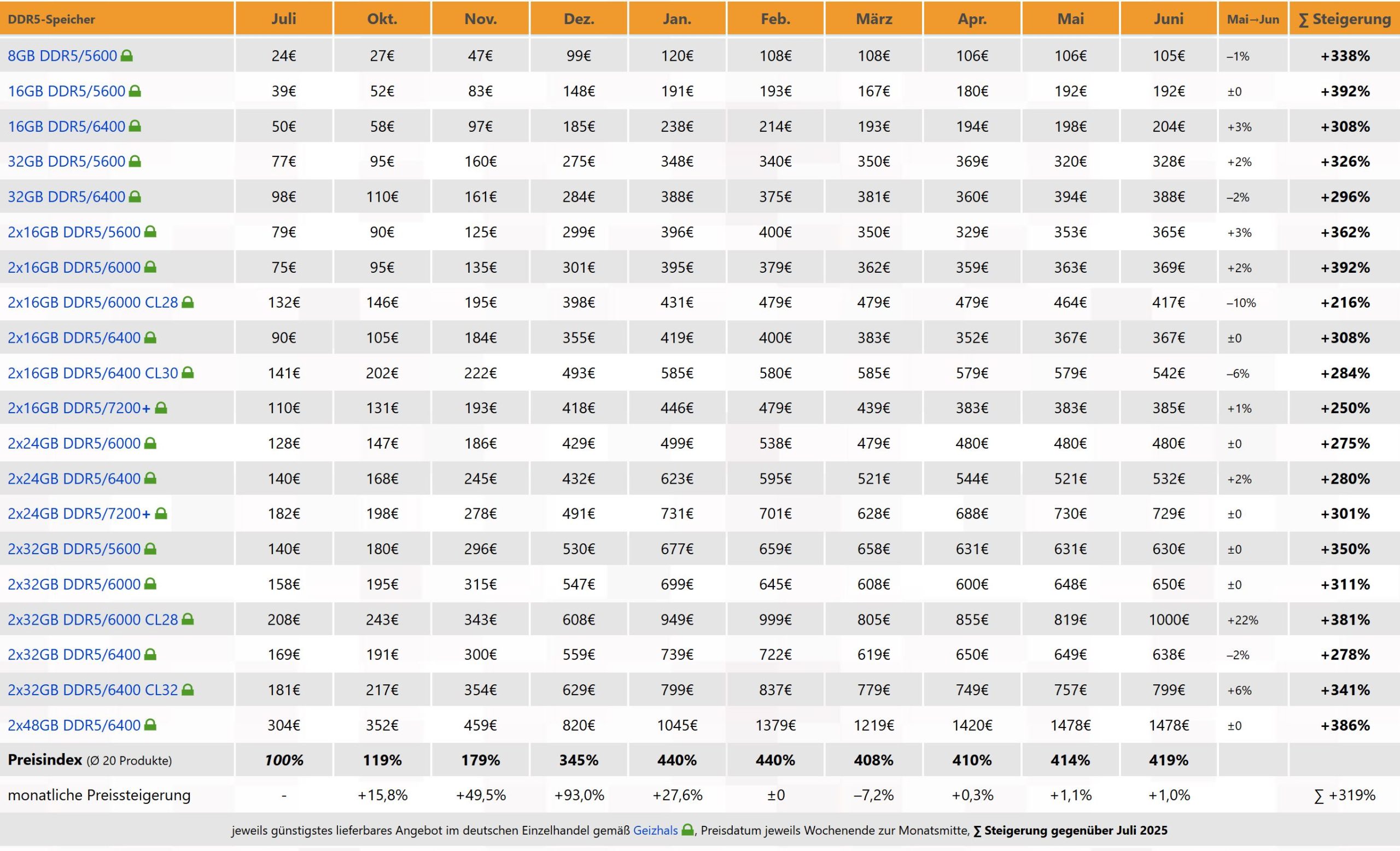
💡Rising DDR5 costs directly impact the TCO of building and running local AI infrastructure.
⚡ 30-Second TL;DR
What Changed
DDR5 prices are currently 4-5 times higher than historical norms.
Why It Matters
High memory costs increase the barrier to entry for local AI model training and inference hardware. Practitioners may need to optimize for memory efficiency to mitigate infrastructure costs.
What To Do Next
Audit your local inference server memory usage and consider quantization techniques to reduce the hardware footprint.
Key Points
- •DDR5 prices are currently 4-5 times higher than historical norms.
- •Generative AI compute demand is the primary driver of the price hike.
- •Previous price stabilization trends in Germany have ended.
🧠 Deep Insight
Background and context from public sources — not the original article. 33 sources cited.
🔑 Enhanced Key Takeaways
- •The surge in DDR5 prices is significantly influenced by memory manufacturers prioritizing the production of higher-margin High Bandwidth Memory (HBM) for AI accelerators, which consumes the same advanced DRAM wafer capacity as DDR5, thereby reducing its availability for conventional markets.
- •While DDR5 prices in Germany saw a brief period of stabilization or even slight decreases in early 2026 (January-March), the upward trend resumed in April and continued into June, reaching 419% of July 2025 levels.
- •The escalating demand for AI infrastructure has not only driven up DDR5 prices but has also caused price hikes for DDR4 memory, as manufacturers scale back its production to reallocate resources towards DDR5 and HBM.
- •Industry analysts, including AMD's VP and GM of Client Channel Business, David McAfee, predict that DDR5 memory prices are unlikely to return to normal levels until at least 2027 or even 2028, due to the time required to build new manufacturing facilities and the sustained AI demand.
- •The memory market is experiencing a structural shift, rather than a cyclical one, with AI demand establishing a persistent and growing baseline consumption that is capital-intensive and highly concentrated among a few large buyers, leading to supply redirection and increased competition for critical inputs.
📊 Competitor Analysis▸ Show
DDR5 vs. HBM for AI Workloads
| Feature | DDR5 RAM | HBM (High Bandwidth Memory) |
|---|---|---|
| Primary Use | System memory (CPUs, virtualization, enterprise workloads) | GPU/AI accelerator memory (AI training, HPC) |
| Form Factor | DIMM modules | Stacked DRAM dies (3D-stacked architecture) |
| Bandwidth | Moderate (e.g., 50-60 GB/s per module, up to 89.6GB/s theoretical max) | Extremely high (e.g., HBM3E: 1.2 TB/s per stack, NVIDIA H100: terabytes/second) |
| Capacity | Large memory pools (up to 512 GB per DIMM) | Smaller but ultra-fast (e.g., 36GB per stack for HBM3E) |
| Processor Distance | Connected through the motherboard | Physically integrated very close to GPUs/AI accelerators |
| Power Efficiency | Better than DDR4 (1.1V operation, on-DIMM PMIC) | Inherently more power-efficient due to shorter data paths and lower voltage requirements |
| Cost | More cost-effective for general computing (e.g., $5-10/GB before surge) | Significantly higher (e.g., $40-50/GB, 3x DDR5 wafer area) |
| Main Role | CPU and platform memory | AI compute memory, addressing memory wall bottleneck |
| Production Impact | Supply constrained by HBM prioritization | Prioritized by manufacturers due to higher profit margins |
🛠️ Technical Deep Dive
- Increased Bandwidth and Speed: DDR5 offers significantly higher data rates, starting from 4800 MT/s and reaching well above 8000 MT/s in advanced configurations, compared to DDR4's typical 3200 MT/s. This is achieved by doubling the prefetch buffer width from 8n to 16n and employing improved signal integrity features.
- Enhanced Power Efficiency: DDR5 operates at a lower voltage of 1.1V, down from DDR4's 1.2V, resulting in reduced power consumption and thermal output, which is crucial for large-scale data centers. It also incorporates an on-die Power Management IC (PMIC) on the DIMM itself for more precise and stable voltage control.
- Improved Architecture for Data Access: DDR5 memory modules are split into two independent 32-bit sub-channels, which, while maintaining an overall 64-bit data bandwidth like DDR4, significantly enhances data access efficiency. It also doubles the number of memory banks from 4 to 8, increasing the amount of data processed simultaneously.
- Enhanced Data Integrity: DDR5 features On-Die ECC (Error-Correcting Code) which corrects internal chip errors before data transmission, significantly improving memory stability, especially important for critical AI workloads.
- Scalability for AI Workloads: DDR5's increased memory bandwidth and improved CPU architecture enable better scaling for AI inference problems, with some tests showing 40%-200% higher memory bandwidth on DDR5-based platforms over DDR4.
- Decision Feedback Equalization (DFE): This new feature enables input/output (I/O) speed scalability, contributing to higher bandwidth and performance improvements.
🔮 Future ImplicationsAI analysis grounded in cited sources
⏳ Timeline
📎 Sources (33)
Factual claims are grounded in the sources below. Forward-looking analysis is AI-generated interpretation.
- microchipusa.com
- accio.com
- nzxt.com
- juniperresearch.com
- peerlist.io
- wikipedia.org
- astutegroup.com
- youtube.com
- newegg.com
- wccftech.com
- pcmag.com
- trendforce.com
- reddit.com
- bitkart.com
- worldstream.com
- tweaktown.com
- sourceability.com
- tomshardware.com
- electronics.org
- wccftech.com
- investing.com
- keysight.com
- medium.com
- massedcompute.com
- patsnap.com
- wikipedia.org
- silicon-power.com
- adata.com
- techinsights.com
- patsnap.com
- youtube.com
- micron.com
- mashable.com
Weekly AI Recap
Read this week's curated digest of top AI events →
👉Related Updates


AI-curated news aggregator. All content rights belong to original publishers.
Original source: cnBeta (Full RSS) ↗
This is a summary, not the original. Read the source, or get the weekly briefing.
Weekly AI briefing
One email a week. Unsubscribe anytime.