DDR3 Spot Prices Surpass DDR5 Memory
💡Memory price inversion could impact your hardware procurement strategy for AI edge deployments.
⚡ 30-Second TL;DR
What Changed
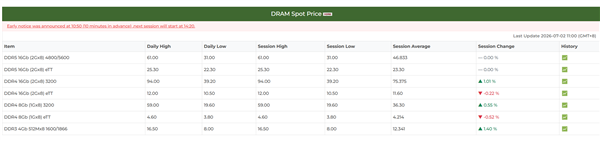
DDR3 512MB unit price is $12.341, equivalent to $24.682 per GB.
Why It Matters
This inversion highlights supply chain volatility that could affect hardware procurement costs for AI edge devices still relying on legacy memory architectures.
What To Do Next
Audit your hardware BOM costs for edge AI projects to ensure you aren't overpaying for legacy DDR3 components.
Key Points
- •DDR3 512MB unit price is $12.341, equivalent to $24.682 per GB.
- •DDR5 2GB unit price is $46.833, equivalent to $23.416 per GB.
- •Market supply-demand dynamics have caused a counter-intuitive price inversion.
🧠 Deep Insight
AI-generated analysis for this event — not the original article.
🔑 Enhanced Key Takeaways
- •The price inversion is primarily driven by the cessation of mass production for DDR3 by major manufacturers like Samsung, SK Hynix, and Micron, leading to a scarcity of legacy supply.
- •Industrial and embedded systems, which cannot easily migrate to newer architectures, are creating a 'captive market' that sustains high demand for DDR3 despite its obsolescence in consumer PCs.
- •DDR5 production capacity has expanded significantly due to AI server demand and high-performance computing requirements, creating economies of scale that have rapidly driven down per-GB costs.
- •The cost disparity is exacerbated by the 'long-tail' maintenance costs of legacy fabrication plants (fabs) that are less efficient than modern EUV-enabled facilities used for DDR5.
- •Market analysts note that DDR3 spot prices are increasingly decoupled from commodity memory trends, behaving more like specialized industrial components rather than consumer electronics.
📊 Competitor Analysis▸ Show
| Feature | DDR3 (Legacy) | DDR5 (Modern) | LPDDR5X (Mobile) |
|---|---|---|---|
| Data Rate | 800-2133 MT/s | 4800-8400+ MT/s | 8533-9600+ MT/s |
| Voltage | 1.5V | 1.1V | 1.05V |
| Primary Use | Industrial/Embedded | AI/Server/Desktop | Mobile/Ultra-thin |
| Cost/GB | High (Scarcity) | Low (Volume) | Moderate |
🛠️ Technical Deep Dive
- DDR3 utilizes a 1.5V operating voltage and a 8n prefetch architecture, which is significantly less power-efficient than DDR5's 1.1V and 16n prefetch design.
- DDR5 integrates On-Die ECC (Error Correction Code) and dual 32-bit sub-channels per DIMM, features entirely absent in the DDR3 architecture.
- The manufacturing process for DDR3 has largely shifted to older nodes (e.g., 20nm-25nm), whereas DDR5 is produced on advanced 10nm-class (1a, 1b) nodes, resulting in higher yield and density.
- DDR3 relies on a centralized power management system on the motherboard, while DDR5 moves the Power Management Integrated Circuit (PMIC) directly onto the DIMM, increasing complexity and cost for DDR5 but improving signal integrity.
🔮 Future ImplicationsAI analysis grounded in cited sources
⏳ Timeline
Weekly AI Recap
Read this week's curated digest of top AI events →
👉Related Updates




AI-curated news aggregator. All content rights belong to original publishers.
Original source: cnBeta (Full RSS) ↗
This is a summary, not the original. Read the source, or get the weekly briefing.
Weekly AI briefing
One email a week. Unsubscribe anytime.