Daylight expands MDR security to Claude Enterprise
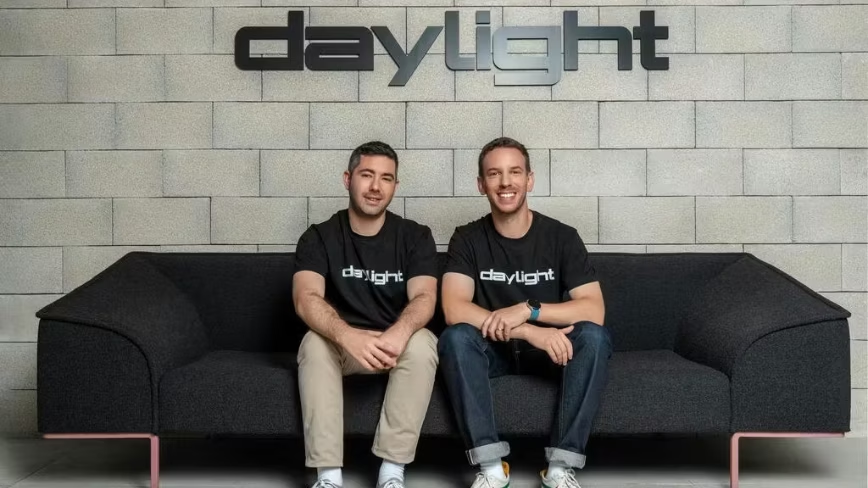
💡Essential security update for enterprises scaling Claude AI workflows against emerging threats.
⚡ 30-Second TL;DR
What Changed
Addresses security threats in generative AI operational infrastructure
Why It Matters
As enterprises integrate AI, traditional security tools often fail; this partnership provides a necessary layer of specialized oversight for AI-driven operations.
What To Do Next
Audit your current LLM deployment logs to see if your existing security stack can detect anomalous code generation or data exfiltration patterns.
Key Points
- •Addresses security threats in generative AI operational infrastructure
- •MDR services now cover Claude Enterprise environments
- •Focuses on risks from AI-powered automation and code generation
- •Provides specialized monitoring for enterprise AI platforms
🧠 Deep Insight
Background and context from public sources — not the original article. 14 sources cited.
🔑 Enhanced Key Takeaways
- •Daylight Security employs a 'Managed Agentic Security Services (MASS)' model, which combines autonomous AI agents for investigation and execution with human experts who provide critical judgment and accountability for security outcomes.
- •The integration specifically targets the 'blind spot' created by enterprise AI adoption, addressing challenges in monitoring data access, prompt interactions with sensitive repositories, and risks introduced by AI extensions like Skills or plugins within Claude Enterprise.
- •Daylight's MDR platform is designed for rapid deployment, integrating within an hour via API connections across endpoint, cloud, identity, and SaaS environments to collect comprehensive business context.
- •Anthropic recently (May 21, 2026) launched its Claude Compliance API, enabling programmatic access to Claude conversation content and activity logs, which Daylight's service likely leverages for enhanced visibility and governance.
- •Daylight's offering extends beyond mere detection to include true end-to-end incident response, proactive threat hunting, and agentic Data Loss Prevention (DLP) investigation and response, aiming to resolve threats rather than just escalating alerts.
🛠️ Technical Deep Dive
- Daylight's platform utilizes 'Agentic AI Investigation and Response,' where AI agents actively investigate, correlate signals, analyze context, and form conclusions in real-time, mimicking expert reasoning to identify and pursue threats.
- It integrates data from identity, cloud, endpoint, and business systems into a centralized data lake, leveraging contextual intelligence from business-critical systems like identity platforms and HR systems to understand unique environmental roles and priorities.
- A central orchestrator deploys specialized AI agents for specific tasks, allowing investigations to adapt dynamically based on emerging evidence rather than fixed playbooks.
- Human security experts define and maintain detection rules and step in for ambiguous cases, customizing detections and leading response during confirmed incidents.
- ChatOps integration with platforms like Slack and Microsoft Teams enables real-time validation of activities and information gathering directly from users.
- Anthropic's Claude Compliance API, a REST interface, provides programmatic access to two key data streams: conversation content (chats, uploaded files, projects) and activity event logs (user logins, admin actions, configuration changes) from Claude Enterprise.
- Claude Enterprise itself offers features such as a 500K context window, GitHub integration, and 'Claude Code' for specialized coding tasks.
- Anthropic also provides 'Claude Security' (formerly Claude Code Security), which scans code repositories for vulnerabilities and generates proposed fixes using Claude Opus 4.7.
🔮 Future ImplicationsAI analysis grounded in cited sources
⏳ Timeline
📎 Sources (14)
Factual claims are grounded in the sources below. Forward-looking analysis is AI-generated interpretation.
Weekly AI Recap
Read this week's curated digest of top AI events →
👉Related Updates


AI-curated news aggregator. All content rights belong to original publishers.
Original source: The Next Web (TNW) ↗
This is a summary, not the original. Read the source, or get the weekly briefing.
The weekly digest
One email a week. Unsubscribe anytime.