D-Wave Tests Entanglement on Dual-Rail Qubits
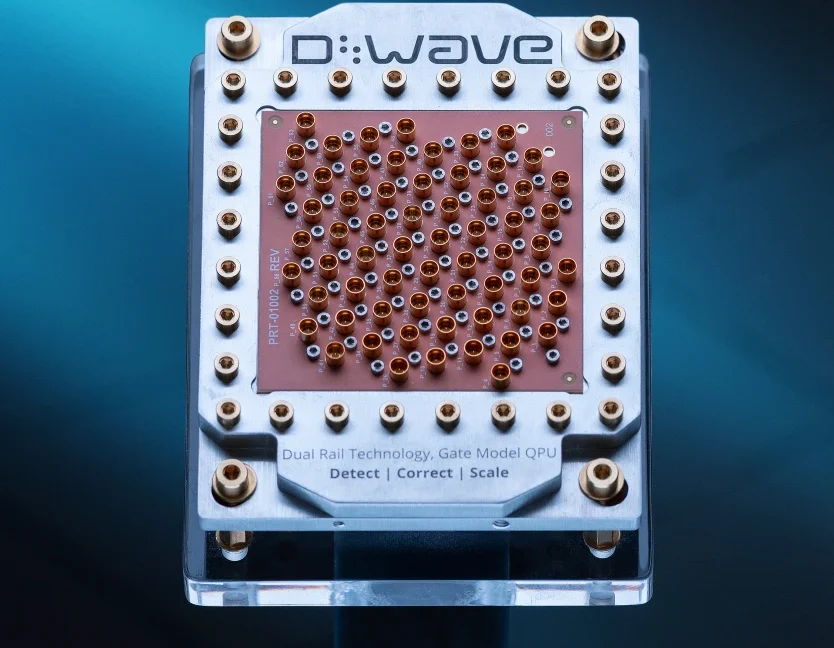
D-Wave is moving beyond annealing—see what its dual-rail entanglement tests mean for quantum AI research.
30-Second TL;DR
What Changed
D-Wave is testing entanglement on dual-rail qubits.
Why It Matters
If the experiments demonstrate reliable entanglement, D-Wave could become a more credible option for researchers exploring gate-based quantum computing. AI practitioners should view this as an early hardware-direction signal rather than an immediately deployable platform.
What To Do Next
Review D-Wave’s reported dual-rail entanglement results and compare their fidelity and scalability metrics with the gate-based platforms in your quantum-ML roadmap.
Key Points
- •D-Wave is testing entanglement on dual-rail qubits.
- •The company is expanding from quantum annealers into gate-based hardware.
- •The effort could broaden D-Wave’s relevance to quantum algorithm and quantum machine-learning research.
Deep Insight
AI-generated analysis for this event — not the original article.
Enhanced Key Takeaways
- •D-Wave's dual-rail qubit architecture utilizes superconducting circuits where information is encoded in the presence of a photon in one of two transmission lines, offering inherent protection against certain types of decoherence.
- •The shift toward gate-based quantum computing is intended to complement, rather than replace, D-Wave's existing quantum annealing roadmap, targeting universal quantum computation capabilities.
- •Dual-rail qubits are specifically being explored for their potential to implement high-fidelity two-qubit gates, which are essential for error-corrected quantum computing.
- •This research leverages D-Wave's existing fabrication facilities in British Columbia, allowing the company to repurpose its mature superconducting manufacturing process for gate-model development.
- •The transition addresses long-standing industry criticism that D-Wave's annealing-only approach limited its utility for general-purpose quantum algorithms like Shor's or Grover's.
Competitor Analysis
- D-Wave (Dual-Rail)
- Superconducting Dual-Rail
- IBM (Transmon)
- Superconducting Transmon
- IonQ (Trapped Ion)
- Trapped Ytterbium Ions
- D-Wave (Dual-Rail)
- Hybrid Annealing/Gate
- IBM (Transmon)
- Gate-Based
- IonQ (Trapped Ion)
- Gate-Based
- D-Wave (Dual-Rail)
- High (Topology Dependent)
- IBM (Transmon)
- Fixed Grid
- IonQ (Trapped Ion)
- All-to-All
- D-Wave (Dual-Rail)
- Experimental/R&D
- IBM (Transmon)
- Commercial/Cloud
- IonQ (Trapped Ion)
- Commercial/Cloud
| Feature | D-Wave (Dual-Rail) | IBM (Transmon) | IonQ (Trapped Ion) |
|---|---|---|---|
| Qubit Type | Superconducting Dual-Rail | Superconducting Transmon | Trapped Ytterbium Ions |
| Primary Model | Hybrid Annealing/Gate | Gate-Based | Gate-Based |
| Connectivity | High (Topology Dependent) | Fixed Grid | All-to-All |
| Maturity | Experimental/R&D | Commercial/Cloud | Commercial/Cloud |
Technical Deep Dive
- Dual-rail encoding uses two physical modes (rails) to represent a single logical qubit, where the state |0> is defined as (1,0) and |1> as (0,1).
- This architecture is designed to be compatible with microwave-based control pulses, similar to standard transmon qubits.
- The implementation focuses on suppressing bit-flip errors by utilizing the parity of the photon distribution across the two rails.
- D-Wave is utilizing its proprietary Josephson junction fabrication process to integrate these dual-rail structures into existing chip designs.
- The gate-based approach aims to achieve higher gate fidelities by isolating the computational states from common noise channels found in single-rail superconducting qubits.
Future ImplicationsAI analysis grounded in cited sources
Timeline
- 1999-01D-Wave Systems founded to pursue quantum computing research.
- 2011-05D-Wave One, the world's first commercially available quantum annealer, is released.
- 2020-09Launch of the Advantage quantum annealing system with 5000+ qubits.
- 2024-02D-Wave announces strategic expansion into gate-model quantum computing research.
- 2026-05Initial successful demonstration of entanglement in dual-rail qubit prototypes.
Weekly AI Recap
Read this week's curated digest of top AI events →
AI-curated news aggregator. All content rights belong to original publishers.
Original source: Ars Technica ↗
This is a summary, not the original. Read the source, or get the weekly briefing.
The weekly digest
One email a week. Unsubscribe anytime.