Cybercab Cabin: No Frunk, Huge Fluid Tank
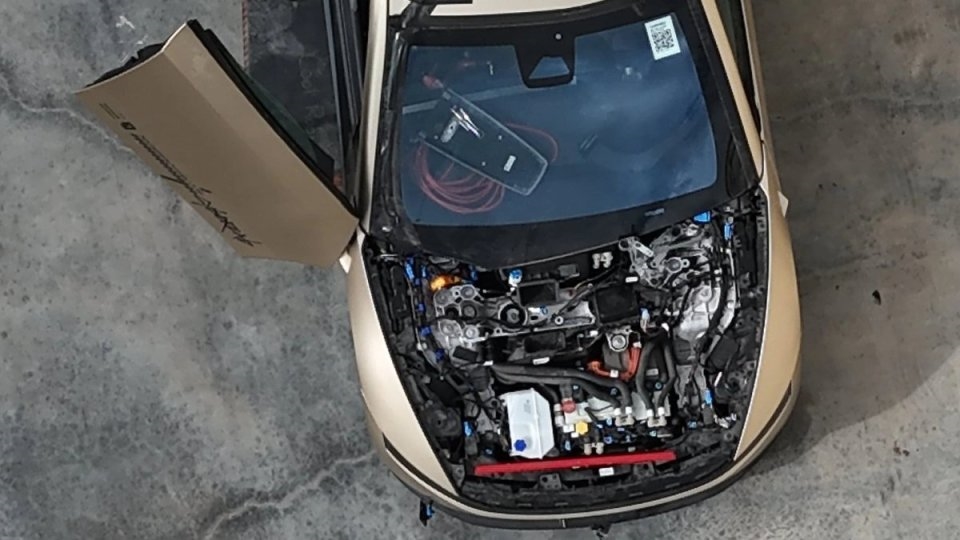
💡Tesla robotaxi ditches frunk for massive tank, revealing AV hardware priorities.
⚡ 30-Second TL;DR
What Changed
Cabin footage sourced from Texas Superfactory collision test center aerial shots.
Why It Matters
Highlights Tesla's robotaxi design prioritizing autonomy hardware over user storage, potentially accelerating unsupervised FSD deployment. Signals shift in EV layout for AI-driven mobility services.
What To Do Next
Benchmark your AV stack against Cybercab's front packaging for compute/cooling optimizations.
Key Points
- •Cabin footage sourced from Texas Superfactory collision test center aerial shots.
- •No front trunk; entire front space dedicated to core vehicle components.
- •Built-in super large fluid tank as critical configuration.
- •Positioned as Tesla's inaugural fully autonomous two-seater model.
🧠 Deep Insight
AI-generated analysis for this event — not the original article.
🔑 Enhanced Key Takeaways
- •The large fluid tank is widely speculated by industry analysts to be part of an advanced thermal management system required for high-compute autonomous driving hardware, rather than traditional vehicle fluids.
- •The absence of a frunk is a design departure from Tesla's existing lineup, signaling a shift toward a 'robotaxi-first' architecture that prioritizes internal component density over consumer-facing storage.
- •Aerial footage indicates the Cybercab utilizes a simplified, non-traditional door mechanism, likely gull-wing or sliding, to facilitate easier passenger ingress and egress in urban environments.
📊 Competitor Analysis▸ Show
| Feature | Tesla Cybercab | Waymo (Zeekr) | Cruise Origin |
|---|---|---|---|
| Design | Purpose-built 2-seater | Purpose-built van | Purpose-built shuttle |
| Steering/Pedals | None | None | None |
| Primary Use | Ride-hailing | Ride-hailing | Ride-hailing |
| Status | Testing/Pre-production | Operational | Paused/Testing |
🛠️ Technical Deep Dive
- Architecture: Dedicated autonomous platform (non-modular) designed without manual controls.
- Thermal Management: High-capacity fluid reservoir suggests a liquid-cooled architecture for centralized AI compute clusters.
- Component Packaging: Front-end volume is entirely repurposed for power electronics, sensor processing units, and cooling infrastructure.
- Seating: Optimized for two passengers, removing the driver-side cockpit entirely to maximize cabin space.
🔮 Future ImplicationsAI analysis grounded in cited sources
⏳ Timeline
Weekly AI Recap
Read this week's curated digest of top AI events →
👉Related Updates


AI-curated news aggregator. All content rights belong to original publishers.
Original source: cnBeta (Full RSS) ↗
This is a summary, not the original. Read the source, or get the weekly briefing.
Weekly AI briefing
One email a week. Unsubscribe anytime.