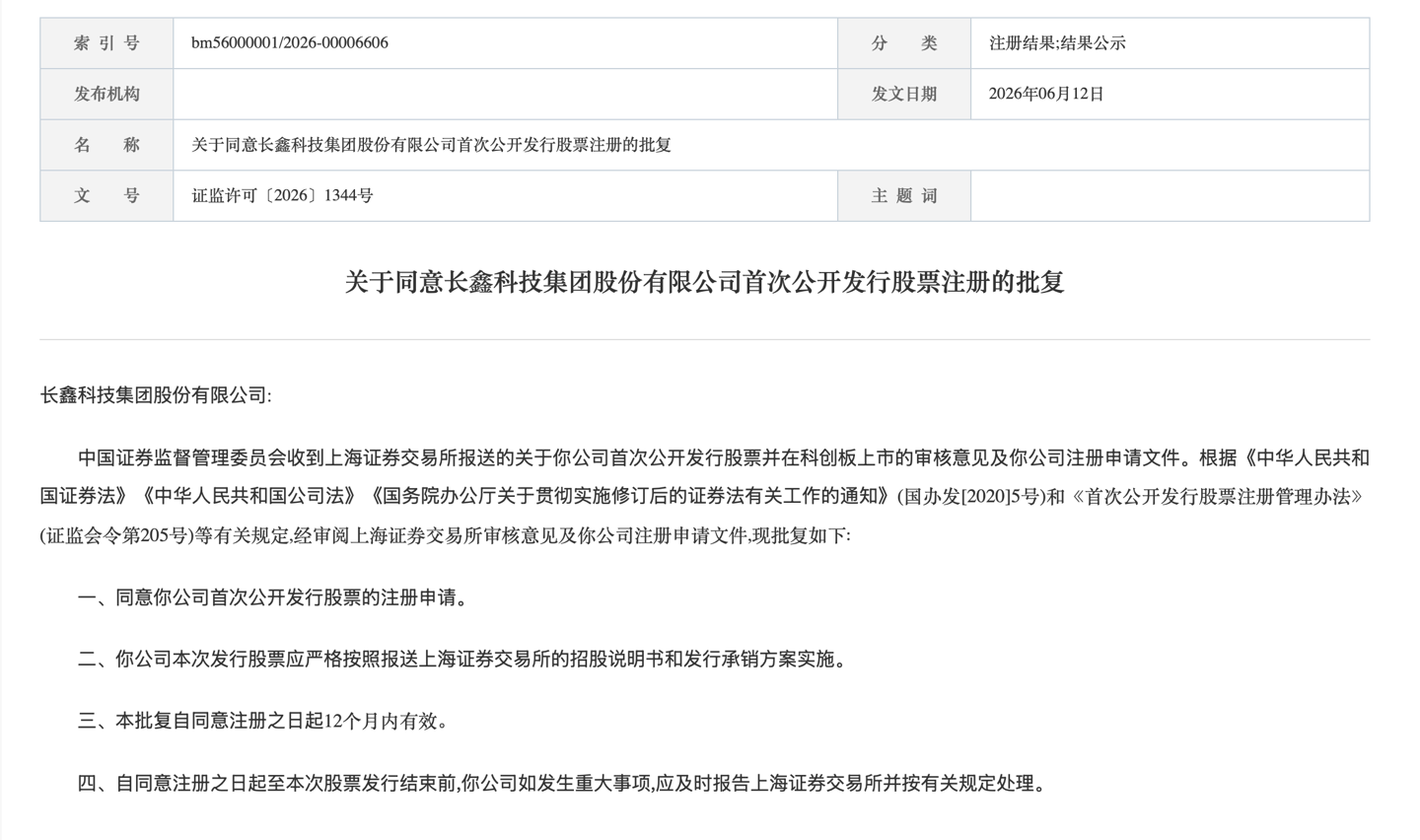
CXMT Receives Approval for STAR Market IPO
💡Major capital injection for a key Chinese memory chip maker, impacting the AI hardware supply chain.
⚡ 30-Second TL;DR
What Changed
CSRC approved CXMT's IPO registration on the STAR Market.
Why It Matters
CXMT's public listing will provide substantial capital to scale production of memory chips, which are critical components for AI hardware and high-performance computing.
What To Do Next
Monitor CXMT's supply chain capacity as their increased production could impact global memory chip availability for AI hardware.
Key Points
- •CSRC approved CXMT's IPO registration on the STAR Market.
- •CXMT is a key player in China's domestic DRAM and memory chip production.
- •The IPO will likely accelerate capital investment in advanced memory manufacturing.
🧠 Deep Insight
Background and context from public sources — not the original article. 24 sources cited.
🔑 Enhanced Key Takeaways
- •CXMT plans to raise 29.5 billion yuan (approximately $4.3 billion USD) through its IPO, positioning it as potentially the second-largest IPO in STAR Market history after Semiconductor Manufacturing International Corp (SMIC).
- •The capital raised from the IPO is primarily allocated for expanding wafer production capacity, upgrading DRAM technology, and increasing research and development investments, including the development of advanced DDR5 and High-Bandwidth Memory (HBM).
- •CXMT reported a significant financial turnaround in Q1 2026, with revenue surging over 700% year-on-year to 50.8 billion yuan and net profit increasing by 1,688% to 33.012 billion yuan, effectively erasing cumulative losses since its inception.
- •By Q1 2026, CXMT had achieved the position of the world's fourth-largest DRAM supplier, holding approximately 8% of the global DRAM market share, a substantial increase from 3% in Q1 2025.
- •CXMT has advanced its manufacturing technology to a 16nm process for its DDR5 products, narrowing the technology gap with global leaders, although it still trails by a few generations in cutting-edge nodes and HBM development.
📊 Competitor Analysis▸ Show
| Feature/Metric | CXMT (ChangXin Memory Technologies) | Samsung Electronics | SK Hynix | Micron Technology |
|---|---|---|---|---|
| Global DRAM Market Share (Q1 2026) | ~8% | ~38.6% | ~28.8% | ~22.4% |
| Latest DRAM Process Node | 16nm (G4 DDR5) | 12-14nm (1c nm) | 12-14nm (1c nm) | 12-14nm (1c nm) |
| DDR5 Products | 16Gb, 24Gb; up to 8000 MT/s | 32Gb (cutting-edge) | 32Gb (cutting-edge) | 32Gb (cutting-edge) |
| HBM Development | HBM3 in collaboration with Huawei (planned) | HBM3E, HBM4 (leading) | HBM3E, HBM4 (leading) | HBM4 (leading, sold out 2026 supply) |
| Primary Market Focus | Domestic Chinese consumer electronics, mobile, PC, servers, AI | High-margin AI server products, HBM | HBM leadership, AI boom beneficiary | Data center demand, HBM |
| US Export Restrictions Impact | Yes, adjusted 17nm to 18.5nm to comply | Limited/None | Limited/None | Limited/None |
| Q1 2026 Revenue Growth (YoY) | ~700% | ~95.4% (DRAM sales) | N/A (revenue slipped) | N/A (revenue slipped) |
🛠️ Technical Deep Dive
- CXMT's latest DDR5 products are based on a 16nm process technology, referred to as its G4 DRAM generation.
- These 16Gb DDR5 chips feature a die size of 66.99mm² and achieve a bit density of 0.239Gb/mm².
- The G4 DDR5 technology represents a 20% reduction in DRAM cell size compared to CXMT's previous G3 (18nm) node.
- CXMT is actively developing 15nm DRAM and High-Bandwidth Memory (HBM) technologies, including plans for HBM3, with reported collaboration with Huawei.
- To navigate US export restrictions on advanced wafer fabrication tools, CXMT clarified its 17nm production node as an 18.5nm technology.
- The company's DDR5 product portfolio supports speeds of up to 8,000 megabits per second and offers chip densities of 16 and 24 gigabits.
🔮 Future ImplicationsAI analysis grounded in cited sources
⏳ Timeline
📎 Sources (24)
Factual claims are grounded in the sources below. Forward-looking analysis is AI-generated interpretation.
- sse.com.cn
- china.org.cn
- bignewsnetwork.com
- kucoin.com
- asiabusinessoutlook.com
- cryptobriefing.com
- all-about-industries.com
- substack.com
- chosun.com
- chosun.com
- grokipedia.com
- counterpointresearch.com
- techtimes.com
- digitimes.com
- semiwiki.com
- techinsights.com
- nomadsemi.com
- wccftech.com
- mk.co.kr
- unibetter-ic.com
- tomcoughlin.com
- hudson.org
- tomshardware.com
- cxmt.com
Weekly AI Recap
Read this week's curated digest of top AI events →
👉Related Updates
AI-curated news aggregator. All content rights belong to original publishers.
Original source: cnBeta (Full RSS) ↗
This is a summary, not the original. Read the source, or get the weekly briefing.
The weekly digest
One email a week. Unsubscribe anytime.