Cursor Projects Coordinates Long-Running Agent Work
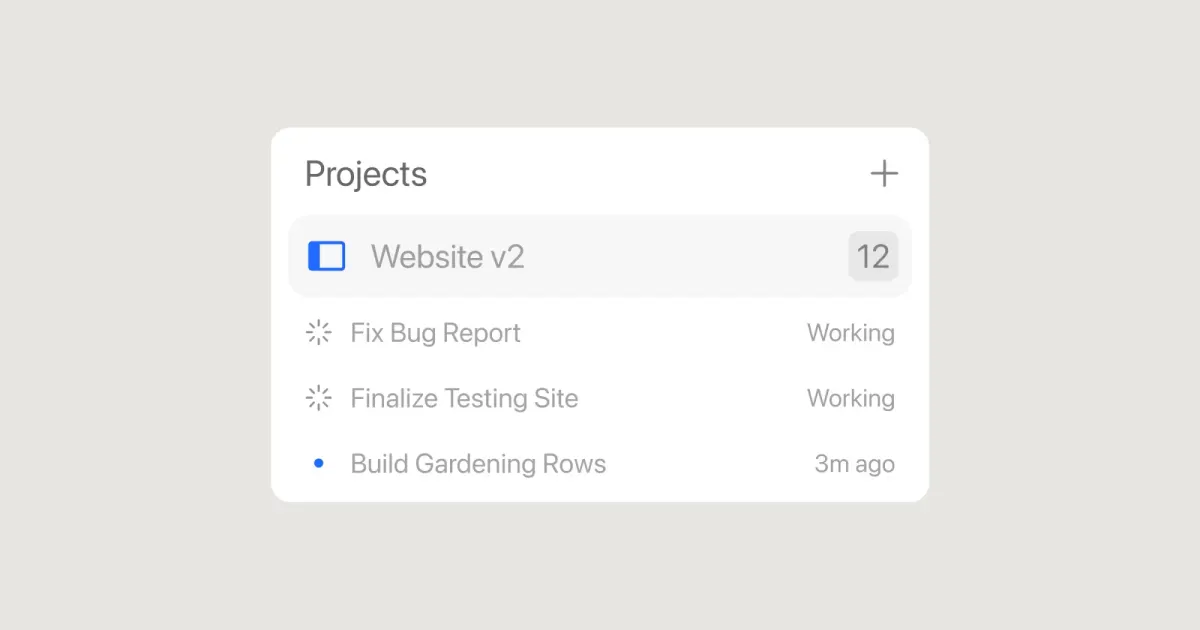
Cursor turns coding agents into a persistent team for long-running software projects.
30-Second TL;DR
What Changed
Projects coordinates fleets of coding agents.
Why It Matters
Cursor is moving beyond single-session coding assistance toward persistent, multi-agent project execution. This could improve throughput for small teams but also raises questions about code review, cost controls, and agent coordination failures.
What To Do Next
Pilot Cursor Projects on one repository with strict branch protections, agent budgets, and mandatory human code review.
Key Points
- •Projects coordinates fleets of coding agents.
- •Agents can use shared context across long-running software work.
- •Cloud computers are included in the workflow.
- •The offering uses recurring subscriptions.
Deep Insight
Background and context from public sources — not the original article. 8 sources cited.
Enhanced Key Takeaways
- •Projects uses a hierarchical coordinator agent dedicated strictly to planning and dispatching tasks, while delegating execution to non-blocking parallel subagents.
- •The infrastructure operates cloud-by-default to allow tasks to run after disconnects, but can automatically fall back to local subagents for hardware-specific tasks like emulators.
- •Shared memory across the project permanently persists discovered procedures, codebase patterns, and test instructions so subsequent subagents do not need to rediscover them.
- •An event-driven Subscriptions system enables agents to continuously monitor GitHub PRs, CI failures, or Slack channels to proactively initiate triage without human prompts.
- •Internal dogfooding metrics show new users merge 30% more PRs, while primary adopters merge up to 6x as many PRs using the Projects workflow.
Competitor Analysis
- Cursor Projects
- Hierarchical Coordinator Agent dispatching to parallel subagent fleets
- GitHub Copilot (Standard)
- Direct single-turn or multi-turn synchronous assistant
- Generic In-Editor AI Chat (e.g., Legacy Chat Panels)
- Single chat session prompt-and-response
- Cursor Projects
- Dedicated cloud computers with automatic local hardware fallback
- GitHub Copilot (Standard)
- Local IDE execution / GitHub hosted API calls
- Generic In-Editor AI Chat (e.g., Legacy Chat Panels)
- Local IDE context only
- Cursor Projects
- Multi-day/week autonomous background runs; survives laptop disconnect
- GitHub Copilot (Standard)
- Ephemeral; tied to active user sessions
- Generic In-Editor AI Chat (e.g., Legacy Chat Panels)
- Session-bound; resets context upon closing chat
- Cursor Projects
- Event-driven subscriptions (CI failures, Slack alerts, GitHub webhooks)
- GitHub Copilot (Standard)
- Manual trigger / user prompt invocation
- Generic In-Editor AI Chat (e.g., Legacy Chat Panels)
- Manual user prompt invocation
- Cursor Projects
- Asynchronous plan and PR review queue management
- GitHub Copilot (Standard)
- Real-time inline code completion and suggestions
- Generic In-Editor AI Chat (e.g., Legacy Chat Panels)
- Interactive prompt-and-code copy/pasting
| Feature / Dimension | Cursor Projects | GitHub Copilot (Standard) | Generic In-Editor AI Chat (e.g., Legacy Chat Panels) |
|---|---|---|---|
| Primary Architecture | Hierarchical Coordinator Agent dispatching to parallel subagent fleets | Direct single-turn or multi-turn synchronous assistant | Single chat session prompt-and-response |
| Execution Environment | Dedicated cloud computers with automatic local hardware fallback | Local IDE execution / GitHub hosted API calls | Local IDE context only |
| Persistence & Runtime | Multi-day/week autonomous background runs; survives laptop disconnect | Ephemeral; tied to active user sessions | Session-bound; resets context upon closing chat |
| Proactive Automation | Event-driven subscriptions (CI failures, Slack alerts, GitHub webhooks) | Manual trigger / user prompt invocation | Manual user prompt invocation |
| Developer Workflow Shift | Asynchronous plan and PR review queue management | Real-time inline code completion and suggestions | Interactive prompt-and-code copy/pasting |
Technical Deep Dive
- Hierarchical Multi-Agent Architecture: Implements a dedicated coordinator agent that exclusively handles state management, planning, and task routing, avoiding the lockouts of peer-to-peer agent designs.
- Decoupled Execution Fleet: Subagents run code execution, builds, and unit tests concurrently in isolated environments, keeping the primary UI non-blocking.
- Hybrid Compute Routing: Default execution targets containerized cloud environments to support continuous multi-day execution, with automatic delegation to local developer hardware for device-specific builds and emulators.
- Synchronized State & Procedural Memory: Workspace artifacts, codebase conventions, and discovered build/test commands are indexed into a persistent shared memory layer shared across all agents in the Project.
- Signal-Based Subscriptions: Hooks into webhooks (CI/CD pipelines, Git PRs, issue trackers) to trigger autonomous diagnostic and remediation subagents without active user input.
Future ImplicationsAI analysis grounded in cited sources
Timeline
- 2026-01Cursor publishes research highlighting failures in peer-to-peer agent coordination and the need for hierarchical models
- 2026-02Cursor rolls out Enterprise research preview for long-running agents exceeding 24-hour runtimes
- 2026-09Cursor officially announces Projects with persistent coordinator fleets and cloud infrastructure
Sources (8)
Factual claims are grounded in the sources below. Forward-looking analysis is AI-generated interpretation.
Weekly AI Recap
Read this week's curated digest of top AI events →
AI-curated news aggregator. All content rights belong to original publishers.
Original source: TestingCatalog ↗
This is a summary, not the original. Read the source, or get the weekly briefing.
The weekly digest
One email a week. Unsubscribe anytime.