Cursor developing Sand, a general-purpose AI agent
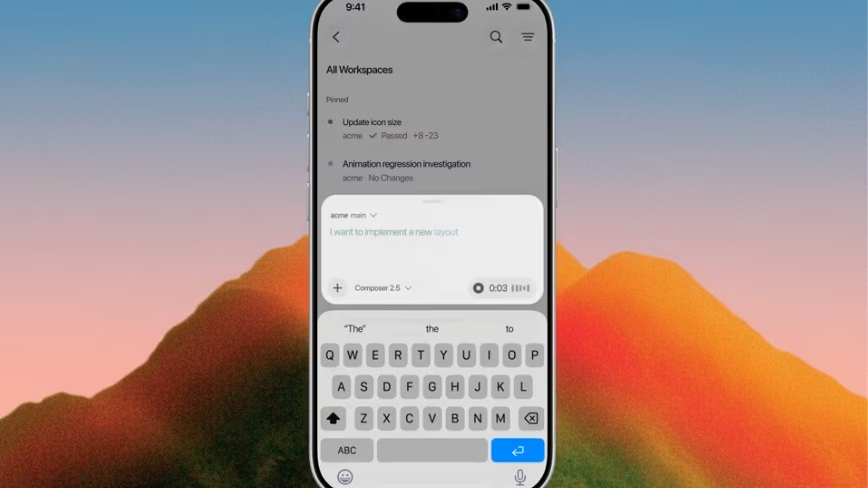
💡Cursor is moving into the agentic AI space; see if their new tool can outperform Claude Cowork.
⚡ 30-Second TL;DR
What Changed
Cursor is building a general-purpose agent named Sand
Why It Matters
If successful, this could shift Cursor from a developer-only tool to a mainstream productivity platform, challenging major incumbents in the agentic AI space.
What To Do Next
Monitor Cursor's official blog for beta access to Sand to evaluate its agentic capabilities against existing Claude or OpenAI solutions.
Key Points
- •Cursor is building a general-purpose agent named Sand
- •The tool aims to compete directly with Anthropic's Claude Cowork
- •Development trajectory may be impacted by Elon Musk's involvement
- •Cursor is pivoting from niche coding tools to broader office automation
🧠 Deep Insight
AI-generated analysis for this event — not the original article.
🔑 Enhanced Key Takeaways
- •Sand is reportedly built on a proprietary 'Agentic Orchestration Layer' that allows it to maintain persistent state across browser sessions and desktop applications, distinguishing it from stateless LLM wrappers.
- •The project utilizes a novel 'Human-in-the-Loop' (HITL) feedback mechanism that learns user preferences by observing cursor movements and click patterns in real-time.
- •Cursor's pivot is supported by a recent $200M Series C funding round, which was specifically earmarked for expanding their infrastructure beyond IDE-integrated coding assistants.
- •Elon Musk's involvement stems from his role as a strategic advisor and early investor in the parent company, with reports suggesting he is pushing for Sand to integrate deeply with xAI's Grok models.
- •Sand is being designed with a 'Local-First' architecture, prioritizing on-device processing for sensitive data to address enterprise security concerns that currently plague cloud-only agents like Claude Cowork.
📊 Competitor Analysis▸ Show
| Feature | Cursor Sand | Anthropic Claude Cowork | OpenAI Operator |
|---|---|---|---|
| Primary Focus | General-purpose office automation | Enterprise workflow orchestration | Web-based task execution |
| Deployment | Hybrid (Local/Cloud) | Cloud-Native | Cloud-Native |
| Pricing Model | Tiered Subscription | Enterprise Per-Seat | Usage-Based |
| Key Benchmark | High task completion rate in desktop apps | Superior long-context reasoning | Best-in-class web navigation |
🛠️ Technical Deep Dive
- Architecture: Utilizes a multi-agent framework where a 'Planner' model decomposes complex user requests into sub-tasks, while 'Executor' models handle specific application interactions.
- Context Window: Implements a dynamic memory retrieval system that compresses historical interaction data into a vector database for long-term task continuity.
- Integration Layer: Employs a proprietary accessibility-API bridge that allows the agent to read and manipulate UI elements in non-web desktop applications.
- Model Foundation: Supports a modular backend, allowing users to toggle between xAI's Grok, Claude 3.5/4, and OpenAI's o-series models depending on task complexity.
🔮 Future ImplicationsAI analysis grounded in cited sources
⏳ Timeline
Weekly AI Recap
Read this week's curated digest of top AI events →
👉Related Updates


AI-curated news aggregator. All content rights belong to original publishers.
Original source: The Next Web (TNW) ↗
This is a summary, not the original. Read the source, or get the weekly briefing.
The weekly digest
One email a week. Unsubscribe anytime.