Cursor Composer 1.5 Ignored in AI Shift
💡Cursor's $500M ARR tool fading? Learn why agentic AI is killing IDE hype (analysis).
⚡ 30-Second TL;DR
What Changed
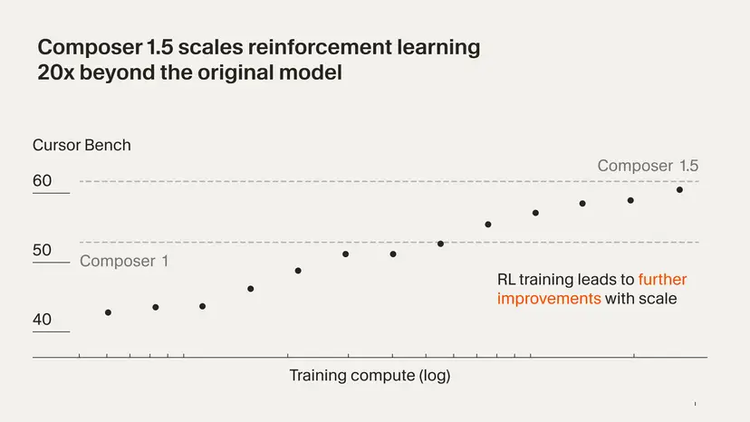
Composer 1.5 expands RL by 20x, exceeds base model pre-training compute
Why It Matters
Highlights AI tool vulnerability to rapid narrative shifts; Cursor's strong metrics may not sustain without adapting to agentic paradigms. Signals end of 'AI-native IDE' hype, favoring terminal-based autonomous coding.
What To Do Next
Test Cursor Composer 1.5's 8-agent parallel execution on a multi-file codebase refactor.
Key Points
- •Composer 1.5 expands RL by 20x, exceeds base model pre-training compute
- •Adds thinking tokens and self-summarization for deeper reasoning in coding
- •Cursor's 5B ARR but silent buzz due to narrative shift to AI agents like Claude Code
- •Evolves from IDE collab to multi-agent (up to 8 parallel) and self-driving codebases
🧠 Deep Insight
Background and context from public sources — not the original article. 6 sources cited.
🔑 Enhanced Key Takeaways
- •Composer 1.5 scales reinforcement learning (RL) 20x on the same pretrained model, with post-training compute exceeding base model pre-training, improving real-world coding benchmarks and balancing speed with deep thinking[1].
- •Introduces self-summarization capability trained via RL, allowing the model to produce summaries when context runs out, maintaining accuracy on long tasks through recursive triggering[1].
- •User feedback highlights faster performance, better context management, less invalid code, and effectiveness for multi-file refactoring in languages like Laravel + Vue.js, though scope control issues persist for complex tasks[2][3].
- •Increased usage limits: Composer 1.5 has 3x the limit of Composer 1, temporarily boosted to 6x through February 16, 2026, with separate Auto+Composer and API pools amid rising agentic coding demand[1].
- •Scores 47.9% on Terminal-Bench 2.0 as standalone model, outperforming Claude Sonnet 4.5 on agentic coding benchmarks, released February 9, 2026[6].
📊 Competitor Analysis▸ Show
| Feature/Benchmark | Cursor Composer 1.5 | Claude Code Opus 4.6 | GPT-5.3 Codex |
|---|---|---|---|
| Terminal-Bench 2.0 Score | 47.9% [6] | Not specified | Not specified |
| Speed | Faster for prototyping, thinking model [2][3] | Not specified | 30% faster than Opus 4.6 [4] |
| Use Case Strengths | Multi-file refactoring, UI consistency [2] | Deep reasoning [2] | One-shot features, smarter/cheaper than Composer 1.5 [2][4] |
| Pricing | Higher usage limits (6x temp boost), cost-effective [1][2] | $200+/month options [6] | Cheaper than Composer 1.5 [2] |
🛠️ Technical Deep Dive
- •Built by scaling RL 20x further on the same pretrained model; post-training compute surpasses base model pre-training[1].
- •Self-summarization trained as part of RL: model produces useful summary when context exhausts, triggers recursively on hard examples to maintain accuracy across varying context lengths[1].
- •Improves real-world coding benchmarks; balances speed and intelligence for interactive daily use, with upgrades in release modeling for faster, smarter coding on long tasks[1].
- •Better context window management: seamless compaction, less accuracy loss as context grows; reduced invalid code output[3].
- •Integrated with features like Plan Mode (strategic thinking before coding), Checkpoints (snapshots for reversion), and Instant Grep (millisecond codebase search)[4].
🔮 Future ImplicationsAI analysis grounded in cited sources
Composer 1.5 advances Cursor toward agentic coding with multi-agent support and self-driving codebases, but faces competition from cheaper, smarter alternatives like GPT-5.3 Codex and Claude Code, potentially pressuring IDE-centric models amid industry shift to autonomous agents[1][2][6].
⏳ Timeline
📎 Sources (6)
Factual claims are grounded in the sources below. Forward-looking analysis is AI-generated interpretation.
- releasebot.io — Cursor
- forum.cursor.com — 151715
- forum.cursor.com — 151348
- GitHub — Cursor AI Tips
- cursor.com — Changelog
- mlearning.substack.com — 100 Tips Cursor 15 vs Claude Code Opus 4 6 Codex Gpt 53 Two Underdogs That Change the Math Openai Anthropic Google Agentic Coding Essential Shortcuts Cursor Composer 15 1 5
Weekly AI Recap
Read this week's curated digest of top AI events →
👉Related Updates


AI-curated news aggregator. All content rights belong to original publishers.
Original source: 虎嗅 ↗
This is a summary, not the original. Read the source, or get the weekly briefing.
Weekly AI briefing
One email a week. Unsubscribe anytime.