Cursor Composer 2.5 delivers 10x cost efficiency
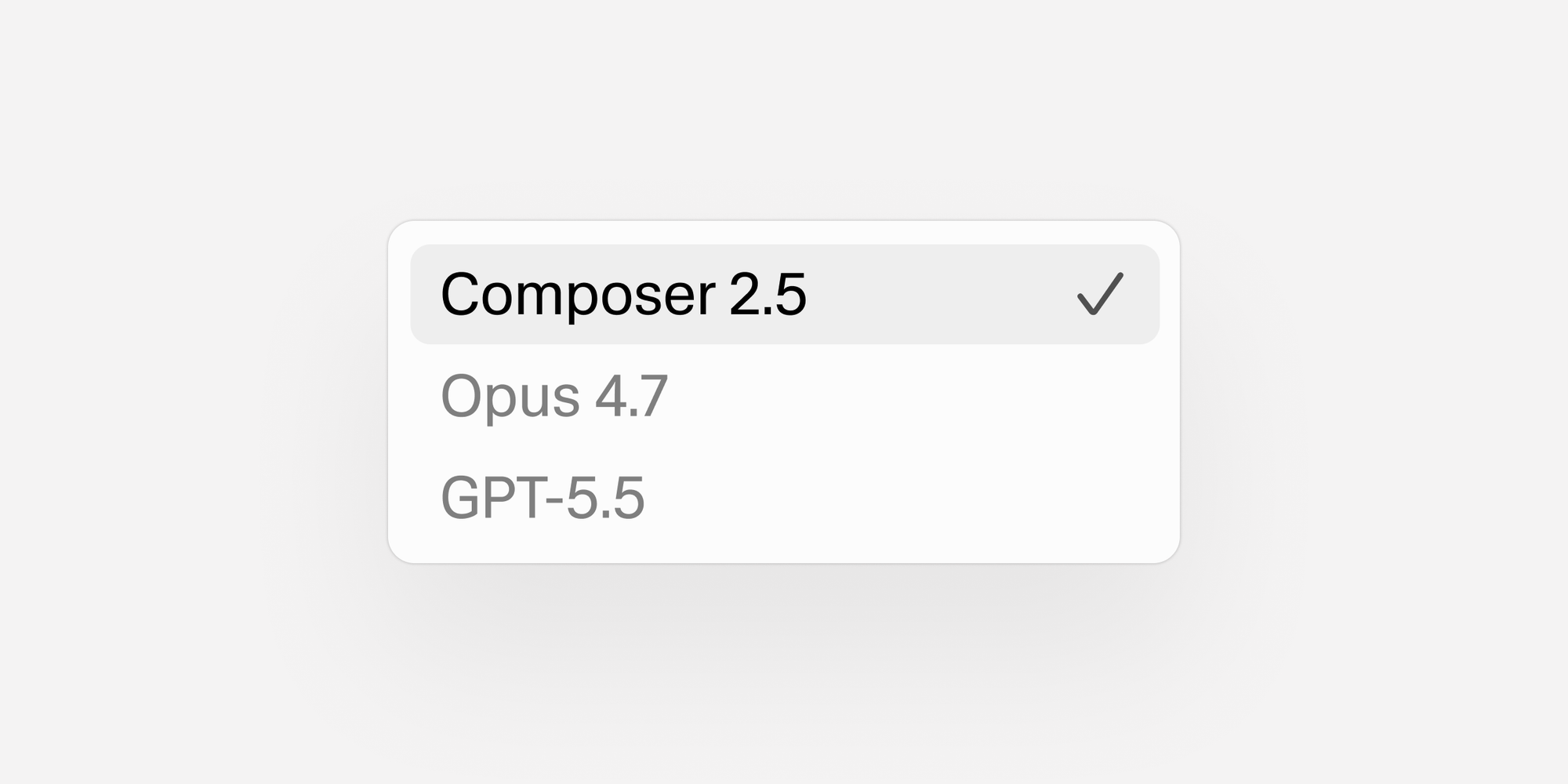
Learn how Cursor's new reinforcement learning approach slashes AI coding costs by 10x.
30-Second TL;DR
What Changed
Achieves up to 10x cost efficiency in AI coding tasks
Why It Matters
This update significantly lowers the barrier for using AI agents in complex, long-running software development projects. Developers can expect more reliable code generation with reduced token consumption.
What To Do Next
Update your Cursor instance and test the new Composer 2.5 on a complex refactoring task to verify the 10x cost efficiency claim.
Key Points
- •Achieves up to 10x cost efficiency in AI coding tasks
- •Integrates targeted reinforcement learning for error correction
- •Uses 25x synthetic training for improved behavioral calibration
Deep Insight
Background and context from public sources — not the original article. 18 sources cited.
Enhanced Key Takeaways
- •Composer 2.5 is built upon Moonshot's open-source Kimi K2.5 checkpoint, augmented by Cursor's proprietary continued pretraining.
- •A significant portion, 85%, of Composer 2.5's compute budget was allocated to additional training and reinforcement learning, indicating a heavy investment in model refinement.
- •Composer 2.5 demonstrates competitive performance on benchmarks such as SWE-Bench Multilingual (79.8%) and CursorBench v3.1 (63.2%), matching the capabilities of frontier models like Opus 4.7 and GPT-5.5, but at a substantially lower cost.
- •Cursor is actively collaborating with SpaceX and xAI to train a successor model, which is planned to be significantly larger, utilizing ten times the compute on the Colossus-2 cluster, equivalent to one million H100s.
- •The synthetic training methodology for Composer 2.5 includes innovative techniques like 'feature deletion,' where the AI agent is challenged to remove specific features from a codebase while maintaining functionality, with tests serving as verifiable rewards for successful reimplementation.
Competitor Analysis
- Cursor Composer 2.5
- AI-native IDE with integrated coding model (Composer 2.5)
- GitHub Copilot
- IDE extension for code completion and chat
- Claude Code
- AI coding tool (model-based)
- Gemini Code Assist
- Google's IDE coding assistant
- Amazon CodeWhisperer
- AWS-native coding assistant
- Cursor Composer 2.5
- Code generation, editing, debugging, multi-file changes, agentic workflows, codebase indexing
- GitHub Copilot
- Real-time code suggestions, contextual chat, repository-aware assistance
- Claude Code
- Excels at understanding complex code and explaining reasoning
- Gemini Code Assist
- Code completion, chat over repo, suggests edits, explains code, refactors
- Amazon CodeWhisperer
- Helps write code, troubleshoot AWS services, generate snippets
- Cursor Composer 2.5
- Standard: $0.50/M input, $2.50/M output tokens; Fast: $3.00/M input, $15.00/M output tokens (Composer 2.5 specific). Pro plan: $20/month for unlimited Tab completions, extended Agent limits, $20 credit pool for premium models.
- GitHub Copilot
- $10/month (individual plan)
- Claude Code
- (Model pricing varies, often usage-based)
- Gemini Code Assist
- Generous free tier
- Amazon CodeWhisperer
- Free for individuals
- Cursor Composer 2.5
- Matches Opus 4.7 and GPT-5.5 on SWE-Bench Multilingual (79.8%) and CursorBench v3.1 (63.2%)
- GitHub Copilot
- Industry standard for inline suggestions
- Claude Code
- Best reasoning
- Gemini Code Assist
- Suited for training and practice
- Amazon CodeWhisperer
- Strong on cloud config, IAM, SDK usage
- Cursor Composer 2.5
- Built on Moonshot's open-source Kimi K2.5 checkpoint
- GitHub Copilot
- Developed by GitHub and OpenAI
- Claude Code
- Anthropic's Claude models
- Gemini Code Assist
- Google's Gemini models
- Amazon CodeWhisperer
- Proprietary AWS models
- Cursor Composer 2.5
- VS Code fork, transitioning away from VS Code base since Cursor 3
- GitHub Copilot
- Integrates with various popular code editors (e.g., VS Code, JetBrains)
- Claude Code
- (Model can be integrated into various tools)
- Gemini Code Assist
- Google's IDEs, Workspace/Cloud accounts
- Amazon CodeWhisperer
- IDEs and AWS console
| Feature/Pricing/Benchmarks | Cursor Composer 2.5 | GitHub Copilot | Claude Code | Gemini Code Assist | Amazon CodeWhisperer |
|---|---|---|---|---|---|
| Product Type | AI-native IDE with integrated coding model (Composer 2.5) | IDE extension for code completion and chat | AI coding tool (model-based) | Google's IDE coding assistant | AWS-native coding assistant |
| Core Functionality | Code generation, editing, debugging, multi-file changes, agentic workflows, codebase indexing | Real-time code suggestions, contextual chat, repository-aware assistance | Excels at understanding complex code and explaining reasoning | Code completion, chat over repo, suggests edits, explains code, refactors | Helps write code, troubleshoot AWS services, generate snippets |
| Pricing (Individual) | Standard: $0.50/M input, $2.50/M output tokens; Fast: $3.00/M input, $15.00/M output tokens (Composer 2.5 specific). Pro plan: $20/month for unlimited Tab completions, extended Agent limits, $20 credit pool for premium models. | $10/month (individual plan) | (Model pricing varies, often usage-based) | Generous free tier | Free for individuals |
| Benchmarks | Matches Opus 4.7 and GPT-5.5 on SWE-Bench Multilingual (79.8%) and CursorBench v3.1 (63.2%) | Industry standard for inline suggestions | Best reasoning | Suited for training and practice | Strong on cloud config, IAM, SDK usage |
| Base Model | Built on Moonshot's open-source Kimi K2.5 checkpoint | Developed by GitHub and OpenAI | Anthropic's Claude models | Google's Gemini models | Proprietary AWS models |
| IDE Integration | VS Code fork, transitioning away from VS Code base since Cursor 3 | Integrates with various popular code editors (e.g., VS Code, JetBrains) | (Model can be integrated into various tools) | Google's IDEs, Workspace/Cloud accounts | IDEs and AWS console |
Technical Deep Dive
- Composer 2.5 is built on Moonshot's open-source Kimi K2.5 checkpoint, with Cursor's proprietary continued pretraining.
- Training was significantly scaled, incorporating 25 times more synthetic reinforcement learning (RL) tasks than Composer 2, with a particular emphasis on long-horizon coding problems that require hundreds of tool calls.
- Targeted RL with textual feedback is employed to refine specific behavioral aspects of the model, including tool use, communication style, and effort calibration, which are crucial for a pleasant developer experience but may not always appear in standard benchmarks.
- A notable synthetic training approach is 'feature deletion,' where the agent is presented with a codebase and tests, instructed to remove code/files while preserving functionality, and then tasked with reimplementing the feature, using the tests as a verifiable reward mechanism.
- Cursor's underlying system architecture comprises three layers: a VS Code fork (providing control over editor rendering, file system, and extension host), an AI Orchestration layer (where context meets models), and a Context Engine (a retrieval pipeline that indexes the codebase).
- A core innovation is 'speculative edits,' which leverages existing source code as 'draft tokens' to achieve speeds of up to 1,000 tokens/second for a 70B model, representing a 13x speedup by recognizing that most of an edited file remains unchanged.
- A continuous reinforcement learning loop retrains the Tab model every 90 minutes based on user acceptance and rejection of suggestions, with new checkpoints deployed multiple times daily.
- The Composer 2.5 announcement mentions 'Sharded Muon and dual mesh HSDP' as part of its training methodology, suggesting advanced distributed training or model architecture components.
- Since Cursor 3, the platform has begun transitioning away from its original Visual Studio Code base.
Future ImplicationsAI analysis grounded in cited sources
Timeline
- 2022Anysphere (parent company of Cursor) founded
- 2023Cursor AI code editor launched
- 2023Raised $8 million in seed funding, led by OpenAI's Startup Fund
- 2024-08Announced $60 million in Series A funding
- 2025-06Overhauled pricing model to usage-based credit pools
- 2026-02Introduced Composer 1.5
- 2026-03Introduced Composer 2
- 2026-05-18Composer 2.5 released
Sources (18)
Factual claims are grounded in the sources below. Forward-looking analysis is AI-generated interpretation.
Weekly AI Recap
Read this week's curated digest of top AI events →
AI-curated news aggregator. All content rights belong to original publishers.
Original source: TestingCatalog ↗
This is a summary, not the original. Read the source, or get the weekly briefing.
The weekly digest
One email a week. Unsubscribe anytime.