Cross-Region Inference for EU Data Compliance
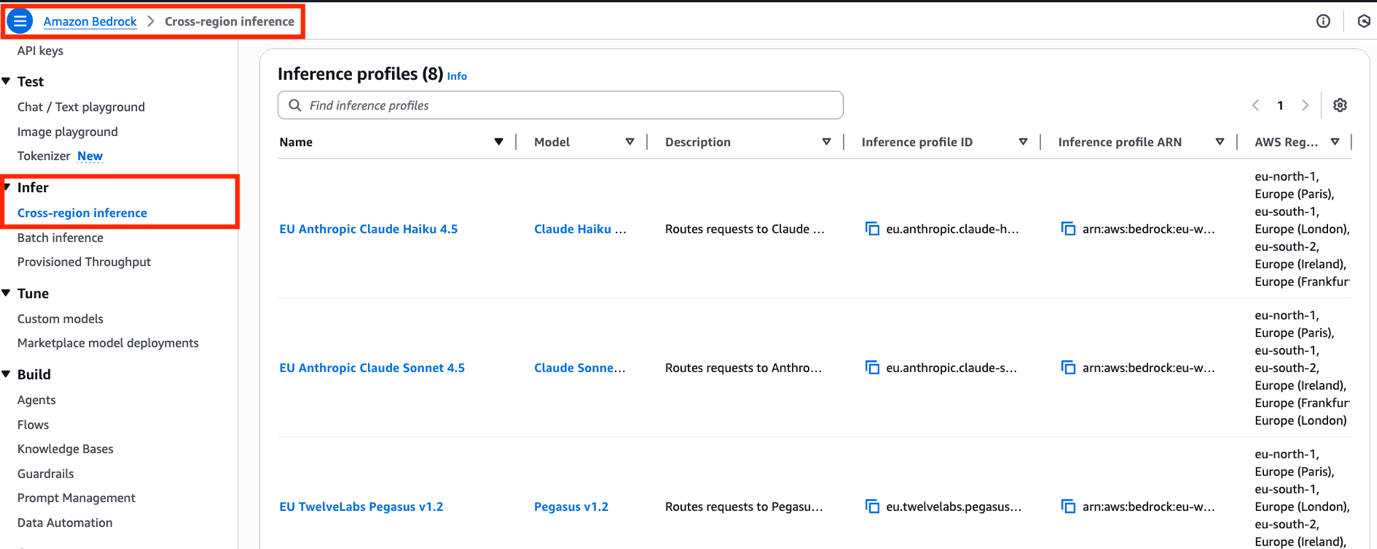
💡Learn how to scale generative AI in Europe while staying compliant with strict data privacy regulations.
⚡ 30-Second TL;DR
What Changed
Automatically routes inference requests across multiple AWS regions
Why It Matters
Enterprises operating in Europe can now scale their AI applications without compromising on data sovereignty or regional regulatory requirements.
What To Do Next
Review your current Bedrock architecture and enable CRIS to optimize latency and availability for your EU-based users.
Key Points
- •Automatically routes inference requests across multiple AWS regions
- •Maintains compliance with EU data processing and privacy standards
- •Increases model availability and capacity for high-demand workloads
🧠 Deep Insight
Background and context from public sources — not the original article. 15 sources cited.
🔑 Enhanced Key Takeaways
- •Amazon Bedrock's Cross-Region Inference (CRIS) offers two distinct profiles: 'Geographic CRIS' which keeps data processing within specified geographic boundaries (e.g., EU, US, APAC) for regional data residency, and 'Global CRIS' which routes requests to supported commercial regions worldwide for optimized resource availability and higher throughput.
- •When using CRIS, customer data such as logs, knowledge bases, and stored configurations are not stored in any destination region; instead, they remain exclusively within the source region, with inference requests traveling encrypted over the AWS Global Network.
- •CRIS can significantly enhance throughput, potentially allowing up to double the default in-region quotas by distributing inference requests across multiple AWS Regions, thereby helping manage unplanned traffic bursts and improve resilience.
- •AWS Bedrock, including its CRIS feature, is designed to support compliance with regulations like GDPR and is working towards alignment with the EU AI Act, though customers retain responsibility for assessing their specific use cases against these regulations.
- •CRIS is compatible with various Amazon Bedrock features, including on-demand model inference, batch inference, Agents, Knowledge Bases, model evaluation, and prompt management, without incurring additional routing or data transfer costs for cross-region operations.
🛠️ Technical Deep Dive
- CRIS operates through 'inference profiles' that define the foundation model and the specific AWS Regions to which requests can be routed.
- Requests originate from a designated source region and are automatically routed to an optimal destination region within the defined inference profile, based on real-time capacity and performance metrics.
- All data in transit during cross-region inference is encrypted over the secure AWS network.
- The latency overhead introduced by cross-region routing in Europe is typically in the single to double-digit milliseconds, which constitutes a minor fraction of the overall Large Language Model (LLM) processing time.
- CRIS routing specifically adds approximately 50ms to the total inference latency, in addition to other components like network round-trip, GPU scheduling, and model prefill times.
- Customer-managed logs, knowledge bases, and stored configurations associated with the inference remain exclusively within the source Region, ensuring data residency.
- AWS Identity and Access Management (IAM) policies and Service Control Policies (SCPs) are critical for fine-grained control over user and role permissions and for setting organization-wide guardrails to ensure compliance with regional data processing restrictions for CRIS.
🔮 Future ImplicationsAI analysis grounded in cited sources
⏳ Timeline
📎 Sources (15)
Factual claims are grounded in the sources below. Forward-looking analysis is AI-generated interpretation.
Weekly AI Recap
Read this week's curated digest of top AI events →
👉Related Updates
AI-curated news aggregator. All content rights belong to original publishers.
Original source: AWS Machine Learning Blog ↗
This is a summary, not the original. Read the source, or get the weekly briefing.
The weekly digest
One email a week. Unsubscribe anytime.