Critique of causal narratives in computational social science
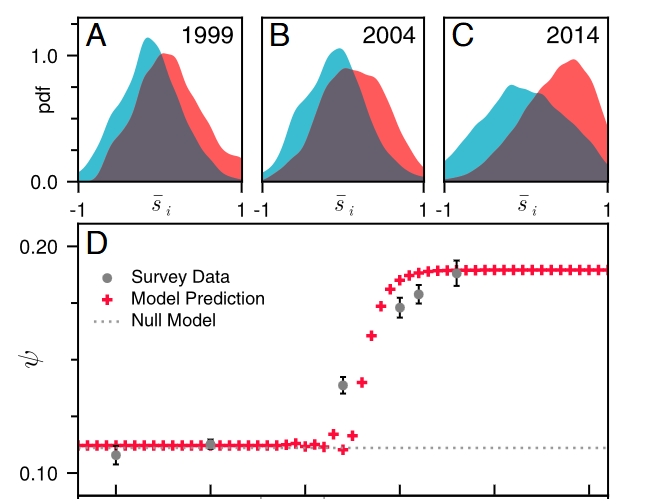
💡Learn why a high-profile PNAS study on AI and polarization was debunked due to flawed data methodology.
⚡ 30-Second TL;DR
What Changed
THK study's core premise of rising social connectivity lacks empirical support.
Why It Matters
This highlights the danger of over-interpreting computational models without rigorous validation of input data, serving as a warning for AI-driven social research.
What To Do Next
When building models on social data, always verify the provenance and consistency of your data collection methods across different time periods.
Key Points
- •THK study's core premise of rising social connectivity lacks empirical support.
- •Inconsistent use of 'name generator' vs 'direct count' methods created statistical illusions.
- •The study's causal model fails when the underlying empirical assumption is proven false.
- •Re-analysis using consistent longitudinal data shows no significant upward trend in core discussion networks.
🧠 Deep Insight
AI-generated analysis for this event — not the original article.
🔑 Enhanced Key Takeaways
- •The critique specifically targets the 2021 PNAS paper by Bail et al., which utilized a large-scale field experiment to examine the effects of social media exposure on political polarization.
- •Critics argue that the original study's reliance on 'name generator' surveys—which ask respondents to list people they discuss important matters with—is prone to recall bias and social desirability bias, complicating longitudinal comparisons.
- •The re-analysis highlights that the original study's findings may have been driven by 'measurement artifacts' rather than genuine shifts in social network structure or ideological alignment.
- •Methodological debates in this field are increasingly focused on the 'replication crisis' in computational social science, where high-profile studies often fail to hold up under rigorous re-examination of raw data.
- •The controversy underscores a broader shift in the discipline toward requiring open-source code and pre-registered analysis plans to mitigate the risks of p-hacking and selective reporting in social media research.
🛠️ Technical Deep Dive
- The critique employs a re-analysis of the General Social Survey (GSS) data, specifically focusing on the longitudinal consistency of network size metrics.
- It identifies a 'measurement drift' where the transition from telephone-based surveys to mixed-mode (web/mail) surveys introduced systematic variance in network reporting.
- The causal model failure is attributed to the violation of the stable unit treatment value assumption (SUTVA) in the original study's experimental design.
- Statistical modeling used in the critique includes sensitivity analysis to demonstrate how small changes in data cleaning protocols lead to divergent conclusions regarding polarization trends.
🔮 Future ImplicationsAI analysis grounded in cited sources
⏳ Timeline
Weekly AI Recap
Read this week's curated digest of top AI events →
👉Related Updates

AI-curated news aggregator. All content rights belong to original publishers.
Original source: 虎嗅 ↗
This is a summary, not the original. Read the source, or get the weekly briefing.
Weekly AI briefing
One email a week. Unsubscribe anytime.