Critical 7-Zip Vulnerability Puts Millions of Devices at Risk
💡Critical security flaws in core utilities can compromise your entire development infrastructure.
⚡ 30-Second TL;DR
What Changed
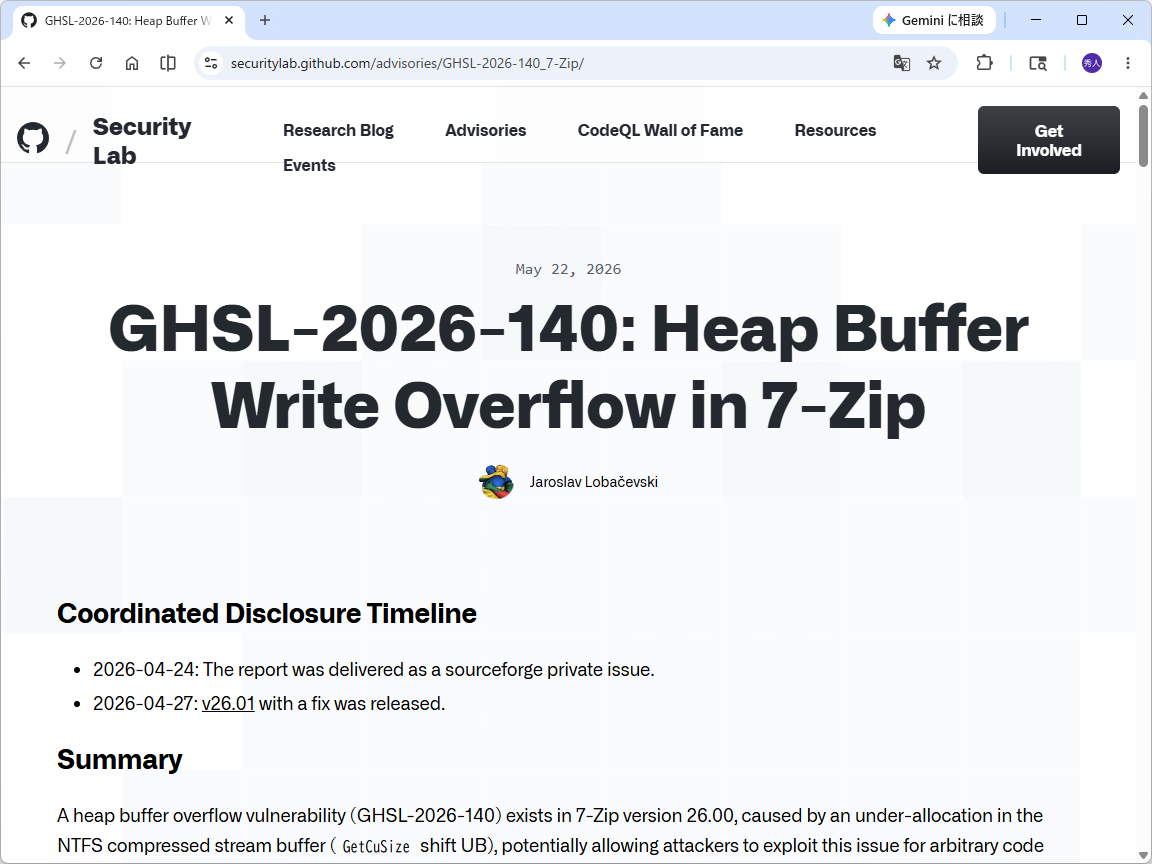
Critical vulnerability allows remote code execution
Why It Matters
This vulnerability poses a significant supply chain risk for developers and automated systems that rely on 7-Zip for data processing, potentially allowing attackers to compromise build environments.
What To Do Next
Audit your CI/CD pipelines and server environments to ensure 7-Zip is updated to the latest patched version immediately.
Key Points
- •Critical vulnerability allows remote code execution
- •Affects millions of global terminal devices
- •Immediate update to the latest version is required
🧠 Deep Insight
Background and context from public sources — not the original article. 12 sources cited.
🔑 Enhanced Key Takeaways
- •The critical vulnerability, identified as CVE-2026-48095 (GHSL-2026-140), is a heap buffer write overflow located in 7-Zip's NTFS archive handler.
- •The flaw specifically stems from an under-allocation bug in the
CInStream::GetCuSize()function, where a crafted NTFS image can trigger undefined behavior in buffer size calculation, leading to a 1-byte buffer allocation that is then overflowed. - •Affected versions include 7-Zip 26.00 and all earlier versions, with the fix being released in version 26.01 on April 27, 2026.
- •The attack surface is broadened because 7-Zip's signature-based fallback logic can route malicious NTFS images, even if they have common extensions like .7z, .zip, or .rar, into the vulnerable NTFS parser.
- •Successful exploitation can lead to arbitrary code execution through vtable hijacking, where attacker-controlled data overwrites the stream object's vtable pointer, allowing a subsequent read operation to dispatch execution through the corrupted pointer.
📊 Competitor Analysis▸ Show
| Feature/Aspect | 7-Zip (v26.01) | WinRAR | PeaZip | WinZip |
|---|---|---|---|---|
| Licensing | Free and Open-Source (LGPL) | Commercial (proprietary RAR format) | Free and Open-Source (LGPL/GPL) | Commercial |
| Native Format | 7z (high compression) | RAR (proprietary, good compression) | 7z, ZIP, TAR, GZIP, BZIP2, etc. (supports many) | ZIP (de-facto standard) |
| Compression Ratio | Excellent (especially with LZMA/LZMA2) | Very Good (RAR5) | Good (supports 7z, other formats) | Moderate (ZIP) |
| Compression Speed | Slower for 7z (medium settings) | Faster for ZIP, good for RAR | Fastest for ZIP, good for 7z (fast) | Slowest for ZIP |
| Decompression Speed | Fast (7z medium) | Good (RAR) | Fastest (7z fast) | Significantly slower for ZIP |
| Encryption | Strong AES-256 | AES-256 (for RAR5) | AES-256 (for 7z, ZIP) | AES-256, Zip 2.0 Legacy |
| Update Mechanism | Manual user updates/package managers | Typically manual/user-initiated | Manual (can be managed by tools like PatchMyPC) | Automatic updates (for some versions/platforms) |
| Platform Support | Windows, macOS, Linux (command-line) | Windows, macOS, Linux, Android | Windows, macOS, Linux | Windows, macOS, Android, iOS |
🛠️ Technical Deep Dive
- The vulnerability, CVE-2026-48095 (GHSL-2026-140), is a heap buffer write overflow in the
CInStream::GetCuSize()function within 7-Zip's NTFS archive handler. - It occurs due to an under-allocation bug where a crafted NTFS image can manipulate a 32-bit shift expression used for buffer sizing. When the shift exponent reaches 32, it triggers undefined behavior in C++, resulting in the
_inBufbeing allocated as only 1 byte. - Subsequent read operations then attempt to write attacker-controlled data into this tiny 1-byte buffer, leading to a classic heap overflow condition.
- This overflow is exploitable because the adjacent heap layout allows the attacker to corrupt the stream object's vtable pointer. A second read operation then dispatches execution through this corrupted pointer, achieving arbitrary code execution.
- The attack is not restricted to files with
.ntfsor.imgextensions because 7-Zip employs a signature-based fallback mechanism. If the format matching the file extension fails to open, 7-Zip attempts to process the file with other handlers based on signature priority, potentially routing a disguised malicious file to the vulnerable NTFS parser. - In addition to CVE-2026-48095, 7-Zip 26.01 also addressed a cluster of other memory safety issues (GHSL-2026-115–GHSL-2026-122) across various archive formats, including SquashFS, UEFI capsules, UDF, and WIM, which involved out-of-bounds reads, integer overflows, and use of uninitialized heap memory.
- 7-Zip's core compression utilizes algorithms like LZMA, LZMA2, PPMd, and BZip2, with LZMA being the default for the 7z format.
- The 7z format supports strong AES-256 encryption, where the key is derived from a user-supplied passphrase using an SHA-256 hash function with a high number of iterations (key stretching) to resist brute-force attacks.
🔮 Future ImplicationsAI analysis grounded in cited sources
⏳ Timeline
📎 Sources (12)
Factual claims are grounded in the sources below. Forward-looking analysis is AI-generated interpretation.
Weekly AI Recap
Read this week's curated digest of top AI events →
👉Related Updates
AI-curated news aggregator. All content rights belong to original publishers.
Original source: cnBeta (Full RSS) ↗
This is a summary, not the original. Read the source, or get the weekly briefing.
The weekly digest
One email a week. Unsubscribe anytime.