Crackdown on Illegal AI API Reselling Platforms
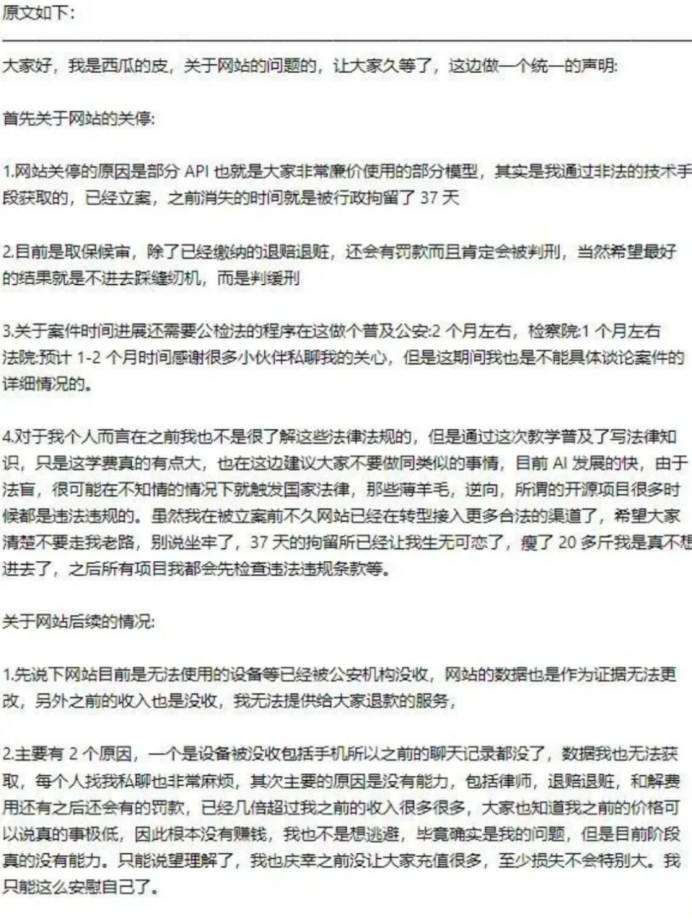
Unauthorized AI API proxies are being shut down; ensure your app's backend isn't relying on risky third-party endpoints.
30-Second TL;DR
What Changed
Illegal AI transit stations are facing legal enforcement actions.
Why It Matters
This crackdown will likely force developers to shift toward official API channels, increasing costs but improving security and reliability. It marks the end of the 'wild west' era for cheap, unauthorized API access in the region.
What To Do Next
Audit your infrastructure to ensure all API calls are routed directly to official provider endpoints rather than third-party proxy services.
Key Points
- •Illegal AI transit stations are facing legal enforcement actions.
- •These platforms often exploit API vulnerabilities or unauthorized account sharing.
- •Users of these services face potential data privacy leaks and service instability.
- •The crackdown signals a tightening of AI service regulation in the Chinese market.
Deep Insight
Background and context from public sources — not the original article. 23 sources cited.
Enhanced Key Takeaways
- •The crackdown is part of a broader regulatory effort in China that includes mandates for content safety, training data quality, and security assessments for AI services.
- •Illegal platforms often utilize 'shadow APIs' and proxy servers located outside China to obscure the origin of requests, enabling them to resell access to advanced Western AI models like Claude and Gemini at significantly reduced prices.
- •Authorities have specifically fined platforms for impersonating legitimate AI services such as OpenAI's ChatGPT and DeepSeek, deceiving users into paying for fraudulent AI dialogues or unauthorized 'local deployment' services.
- •The illicit reselling market is driven by a persistent demand from Chinese developers for advanced Western AI models, which they often perceive as superior for complex tasks like coding, reasoning, and agentic AI workloads, despite the increasing capabilities of domestic alternatives.
- •The enforcement actions also target 'AI data poisoning,' a cybersecurity concern where malicious or manipulated information is intentionally injected into AI training datasets to corrupt model outputs or compromise systems.
Technical Deep Dive
- Shadow APIs and Proxy Servers: Illegal platforms route API requests through proxy servers located outside mainland China to bypass geographical restrictions and mask the true origin of the users.
- Exploitation of Subscription Models: Operators create numerous accounts, potentially thousands daily, across various regions to exploit the cost difference between direct API credits and subscription plans, making detection challenging by avoiding identifiable usage patterns.
- Stolen Credentials and Model Substitution: Some illicit operators use stolen credentials to access legitimate AI services and may substitute models, while also harvesting user prompts and outputs for resale as AI training data.
- API Vulnerabilities: The underlying API infrastructure can be exploited through weak authentication, input manipulation (e.g., SQL injection), and insecure endpoints, leading to unauthorized access or data exfiltration.
- AI-Enhanced Cyber Attacks: AI itself can be leveraged by attackers to generate highly convincing phishing campaigns, create malicious code with embedded vulnerabilities, and potentially bypass advanced security measures like two-factor authentication.
Future ImplicationsAI analysis grounded in cited sources
Timeline
- 2022-11China's Administrative Provisions on Deep Synthesis in Internet-based Information Services (Deep Synthesis Regulation) adopted.
- 2023-01China's Deep Synthesis Regulation came into force, regulating AI-generated synthetic media.
- 2023-08China's 'Interim Measures for the Management of Generative Artificial Intelligence Services' came into effect, imposing obligations on generative AI service providers.
- 2024-04Chinese Ministry of Public Security announced 10 AI-related cybercrime cases, including instances of AI-facilitated disinformation.
- 2025-02A surge of counterfeit DeepSeek mini-programs and websites emerged, engaging in illegal activities like brand confusion and false advertising.
- 2026-02China's State Administration for Market Regulation (SAMR) penalized several companies for impersonating ChatGPT and DeepSeek services.
- 2026-05China launched a four-month nationwide campaign targeting 'malpractices in AI applications,' including data poisoning, misinformation, and impersonation.
Sources (23)
Factual claims are grounded in the sources below. Forward-looking analysis is AI-generated interpretation.
Weekly AI Recap
Read this week's curated digest of top AI events →
AI-curated news aggregator. All content rights belong to original publishers.
Original source: 钛媒体 ↗
This is a summary, not the original. Read the source, or get the weekly briefing.
The weekly digest
One email a week. Unsubscribe anytime.