Couchbase launches AI Data Plane for edge-ready agent memory
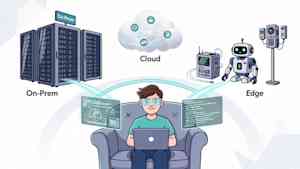
A new unified platform for AI agent memory that works even in disconnected edge environments.
30-Second TL;DR
What Changed
Combines persistent agent memory, real-time context retrieval, and an enterprise-managed MCP server.
Why It Matters
This platform simplifies the AI stack by replacing fragmented services with a single, ACID-compliant database, potentially reducing latency and operational complexity for enterprise AI deployments.
What To Do Next
Evaluate the Couchbase AI Data Plane if your AI agents require low-latency, ACID-compliant memory or need to operate in disconnected edge environments.
Key Points
- •Combines persistent agent memory, real-time context retrieval, and an enterprise-managed MCP server.
- •Features a memory-first architecture that enables 10x faster write speeds compared to disk-based storage.
- •Supports disconnected edge environments, allowing AI agents to function without a network connection.
- •Includes built-in guardrails like token constraints, time-to-live limits, and metering controls.
Deep Insight
AI-generated analysis for this event — not the original article.
Enhanced Key Takeaways
- •The AI Data Plane leverages Couchbase's existing Capella iQ generative AI assistant technology to streamline the integration of vector search and metadata filtering.
- •It utilizes the Model Context Protocol (MCP) to standardize how AI agents interact with Couchbase data, reducing the need for custom API connectors.
- •The architecture specifically addresses the 'cold start' problem for edge AI by synchronizing subsets of data locally before agents are deployed to disconnected environments.
- •It introduces a new 'Agent Memory Store' layer that automatically manages vector embeddings and semantic indexing without requiring manual database schema updates.
- •The platform includes native integration with popular agent frameworks like LangChain and LlamaIndex, allowing developers to swap out storage backends with minimal code changes.
Competitor Analysis
- Couchbase AI Data Plane
- Native/Disconnected
- MongoDB Atlas Vector Search
- Limited/Cloud-dependent
- Pinecone Serverless
- Cloud-only
- Couchbase AI Data Plane
- Memory-first
- MongoDB Atlas Vector Search
- Disk-optimized
- Pinecone Serverless
- Managed Vector DB
- Couchbase AI Data Plane
- Native Enterprise Server
- MongoDB Atlas Vector Search
- Via Community Adapters
- Pinecone Serverless
- Via Community Adapters
- Couchbase AI Data Plane
- Consumption-based
- MongoDB Atlas Vector Search
- Tiered/Usage-based
- Pinecone Serverless
- Usage-based
| Feature | Couchbase AI Data Plane | MongoDB Atlas Vector Search | Pinecone Serverless |
|---|---|---|---|
| Edge Capability | Native/Disconnected | Limited/Cloud-dependent | Cloud-only |
| Architecture | Memory-first | Disk-optimized | Managed Vector DB |
| MCP Support | Native Enterprise Server | Via Community Adapters | Via Community Adapters |
| Pricing Model | Consumption-based | Tiered/Usage-based | Usage-based |
Technical Deep Dive
- Memory-first architecture utilizes a distributed RAM-based storage engine to minimize latency for high-frequency agent state updates.
- Implements a tiered storage strategy where hot data resides in memory and cold data is asynchronously persisted to disk or cloud object storage.
- Supports multi-model vector indexing, allowing agents to store and retrieve embeddings from different LLMs within the same memory space.
- Provides built-in TTL (Time-to-Live) policies at the document level to automatically prune stale agent context and manage memory footprint.
- Uses a conflict-free replicated data type (CRDT) approach for data synchronization in disconnected edge scenarios to ensure consistency when re-establishing network connectivity.
Future ImplicationsAI analysis grounded in cited sources
Timeline
- 2023-09Couchbase launches Capella iQ to integrate generative AI into its database platform.
- 2024-05Couchbase introduces vector search capabilities to its Capella database service.
- 2025-02Couchbase expands edge computing support with enhanced synchronization features for mobile and IoT.
- 2026-06Couchbase launches the AI Data Plane to unify agent memory and context retrieval.
Weekly AI Recap
Read this week's curated digest of top AI events →
AI-curated news aggregator. All content rights belong to original publishers.
Original source: VentureBeat ↗
This is a summary, not the original. Read the source, or get the weekly briefing.
The weekly digest
One email a week. Unsubscribe anytime.